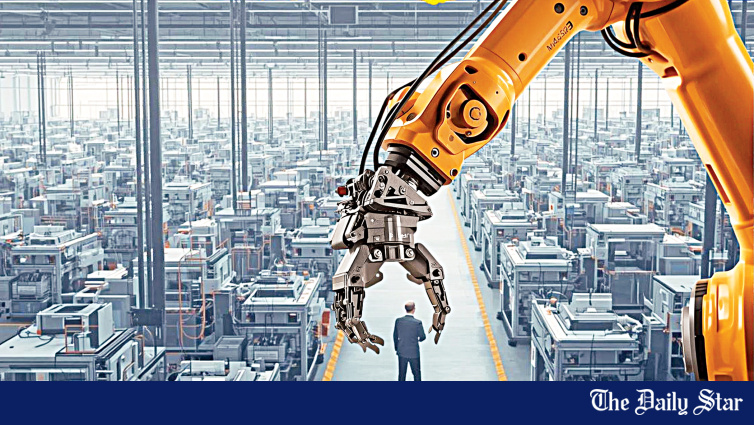
Fear of new technology is not new. Whether new technology will replace humans is a question that has haunted humanity since time immemorial. Some of you may remember the British “Luddites” of the early 19th century. These are the workers who went to destroy the new looms because they were afraid of being replaced by human labor.
With the advent of artificial intelligence (AI), these concerns are back.
Advances in computing power have led to the development of highly versatile tools and applications that can perform many tasks previously performed by humans. The technology is portable, so it can be used in countries with the necessary infrastructure. And it comes at a time when Bangladesh’s labor market is already facing multiple challenges. Naturally, the question arises whether the challenges ahead will be even more difficult.
Bangladesh’s labor market woes are worsening
There are always challenges in Bangladesh’s labor market. Lack of quality jobs in the formal sector, high dependence on the informal sector, low and declining female participation, declining employment of women in the ready-made garment industry, and high youth unemployment are not new problems.

Figure 1
Source: Prepared by author using data from Bangladesh Bureau of Statistics: Labor Force Survey 2024
Data from the 2024 Labor Force Survey shows that labor market woes are worsening. In recent years, the process of structural transformation of the labor market is moving in the opposite direction, as manufacturing employment has hardly increased. Rather than the share of manufacturing rising and the share of agriculture falling, the opposite is happening.
Unemployment among the educated remains a major problem, with unemployment rates being highest among those with higher education (Figure 1).
The advent of artificial intelligence (AI) is raising concerns
Previous experience with technological and industrial revolutions shows that while innovations can change human life, they also create challenges and raise concerns about possible negative effects. While AI has great potential to improve productivity, the potential negative impact on employment and the need to develop new skills have emerged as key issues.

Figure 2
Source: Created by author using data from Cerity Partners, McKinsey & Company Survey 2024
Which areas are likely to make greater use of AI?
Almost every sector of the economy can use AI in some way. However, there are certain areas where it can be used more easily and effectively. These include manufacturing, wholesale and retail trade, transportation, information and communications, finance, health, education, and various types of services.
The above list does not imply that sectors such as agriculture cannot benefit from AI. For example, it can be effectively used for research and development work, innovative and yield-enhancing practices, marketing efficiency, etc.
Will AI disrupt the labor market?
In the extreme, a commonly publicized fear is that AI could replace human labor in most jobs, and that the widespread adoption of this technology could mean the end of jobs. However, if we look at the history of technological advances, some jobs are lost, new jobs are created, and more people are employed overall. Will it be different this time? It is too early to give a definitive answer to this question, but it is possible to say a few words based on current experience.
In developing countries, little research has been done on the potential impact of AI on labor markets, so we might look to the situation in developed countries for some indication. In this context, data from a survey conducted in the United States in 2024 (Figure 2) may be relevant. If anything, this data does not support the often portrayed doomsday scenario. Overall, less than one-third of companies surveyed expect AI to lead to fewer employees, while 19% expect it to increase their workforce. Considering those who answered that there will be “little change,” it can be said that more than half do not expect a decrease in employment.

Source: Prepared by author using data from Bangladesh Bureau of Statistics: Labor Force Survey 2024
The above scenarios vary by sector, but even in manufacturing, nearly half do not foresee a reduction in their workforce. If that is the expected impact in developed countries like the United States, could the outcome in developing countries, where the rate of technology adoption is likely to be much slower and more limited, be one of massive job losses?
How will the labor market in Bangladesh be affected by AI?
To answer the above question, one has to ask whether there is a possibility of widespread application of AI in Bangladesh in the near future. The answer to this question depends on the structure of the economy and the expected rate of change within it. In this context, it is important to focus on the sectoral composition of employment. The data shown in Figure 3 shows that agriculture remains the main employer in the labor market. Additionally, sectors where AI is likely to penetrate more quickly and easily, such as manufacturing, trade, education, healthcare, and finance, account for only about a third of total employment. Moreover, some activities are mostly carried out in the informal sector, limiting the potential for AI implementation.
Bangladesh’s labor market is already facing Unemployment, irregular employment, and weak structural change. Evidence from developed countries is I do not support widespread job destruction due to AI. Limitations of Bangladesh’s employment structure As AI adoption continues to accelerate, educated workers face new risks and opportunities. The long-term benefits of AI will depend on: Investing in skills, infrastructure and policy preparedness.
However, the above should not be interpreted to mean that Bangladesh can or should ignore opportunities related to AI. Productivity and competitiveness are important, and AI can help achieve these goals.
Additionally, AI is particularly important from the perspective of educated job seekers. This is because job seekers are more likely to seek employment in the modern economy. There is ample potential for application. However, they already face high rates of problems such as: Unemployment; AI presents them with both opportunities and challenges. Those with technical capabilities in this field can benefit from the opportunities, while those without such skills will be left behind. Therefore, rather than dismissing AI as irrelevant or fearing it, it is important to increase readiness to adopt and benefit from AI.
Is Bangladesh ready for AI?
There are at least two key aspects to preparing to deploy and benefit from AI: physical infrastructure and social infrastructure. The former includes hardware, especially what are known as “data centres,” power supplies, and internet services. Social infrastructure basically refers to the competency level of the workforce, which in practice refers to qualifications in science, technology, engineering, and mathematics (STEM) fields.
A data center is a large computing infrastructure used primarily for storing data, hosting websites, and supporting computer applications. On the hardware side, it forms an important pillar of the IT department. The United States is the world’s leading country in terms of the number, strength, and capacity of data centers. China, India, and South Korea are in the top 10 countries. Bangladesh has some capacity, including one government-run “Tier IV” and one “Tier III” data center, and a number of centers run by private companies. Whether they are sufficient to meet future demands will depend on the speed of technology adoption. However, given the cost and scale of investment required to set up appropriately sized data centers, it may be unrealistic to expect private initiatives in this area. Unless, of course, we can attract foreign investment.

The readiness of the workforce to effectively leverage AI is highly dependent on STEM subject proficiency. That’s a big concern. For example, in 2022, approximately 8,000 students graduated with engineering degrees in various fields. For reference, note that in 2018 (the year in which 2022 graduates could have passed the HSC), approximately 860,000 people passed the HSC exam. Therefore, it is clear that the proportion of students studying engineering and related subjects is very small. Even if other science subjects and mathematics were added, it is unlikely that the percentage would be this high. In India, the share of undergraduate engineering admissions was 12% in 2021, despite a decline in recent years.
What strategy do you need?
Benefiting from AI’s potential requires action to strengthen both physical and social infrastructure. Physical infrastructure will likely require significant investment, so governments will need to step up. There will be a need to reorient students toward STEM subjects. It’s better to do it early on. The capacity of the education system needs to be strengthened accordingly. In addition, administrators must familiarize themselves with the potential uses and possible abuses and pitfalls. What is needed is a long-term strategy that focuses on both hardware and skills.
Rizwanul Islam Economist and former special advisor for employment at the International Labor Office in Geneva