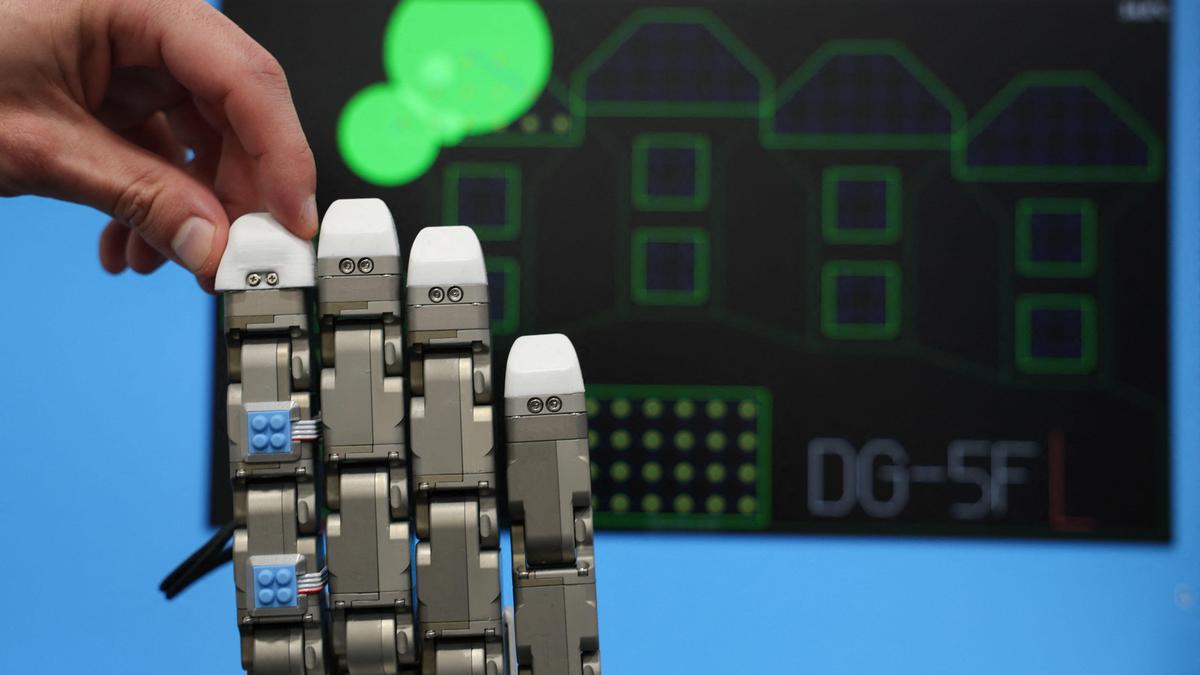

XELA Robotics Co., Ltd.'s uSkin human touch sensor is being demonstrated for pressure sensing on a robot hand at the annual Consumer Electronics Show (CES) in Las Vegas, Nevada on January 6, 2026. Photo credit: Patrick T. Fallon
Humans and AI will define the future of work, with nearly all HR leaders (97%) expecting that by 2027, the nature of work will be shaped by humans working collaboratively with AI, rather than intermittently, according to a Nasscom study conducted in partnership with US-based job site Indeed.
According to the study, this trend signals AI's transition from an auxiliary tool to an integral part of everyday roles, workflows, and decision-making processes. Additionally, new models of human-AI collaboration are being reported as the next phase of transformation, and success will depend on how effectively AI augments human capabilities, empowers employees, and aligns with organizational purpose.
AI is not only creating new jobs, it is already reshaping jobs. For example, around 20-40% of the work across technology organizations is already done through AI across various departments. About 45% of respondents highlighted that more than 40% of software development is done by AI, followed by intelligent automation and BPM at 39% and 37%, respectively. At the same time, the report emphasizes that AI is not independent. More than half of respondents highlighted incomplete and low-quality deliverables, reinforcing the need for human oversight to remain important.
This report highlights that the most effective human-AI partnerships are emerging across higher-level activities such as scope definition, system architecture, and data model design. At the same time, more mundane and repeatable tasks, such as generating boilerplate code and writing unit tests, are expected to be increasingly automated by AI over the next two to three years.
Ketaki Karnik, head of research at Nasscom, said: “AI is no longer a future consideration for the technology industry; it is already shaping the way we work. The real opportunity now lies in preparing people to work effectively with AI.”
As AI adoption increases, building skills and capabilities will be central to ensuring talent continues to move up the value chain and deliver meaningful outcomes for companies, he added.
Research shows that as AI changes tasks within roles, hiring is moving from selection based on numbers and qualifications to competency-based evaluation that emphasizes proof of work through performance and impact.
“What's changing is not the number of jobs, but what those jobs expect from people,” said Sashi Kumar, managing director of Indeed India. “We are seeing roles evolve within the company long before hiring signals catch up.
The report also highlights that 85% of recruiters believe skills-based hiring will increase, and 98% emphasize the need for hybrid and interdisciplinary skills. For entry-level talent, organizations are expecting candidates who can hit the ground running, and assessments are moving to live projects, hackathons, case-based questions, and portfolios, with a focus on measurable outcomes. A Nasscom-Indeed study found that for mid- and senior-level hires, evaluations are more focused on end-to-end ownership, decision-making under ambiguity, and multidisciplinary skill sets, with more emphasis on past projects and their impact.
issued – January 13, 2026 8:21pm IST