

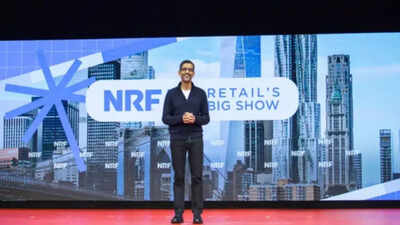
At National Retail Federation 2026, Google CEO Sundar Pichai explained the company's vision for how Google can help retailers succeed in this rapidly changing era where AI platforms are accelerating at a breakneck pace. When it comes to new developments and advancements, Google AI will help realize our vision for the future of retail, helping us reshape not only the customer experience, but other business and commerce areas as well. Google AI has reached a tipping point for retailers looking for innovation and ways to respond to changing consumer needs.
Sundar Pichai talks about making shopping smarter with AI
According to Google Blog, Sundar Pichai introduced that these are very dynamic times in the retail industry, primarily driven by the adoption of AI technology. Google has been working with the retail industry for over 20 years. The company is currently using a full-stack approach to innovate in the field of artificial intelligence.The extent of adoption can be gauged by the volume of tokens processed by Google's APIs for retailers in December 2024. It was 8.3 trillion, but by the end of 2025 that number will exceed 90 trillion, which is an 11x increase in one year, making this scale critical when it comes to providing the right AI solutions to both retailers and customers. Looking back on nearly 30 years of working with retailers, Pichai exclaimed: “Success is always shared.Google is building a future for retailers where customers have a seamless experience using familiar Google products, embedding AI into every aspect of the retailer experience and building long-term customer engagement beyond search and purchase.
Introduction to universal commerce protocol
Discovery is fascinating, but decision-making can be difficult. To address this, Google is developing the foundation for agent commerce. With agent commerce, intelligent agents guide shoppers from exploration to purchase. At the heart of this effort is the Universal Commerce Protocol (UCP).UCP is designed to support both retailers and customers, ensuring the entire shopping experience remains seamless. Developed in collaboration with industry leaders like Shopify, Etsy, Wayfair, Target, and Walmart, and endorsed by over 20 other companies, the protocol is open, agnostic, and compatible with existing industry standards. UCP supports cross-industry applications and is ready for use.One example of UCP in action is native checkout. Shoppers can complete purchases directly within Google Surfaces, including search and Gemini's AI mode. For example, a customer looking for a Monos suitcase can instantly receive personalized pricing, loyalty options, product suggestions, and complete the transaction through Google Pay, with the retailer in full control of the customer relationship.
Sundar Pichai explains how AI agents are powering retail services
Artificial intelligence agents are also transforming the way business is done. With the help of company and customer data, artificial intelligence agents can provide personalized experiences both on the internet and offline. Google's latest product, Gemini Enterprise for Customer Experience, is designed to fit perfectly into retail scenarios where artificially intelligent agents become a reality. Some retailers, such as The Home Depot and McDonald's, are already enlisting the help of these agents.Additionally, Google is working with retailers like Kroger to develop AI-powered shopping agents within their apps. These agents act as virtual salespeople, offering detailed guidance, proactive recommendations, and personalized support. All of this is designed to digitally recreate the in-store shopping experience. Gemini Enterprise for Customer Experience is available in preview and is fully integrated with the Universal Commerce Protocol and supports open standards for widespread adoption.Shipping remains an important and challenging aspect of retail. Wing, Google's delivery platform, focuses on ways to reduce costs and increase efficiency. By partnering with Walmart, Wing will be able to double its delivery volume in 2025 within its existing markets and is now expanding into new cities such as Houston, Orlando, Tampa, and Charlotte. These enhancements are aimed at creating a faster and more reliable delivery experience, allowing retailers to reimagine the entire shopping process from discovery to doorstep.


