The rapid growth of artificial intelligence has revealed a fundamental bottleneck that is much more difficult than the lack of GPUs: a large, sustained, reliable supply of energy. Meta's recent announcement about the details of a multi-gigawatt nuclear energy deal is more than just an environmental footnote. This is a stark declaration that the infrastructure war for AI supremacy will be fought and won on the power grid. This strategic shift marks a major shift in how hyperscalers think about future operational risk, recognizing that AI training and inference requires power densities never seen before in enterprise history.
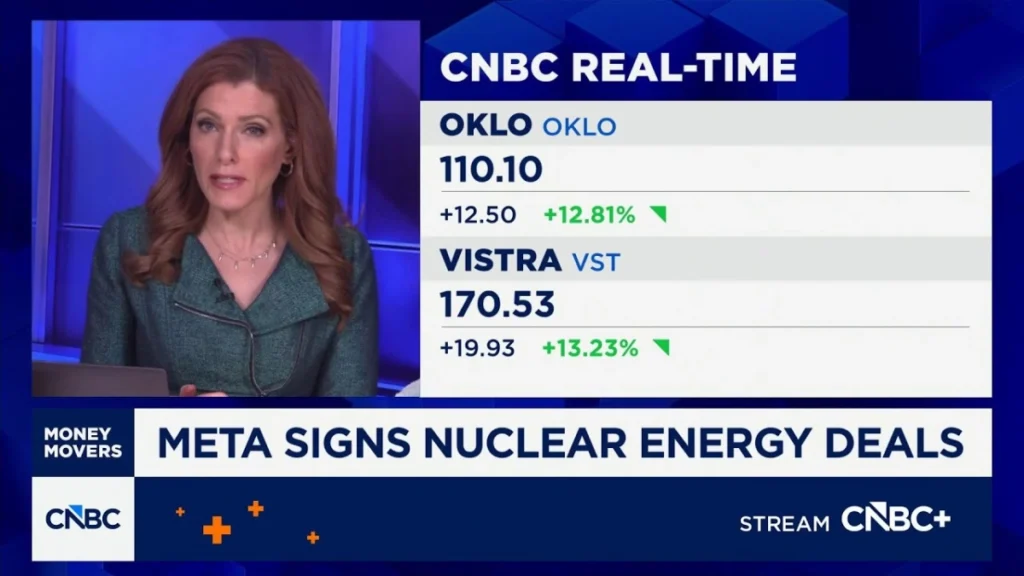
Julia Boorstin reports on CNBC's “Money Movers” detailing Meta's innovative energy procurement strategy and highlighting the company's pivot to nuclear power. The initiative, which was publicly discussed by Joel Kaplan, Meta's Chief International Affairs Officer, includes key partnerships with Vistra, Oklo, and TerraPower to directly address the rapidly increasing power demands of generative AI infrastructure. These agreements are expected to make up to 6.6 gigawatts of clean nuclear energy available, more capacity than the combined energy needs of every U.S. state, including New Hampshire.
The market immediately reacted to the perceived value injection into the energy sector. Shares in Okro and Vistra rose approximately 13% on the news, reflecting investor confidence that these long-term corporate power purchase agreements (CPPAs) provide vital financial stability and facilitate the development of advanced nuclear technology. For Meta, securing this capacity is insurance against future energy price fluctuations and supply constraints, which is necessary given the sheer scale of the computational infrastructure needed to keep pace with competitors.
This is more than just a small hedge. That's a fundamental change. Joel Kaplan, Meta's chief international affairs officer, emphasized the magnitude of the effort, saying these agreements “make Meta one of the most significant nuclear energy purchasers in U.S. history.” This emphasis on historical importance emphasizes the role of meta in facilitating the next generation of power generation. This transaction is more than just purchasing electricity. That includes extending the life of existing nuclear facilities, accelerating the commercialization of new reactor technologies, and addressing directly the supply side of the equation.
The economic impact is staggering. Meta's capital expenditures are projected to jump from $39 billion in 2024 to $72 billion by the high end of the forecast range in 2025. This large allocation is primarily driven by infrastructure needs, specifically data centers, GPUs, and the power required to run them, highlighting the reality that energy supply is currently the primary constraint to scaling AI. The need to have predictable, reliable, high-density power supplies is driving capital investment budgets to unprecedented levels.
The urgency is clear. Meta is racing to match the infrastructure investments already being made by competitors such as Microsoft, Google, and OpenAI.
Meta's rivals are also investing in nuclear technology, but Meta's total commitment of 6.6 GW is a decisive indicator. While Microsoft is considering small modular reactors (SMRs) for its data centers and Google has long prioritized carbon-free energy, Meta's move is perhaps the most aggressive and far-reaching corporate procurement strategy for advanced nuclear technology to date. The selected partners are especially bright. Bill Gates-backed TerraPower focuses on advanced molten salt and sodium-cooled fast reactors, while Oklo specializes in micro-reactors. These are not traditional power supplies. These represent a bet on distributed, high-density power generation required for data center proximity and efficiency.
Nuclear power provides an ideal solution for the computational intensity of generative AI, as it provides high capacity utilization (the ability to operate close to maximum power almost all of the time), which is essential for continuous AI training and inference workloads. Unlike intermittent renewable energies such as solar and wind, nuclear power provides baseload electricity 24/7, reducing the risk of power outages and reliance on expensive carbon-emitting peaker plants. This reliability is directly reflected in the operational uptime of Meta's growing AI data center fleet.
Kaplan highlighted the economic benefits of these deals beyond Meta's balance sheet, noting that the project would “create thousands of skilled jobs” and accelerate new nuclear reactor technology. This framework positions Meta's energy investments not just as a corporate necessity, but as a contribution to the nation's energy resilience and technological leadership. For defense analysts and government officials, this corporate action proves the strategic importance of nuclear energy to maintaining America's competitiveness in the global AI race.
However, these benefits take a long time to realize. New nuclear facilities are expected to come online from around 2030, highlighting the inherent lag between strategic infrastructure investment and actual operations. This delay will require Meta to sustain significant capital investments for many years before the full operational efficiency of these clean energy sources is realized. Nevertheless, the deal confirms important insights into the startup ecosystem. This means that the infrastructure behind frontier AI is rapidly becoming more vertically integrated, more energy-constrained, and increasingly reliant on a massive decade-long commitment to non-intermittent power sources. The fight over AI computing power is now crucially linked to the fight over gigawatts.