The operational efficiency of large-scale language models is rapidly changing from simply achieving high accuracy to mastering large-scale deployment. For organizations running mission-critical AI workloads, the challenge is not the models themselves, but the chaotic nature of inference traffic. Imagine an airport where small domestic planes and large international jets are lined up on the same runway. Congestion is a reality in many poorly optimized LLM deployments today. This bottleneck directly leads to frustrating delays and prohibitive costs, undermining the business case for widespread adoption of AI.
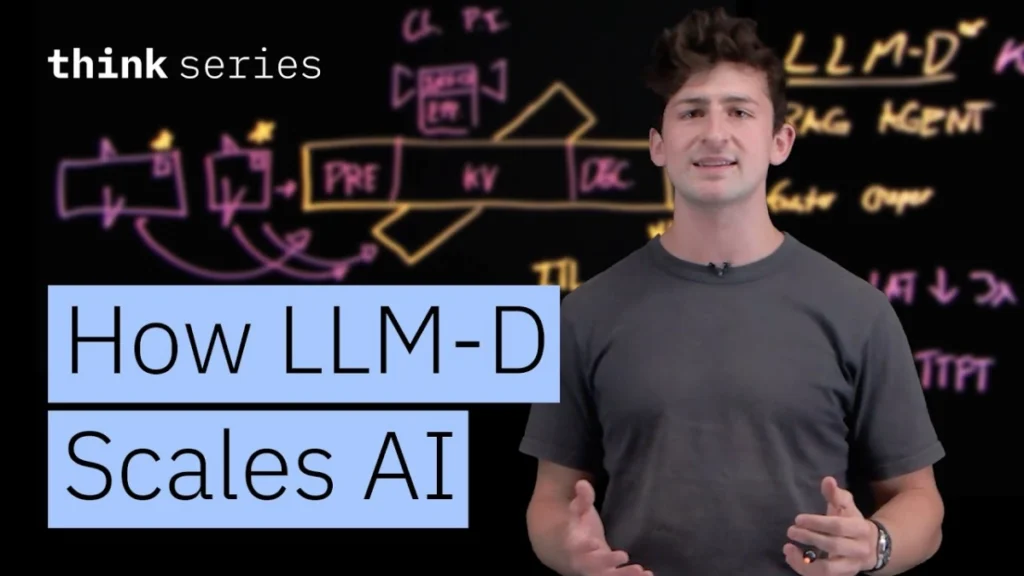
Cedric Clyburn, senior developer advocate at Red Hat, recently detailed LLM-D (Large Language Model – Distributed), an open source solution to this core infrastructure problem. Clyburn's presentation focused on how the technology leverages intelligent routing, search augmented generation (RAG), and Kubernetes to build smarter, faster, and cheaper datasets for next-generation AI systems. The fundamental insight driving LLM-D is that not all LLM requests are created equal, and treating them uniformly (the standard approach for many inference servers) is inherently inefficient.
In a typical setup, requests, whether for short RAG queries or complex agent coding tasks, are often processed sequentially or through simple round-robin load balancing. This method makes a big difference in performance. “If you try to do typical round-robin balancing, you're going to end up with congestion,” Clyburn said. This congestion manifests itself in high inter-token latency (ITL), the delay between receiving the first token and receiving subsequent tokens, which can significantly degrade the user experience, especially for interactive or real-time applications.
LLM-D acts as a reasoning gateway and functions exactly like an air traffic controller. Before routing incoming requests, we evaluate them based on several key metrics, including current load, expected latency, and the likelihood that the data will be cached. This intelligent routing mechanism is facilitated by an “endpoint picker” (EPP) that ensures that requests are matched to the best workload replica based on specific resource demands. This avoids scenarios where small, quick queries get stuck behind large, long-running agent tasks.
The architectural innovation behind LLM-D is to decompose the LLM inference process into two distinct, independently scalable phases: prefill and decode. The prefill phase, which processes input prompts, is memory-intensive and often benefits from a high-memory GPU. Conversely, the decoding phase that generates the output tokens is highly continuous but can be scaled across many small computing resources.
By separating these phases, LLM-D allows organizations to more efficiently utilize hardware acceleration resources. The system optimizes both phases while sharing the same key-value (KV) cache for similar requests, significantly reducing redundant calculations and memory usage.
This distributed approach provides visible and measurable performance improvements that are essential for enterprise-grade AI. According to Clyburn, LLM-D improved P90's latency by “3x” and increased “first token response time by 57x.” These metrics are essential to meeting the stringent service level objectives (SLOs) and quality of service (QoS) agreements that underpin commercial AI services.
The economic benefits are equally attractive. Distributing workloads and intelligently reusing cached resources means organizations can achieve higher throughput with less physical hardware. This directly translates into lower operational costs, making large-scale LLM deployments economically viable for more use cases.
Integration with Kubernetes (K8s) is key to the viability of LLM-D in modern enterprise environments. Kubernetes provides the robust orchestration layer needed to manage the complex and dynamic scaling required for fine-grained inference workloads. This combination allows you to dynamically scale the decoding process based on real-time demand, maximizing GPU utilization and maintaining low latency even during peak loads. For founders and venture capitalists evaluating the next wave of infrastructure strategies, solutions like LLM-D represent the plumbing needed to move LLM from experimental prototype to reliable, cost-effective enterprise utility. The focus has shifted from just running the LLM to running the LLM well under real-world constraints.