

YouTube has become one of the world's largest libraries of knowledge in the form of video content. A huge amount of valuable information is published on video every day, including university lectures, technical tutorials, interviews, product reviews, and more. However, while this video content provides an engaging way to gain knowledge, it is not necessarily an efficient format for extracting specific information such as insights, facts, and analysis.
As content consumption moves from passive viewing to active exploration, the challenges are becoming more apparent. People now need to quickly look up, reference, cite, and reuse information instead of watching an entire video from start to finish. As a result, artificial intelligence (AI) is increasingly shaping the way people obtain information from video content, particularly through AI transcription and video-to-text technologies.
Why video content is difficult to analyze at scale
The information contained in YouTube videos is generally more difficult to analyze than text-based content. Videos naturally follow a linear structure from start to finish. Unlike text-based documents and files, they cannot be easily skimmed, organized in detail, or precisely searched without additional tools. Trying to find specific statements from a 40-minute interview or extract key takeaways from various tutorial videos can be a time-consuming process.
For researchers and students, this makes it more difficult to cite sources and compare ideas across different videos. Meanwhile, content creators and marketers find it difficult to analyze competitors' content, identify trends, and reuse insights across blogs, newsletters, and social media. Even if you're a media professional, reviewing hours of recorded footage can slow down your production and workflow.
This is where AI-powered video content becomes essential. AI transcription turns spoken content into text for faster searching, browsing, and information extraction.
How AI transcription actually works
AI transcription systems rely on advanced speech recognition models trained on large multilingual datasets. These models have the ability to identify spoken words and segment sentences, and often include speaker detection, timestamps, and punctuation. For more advanced systems, background noise, accents, and terminology can also be handled.
Once content is transcribed, it can be searched, scanned, and edited. Users can easily find and access keywords, highlight important information, and extract quotes without having to play the video multiple times. This process fundamentally changes the way you use YouTube transcripts, turning your videos into text-based resources that fit seamlessly into your research, documentation projects, and workflows.
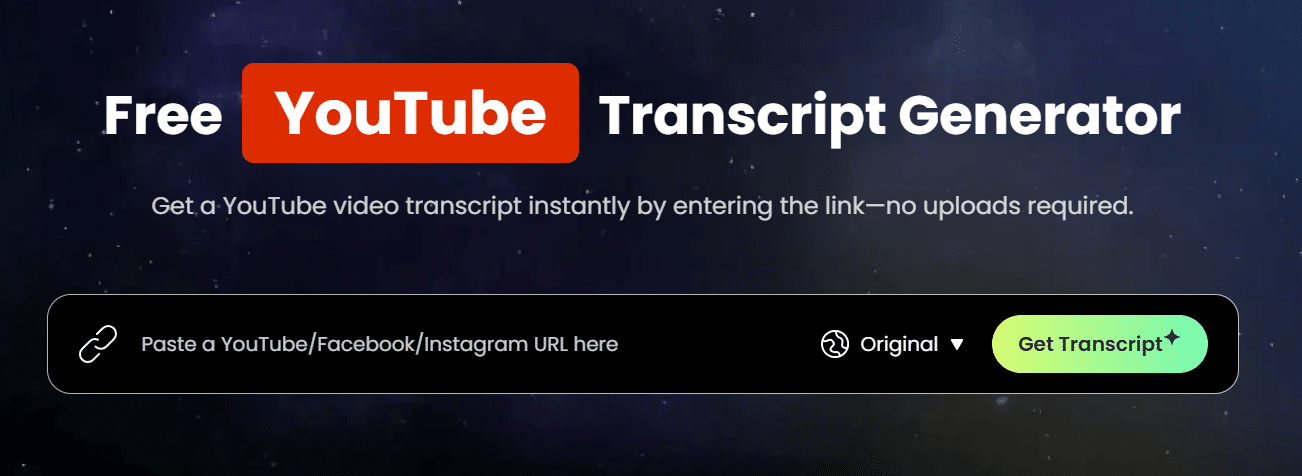
As video platforms continue to dominate online content, many are turning to AI-powered options like YouTube Transcript Generator to convert spoken content into text (transcripts) for a variety of purposes.
Why text still matters in a video-first world
Despite the rise of short and long-form videos, text remains the backbone of information processing. This is because search engines, academic databases, and AI search systems continue to rely heavily on text to interpret and rank content. In that case, without the transcript, much of the information in the video remains hidden from these systems.
Text is easier to use than video for deeper understanding of information. Readers can pause, go back, take notes, and compare ideas without having to play the entire clip. This is most important when the topic is technical or unfamiliar, as details can easily be overlooked. Text also enables translation, allowing your video content to reach audiences who speak different languages.
In this setting, AI transcription acts as a support layer rather than a replacement. This makes the information in the video more accessible and allows both creators and viewers to use visual content alongside written references.
Real-world use cases across various industries
AI transcription impacts many areas. In educational settings, students can turn recorded lectures into study notes, making them easier and more accessible for review. Educators can also find common questions and themes within lectures to improve the way they design their courses.
In research, analysts and journalists use transcripts to fact-check interviews, collect quotes, and compare expert opinions across sources. This is useful for long discussions or panel videos where important points may be spread out.
Meanwhile, content marketers and SEO experts use YouTube transcripts to identify high-performing topics, extract reusable content for blogs and newsletters, and improve content discovery. Transcribed videos can be reused in articles, social posts, or training materials without having to do anything twice.
Apart from these, accessibility is also an important area. Transcripts are useful for users who are deaf or hard of hearing, and make complex discussions easier to understand for non-native speakers. Accessibility is legally mandated in many places, making AI transcription essential for inclusive content.
The role of AI transcription in SEO and AI search
Search visibility increasingly depends on how easily your content can be understood by both traditional search engines and AI systems. Video alone provides limited context, while text provides clear signals.
Creating a YouTube transcript will help your content be indexed and appear in search results, featured snippets, and AI-generated summaries. Transcripts also support internal linking and content organization, helping platforms understand a particular creator's expertise on a particular topic.
As AI-powered search continues to evolve, structured, clear, and easy-to-summarize content will have an advantage. Video-to-text technology is key to enabling machines to access and understand valuable insights in videos.
conclusion
AI transcription is no longer just a convenience; it is becoming an integral part of how knowledge is stored and used in today's digital world. As technology improves, features such as summarization and topic analysis make it easier to understand and interact with video content. Over time, the line between video and text may become more important than how easily information can move between formats. By converting audio content to text, YouTube videos are searchable, citable, and useful for learning, research, and knowledge sharing.


