
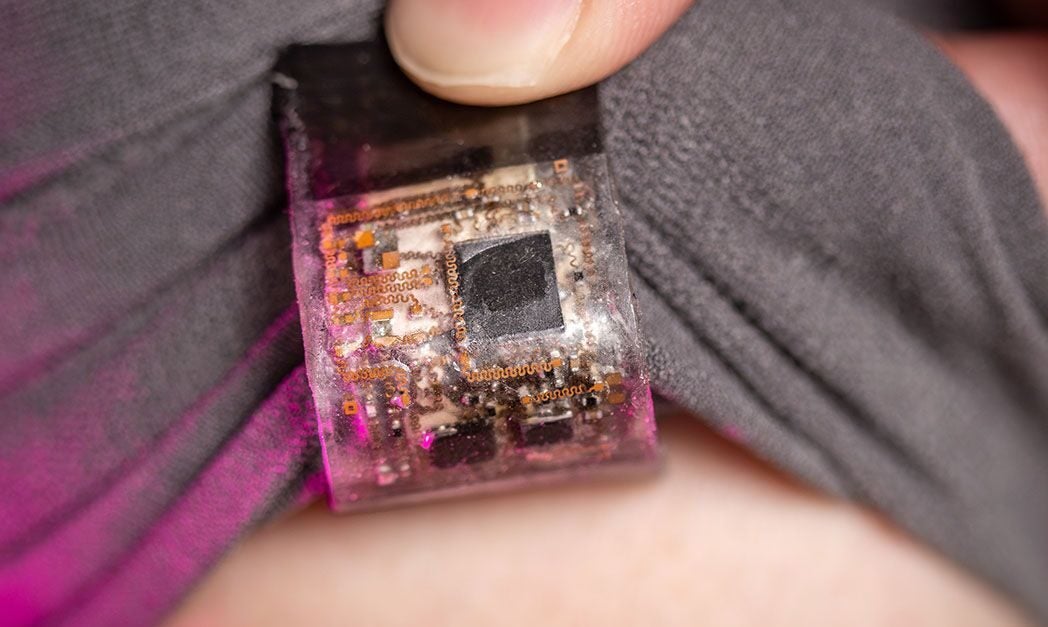
With a soft patch on your arm, you'll soon be able to control your robot with simple hand movements, even when your entire body is moving. That's the promise of a new wearable system from engineers at the University of California, San Diego. They set out to solve a problem that has hindered gesture control for years.
Gesture-based wearables typically only work in calm lab environments. If you start jogging, drive over a bump, or move through choppy water, the signal will drop out. Real-world movement drowns out the gestures your device is trying to read.
This new system uses stretchable electronics and artificial intelligence to filter that clutter in real time. This allows users to reliably control their machines with everyday gestures, even in situations that were previously “off-limits” to wearables.
Why gesture control often fails in real life
Most existing gesture devices rely on clean signals from motion or muscle sensors. It works when you sit still. When you start moving, the sensors pick up extra vibrations and shocks, making it difficult for your device to distinguish intentional gestures from background noise.
“Wearable technologies with gesture sensors work fine when the user is sitting still, but when there is excessive motion noise, the signal starts to fall apart,” says Xiangjun Chen, a postdoctoral fellow in the Aiso Yufeng Li family in the Department of Chemical and Nanoengineering at the University of California, San Diego and co-author of the study.
This noise problem limits the situations in which gesture controls are useful. Additionally, many devices have become frustrating and unreliable outside the lab. Chen and his colleagues wanted a system that worked in line with how people actually move around in their daily lives.
Soft patch packed with electronics
The team built a human-machine interface around a soft electronic patch. The patch is glued to a cloth armband that wraps around your upper arm so it stretches and moves with your muscles.
Within a patch, several parts work together. Motion sensors track arm movements. Muscle sensors receive electrical signals from your muscles when you bend or make gestures. A small Bluetooth microcontroller collects these signals and sends them to your computer. The stretchable battery powers the entire system while bending and bending to fit the patch.
“The hardware is not the only difference in this design. We combined the patch with a custom artificial intelligence model that acts like a smart filter. The patch learns to separate the gesture signals of interest from all the jostling and jostling that comes with movement,” Chen told The Brighter Side of News.
Teach the system to ignore chaos
To train their AI, researchers created a large, composite dataset. Volunteers wore the patches while making specific gestures under different types of disturbances. They ran on a treadmill. Exposure to strong vibrations. They moved and changed their positions. They also faced movements such as those caused by ocean waves.
Each recording contained both an intended gesture and a layer of motion noise. The team fed this data into a deep learning framework that learned patterns over time. The model gradually learned which parts of the signal belonged to gestures and which parts came from random movements.
Once trained, the system can capture raw data from the arm, remove interference, and recognize intended gestures in real time. The gestures were then translated into commands and sent over the air to control the machine.
“This advancement brings us closer to intuitive and robust human-machine interfaces that can be implemented in everyday life,” Chen said.
Tests on land, in vehicles, and on waves
To show that the device could work in harsh conditions, the researchers asked volunteers to use it to control a robotic arm. Participants guided the robot during a run while being exposed to high-frequency vibrations and a combination of these disturbances.
The system was also subjected to more rigorous testing at the Scripps Institution of Oceanography at the University of California, San Diego. So the team used the Scripps Ocean-Atmosphere Research Simulator to recreate both laboratory-generated and real-world ocean movements. The patch rode through simulated waves while the wearer commanded the machine using gestures.
In all these configurations, the interface provided precise control with low latency. The robotic arm responded smoothly to gestures, even when the person's entire body was shaking. This level of reliability against various failures is what makes this system stand out.
Who can benefit from this technology?
The original idea was born out of a very specific need. The team wanted to allow military divers to control underwater robots without using complex equipment or handheld controllers. They soon realized that the same failure appeared almost everywhere in the wearables space. Operating noise negatively impacts the performance of workers, patients, and consumers alike.
Once this technology is introduced in the clinic, people undergoing rehabilitation will be able to move robotic aids with natural arm gestures rather than small finger movements. Even people with limited dexterity can control the assistance robot without having to struggle with hard buttons or joysticks.
Industrial workers and first responders can keep their hands free while controlling tools and robots in noisy, fast-moving environments. Divers and remote operators can guide underwater vehicles through rough water where other systems have failed. For everyday gadgets, this kind of robust gesture reading could ultimately make wave and control interfaces reliable rather than gimmicky.
“This research establishes a new method for noise immunity in wearable sensors,” Chen said. “This paves the way for the next generation of wearable systems that are not only stretchable and wireless, but also capable of learning from complex environments and individual users.”
Practical implications of the research
This research shows that adding machine learning directly to software wearables can solve one of the biggest problems in gesture control: motion noise. Its insights could influence the future design of many healthcare, industrial, and consumer electronics products.
In medicine, we propose a path to intuitive control of prosthetic limbs, exoskeletons, and rehabilitation robots that follow natural gestures during walking and movement. This can make patients more independent and make treatment feel more natural.
In the workplace, noise-tolerant gestural interfaces can help guide robots and machines in noisy, unstable, or dangerous environments without fumbling with physical controls. This can potentially make the task safer and more efficient.
For researchers, this work provides a template for training AI on realistic, messy data rather than idealized laboratory signals. This change will allow new wearable devices to learn from the way people actually move and live, rather than from incremental testing.
For society, such systems suggest a future where we can interact with technology through simple and reliable body language instead of screens and buttons. This could make digital tools more human-like and accessible, especially for people with limited fine motor skills.

