
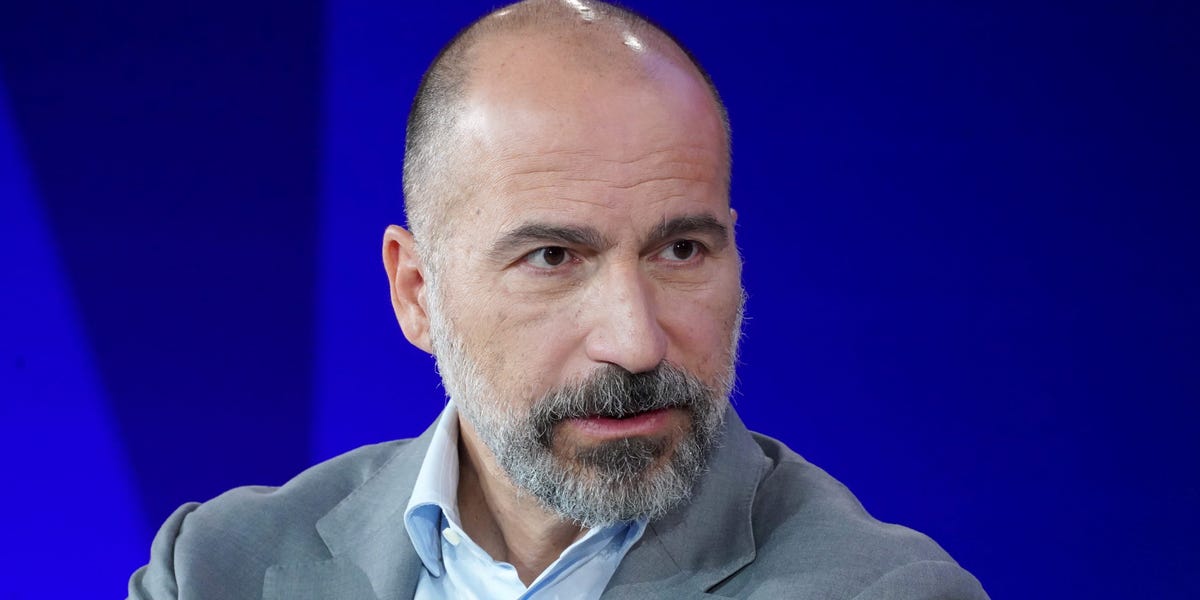
AI stocks may look frothy, but CEO Dara Khosrowshahi says Uber's embrace of technology has changed its operations and delivered huge financial benefits.
“You can debate whether there's a bubble from a valuation standpoint,” Khosrowshahi said on the “On with Kara Swisher” podcast in an episode published Thursday. “The spending on things like data centers is huge.”
But AI creates a lot of value for Uber, he said, such as determining what customers see on the Uber Eats app after they select a carton of oat milk, in a way that's “not space-age but very practical.”
He added that the latest AI models are “very efficient” compared to previous generations and are generating “hundreds of millions of dollars in benefits for us.”
Uber's AI spending was “well worth it, and then some,” he said. “We're not making picks and shovels, but we're riding on that spending, definitely.”
AI stocks have soared to record highs this year, but investors such as The Big Short's Michael Varley are warning that tech giants are overspending on microchips and data centers in the race for computing power and will underperform staggering growth projections.
How Uber is implementing AI
Khosrowshahi described his mobility, delivery and transportation company as an “applied AI” business. He said the technology is used for everything from setting prices and payments to matching, routing, identification and responding to customer complaints.
He said roughly 80% to 90% of Uber's developers now use AI tools. The company no longer needs to have a fleet of engineers on hand to solve problems and spend “hours and hours” trying to figure out what went wrong and where it happened. He continued that AI agents now “constantly monitor all of our systems” and help diagnose problems.
“Then humans will be able to look over the shoulder of the AI agent,” he added.
Khosrowshahi said other technology leaders might see a 20 or 30 percent increase in engineer productivity with AI and conclude that they would need 20 to 30 percent fewer engineers, but that's not his attitude.
“I think they're going to be superhuman,” he said. “So I'm actually hiring more engineers because every engineer becomes more valuable to me.”
Khosrowshahi also mentioned Uber's partnerships with Waymo and other robotaxi companies, saying self-driving cars are gaining popularity.
“There's something to be said about privacy,” he said. He loves talking to Uber drivers and listening to their stories, but he also says, “I enjoy being alone in the car.”
Khosrowshahi predicted that if self-driving cars prove to be a revenue source, Wall Street will embrace them as an investment and want them to access customers on Uber's platform to maximize revenue.
Just as private equity and private debt firms are “funding these data centers and buying Nvidia chips, the same ecosystem is going to be buying fleets of cars,” he said.
Khosrowshahi said Uber could play a similar role to Marriott, which primarily manages and franchises hotels rather than owning them.

