
OFCOM's latest Online Nation report explores how adults and children in the UK experience life online. From the sites and apps we use every day to how people feel about their behavior and what they encounter online.

We as a nation are spending more time online
Adults now spend an average of 4.5 hours online a day, an increase of 10 minutes from last year. Women spend 26 minutes more online each day than men, with an average of 4 hours and 43 minutes per day.
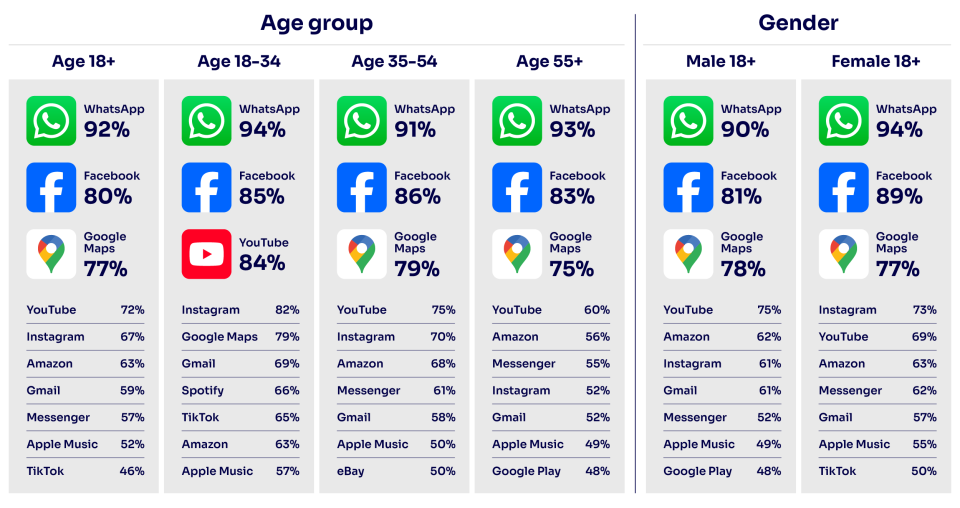
Most of the time online is spent on smartphones, with adults using an average of 41 apps per month. WhatsApp, Facebook, and Google Maps are the three most used apps among adults.
Half of our online time is now spent on services owned by Alphabet and Meta
Two big tech companies now account for more than half of the time people spend online in the UK.
YouTube is the most used service owned by Alphabet, used by 94% of adults. Time spent on YouTube is increasing, reaching an average of 51 minutes per day, excluding TV. A combination of Facebook and Messenger (93% of adults) is the most widely used meta-service, followed by WhatsApp (90% of adults).
AI shakes up search
Four in five adults (82%) use Google Search. It is the most used search service in the UK, with 3 billion searches per month.
AI is changing the UK search experience. Approximately 30% of searches now show AI summaries, and more than half of adults (53%) say they often see these summaries. In most cases, they are not looking for these, but find them included in a search service.
Generative AI services are gaining traction and more people are actively seeking them out. ChatGPT had 1.8 billion visitors to the UK in the first eight months of 2025, up from 368 million in the same period in 2024.
Adults are less positive about the influence of the Internet
This year, just one-third (33%) of adults say they feel the internet is good for society, down from 40% last year. And while almost two-thirds (65%) of adults believe the personal benefits of being online outweigh the risks, this number has steadily decreased from 71% two years ago.
Fewer adults (25%, down from 30% last year) say they feel more free to be themselves online than offline this year, and only 35% feel it's easier to share their opinions online than offline.
What UK kids are doing online: social media, schoolwork and regrets over spending
The younger Generation Z and the oldest Generation Alpha are mobile-first, video-native internet users. Children aged 8-14 spend almost 3 hours online each day, rising to 4 hours for 13-14 year olds and around 2 hours for 8-9 year olds. This only counts time spent on smartphones, tablets, laptops, and computers, not gaming consoles.
When it comes to screen time, YouTube and Snapchat are leading the way. Between the ages of 8 and 14, kids spend about 48 minutes on YouTube and 45 minutes on Snapchat per day, accounting for about half of their total online time. Almost all 8-14 year olds use YouTube (96%) and Google Search (95%). WhatsApp (63%) and TikTok (58%) also rank highly.
Late night scrolling is common. Across the four main services used by children: YouTube, Snapchat, TikTok, and WhatsApp, 15-24% of time spent by the entire 8-14 age group occurs between 9pm and 5am. Depending on the platform, 4-10% of usage occurs after 11pm.
Most kids are happy with their online lives
Overall, 9 in 10 (91%) children aged 8 to 17 say they are satisfied with what they do online.
Teens use social media and messaging apps to stay connected. Almost three-quarters (72%) of 13- to 17-year-olds who use these platforms say they feel closer to their friends. Girls aged 13 to 17 are more likely than boys of the same age to think that being online is good for forming and maintaining friendships (71% vs. 60%).
Overall, seven in 10 (69%) 13-17 year olds go online to support their wellbeing, primarily to relax (45%) or boost their mood (32%). Nearly eight in 10 (78%) say the internet helps them with their schoolwork, and more than half (55%) say they use the internet to learn new skills.
But they pay attention to doomscrolling and 'brain rot'
Some of the children we spoke to reflected on the negative effects of scrolling for long periods on their smartphones. They used the term “brain rot” to describe both the type of content and the emotions it leaves behind. This content is fast-paced, chaotic, and often nonsensical and can overstimulate and confuse viewers.
Reclaim your online space – Gen Z is more likely to take action against harmful content
It found that seven in 10 11-17 year olds had seen or heard harmful content online in the past four weeks, but it also found that nearly two-thirds (64%) of them took action after encountering such content.
Actions include using platform tools such as the “dislike” button (15%), reporting the content (11%), blocking the content poster (10%), and telling an adult (10%).
Importantly, we spoke to children about this before the Child Protection Code of Practice came into force in July 2025. Under the new rules, sites and apps will have to take steps to prevent children from encountering the most harmful content related to suicide, self-harm, eating disorders and pornography. These steps include age checks and preventing this content from appearing in children's “for you” feeds. The reporting tools available to children also need to be improved. We must also act to protect children from misogynistic, violent, hateful or abusive content, online bullying and dangerous challenges.
Online Retail Regrets – Young users regret their online purchases
Nearly six in 10 (58%) children between the ages of 8 and 17 said they spent money online on social media sites, video sharing platforms, or while playing games in the past month.
Children say they have been encouraged to spend money online in a variety of ways, including character customization (30%), advertising (27%), recommendations from friends and family (23%), and influencer content (22%).
However, a third (32%) of kids regretted their in-game purchase, and 43% regretted their purchase on social media. Meanwhile, 42% weren't even sure what they were buying in the game.


