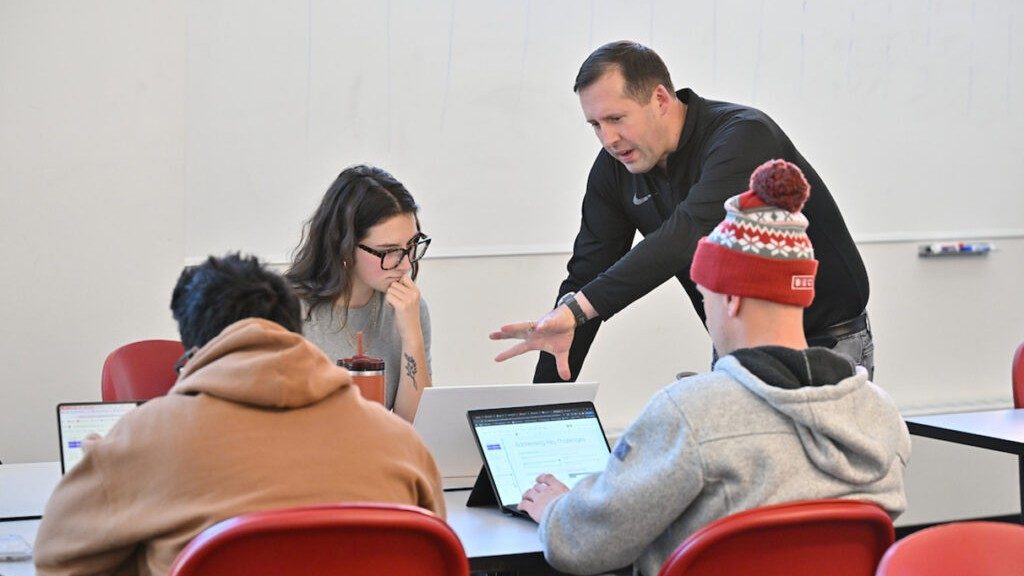
Pullman, WA – Inaugural AI@Carson Workshop hosted by Carson College of Business. November 1st-2ndwhich brought together approximately 60 business students for a two-day immersive event. practical I study in the Spark Academic Innovation Hub at WSU Pullman.
Students from majors from across the university filled the active learning space, ready to build their AI skills and understanding. The workshop emphasized not only using artificial intelligence more effectively, but also recognizing its limitations and approaching new tools with a critical and ethical mindset.
“The goal is to enable students to not only use AI, but to think about it and understand what's good about it, where it's lacking, and how to use it responsibly,” said Robert Crossler, professor and chair of the WSU School of Business, Information Systems, and Entrepreneurship, who founded the event.
Learn how to create better AI prompts
The workshop began with a session on Prompt Engineering. Prompt engineering has quickly become an essential skill for anyone using generative AI tools like Microsoft Copilot, OpenAI's ChatGPT, Google Gemini, or other large-scale language models (LLMs). Students practiced writing clear and purposeful prompts and explored meta-prompts. In other words, we asked AI to help us create better instructions to improve results.
Crossler encouraged students to treat AI like a teammate rather than a tool, reminding them that good results come from experimenting, refining prompts, and building on each response.
“these [AI] The model can be wrong about 20% of the time. ” he said. Review their work, provide feedback, and learn from the process. That's how you should treat the output of your AI. ”
For WSU student Eden Brooks, a third-year international business and management major, it's all about hands-on. practical This approach was what made the workshop experience stand out.
“AI is becoming a part of everyday life,” Brooks says. “Seeing how it can be integrated from a business perspective was the most fascinating part. I'm excited to learn how to use it efficiently and responsibly.”
AI skill development across disciplines
Students then turned their attention to AI and ethics in a session led by Richard Johnson, associate professor of management, information systems and entrepreneurship. They worked in small groups to explore real-world scenarios involving misinformation, bias, and unintended consequences of over-reliance on generative AI tools.
“Generative AI makes people happy,” Johnson said. “It gives you what you want to hear, but it's not always accurate. That's why we always need to remain critical about how we evaluate answers.”
Generative AI makes people happy. It gives you what it thinks you want to hear, but it doesn't necessarily give you the exact thing. That's why we must always remain critical in the way we evaluate responses.
Associate Professor Richard Johnson
washington state university
With that foundation in place, the workshop transitioned into a series of discipline-focused breakout sessions led by faculty and graduate student instructors from Marketing, Accounting, Finance, Hospitality, Human Resources, and Information Systems. These sessions showed students how AI is reshaping business practices across industries and challenged them to apply ethical reasoning to practical domain-specific problems. Other sessions explored how AI is transforming business operations.
In all breakout sessions, faculty emphasized a consistent theme: AI tools are most effective when combined with human judgment and critical thinking.
“AI doesn't do all the work,” said accounting associate professor Beau Burns during a session on AI in accounting and auditing. “It’s important to learn how to leverage technology to enhance your workflow and make better decisions.”
prepare for future work
For students like Nick Lamet, who studies management information systems and accounting, the workshop provided both practical tools and a few surprises.
“The audit process requires a lot of double-checking and can be tedious,” he said. “It was really eye-opening to see how AI agents could support these tasks.”
Students who have completed the 2 days During the training, we received a certificate recognizing new competencies in AI literacy and responsible use.
“The AI@Carson Workshop reflects Carson University’s commitment to experiential learning and technological fluency, preparing graduates who can lead in an increasingly digital, data-driven world,” said Debbie Compeau, university president.