
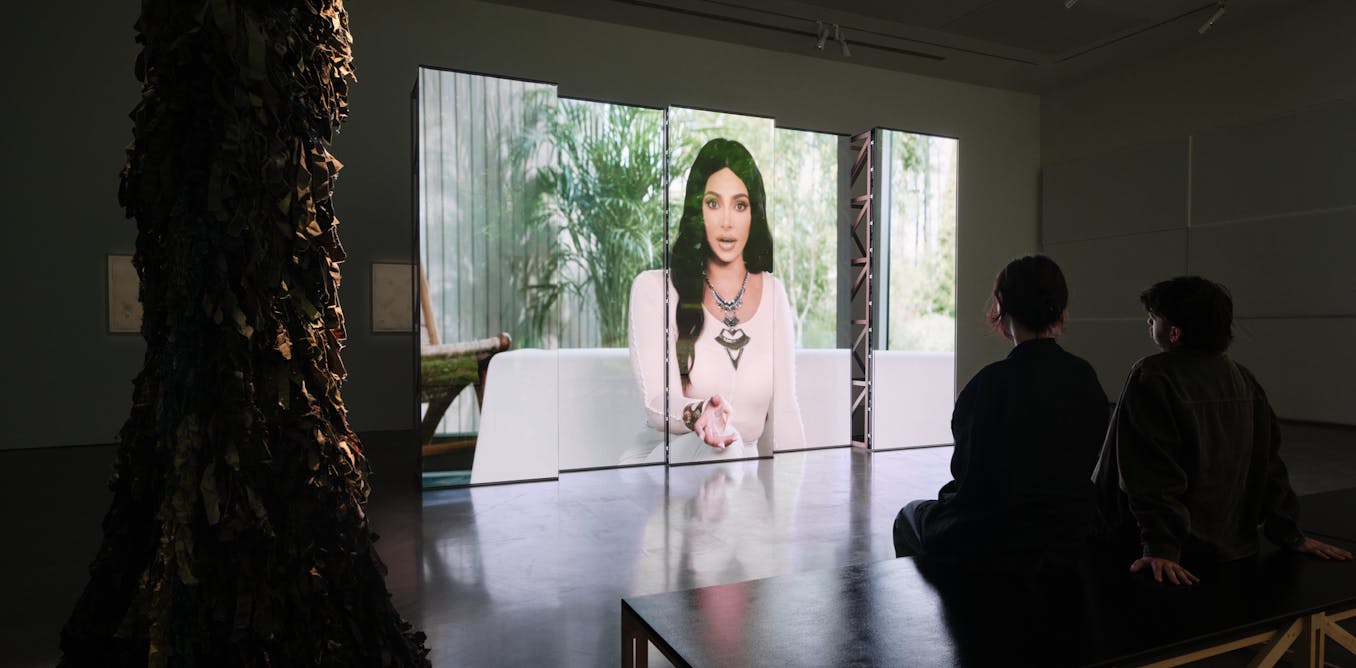
Surrealists believed in the power of dreams. Inspired by Freud’s theories on the unconscious and the workings of dreams, Andre Breton saw the irrationality of dreams as an artistic technique that could reveal new and revolutionary ways of being.
A century later, the meaning of dreams extends beyond the unconscious to the disembodied processes of mechanical systems.
Dreams have become a metaphor for how artificial intelligence metabolizes information and generates “AI slop.”
You can no longer opt out of AI systems. The digitized trace is ultimately redisplayed as a composite output. As AI conjures us from our information, its neural processes go beyond our understanding and amplify our biases in the service of capitalism.
Data Dreams, a contemporary art museum, brings together artists who make these tensions visible.
AI and “social dreams”
Hito Steyerl argues that generative AI produces an “average image,” or a statistical average derived from a training dataset. These are the “dreams of a society that never sleeps” that reflect what society is paying attention to.
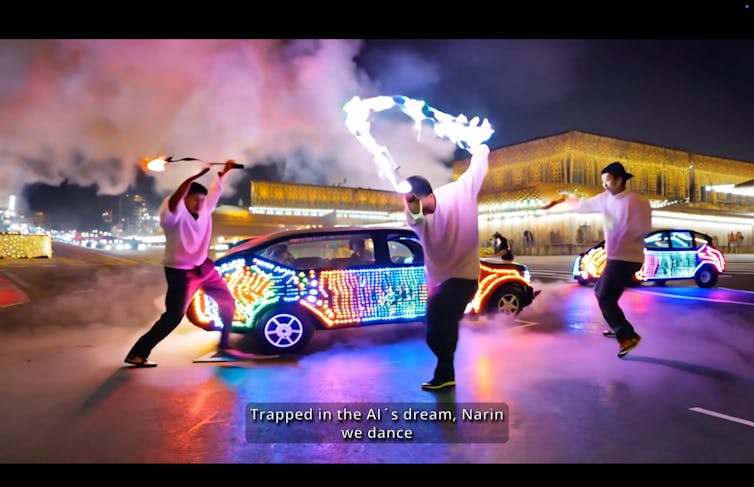
Courtesy of the artist, Andrew Krebs Gallery (New York) and Esther Schipper (Berlin/Paris/Seoul), still image © hito Steyerl / © VG Bild-Kunst, Bonn 2025
Steyerl’s video installation “Mechanical Kurds” features footage from the Domiz refugee camp in Iraq. She follows Kurdish refugee clickworkers who annotate the data of the war system that monitors them.
The gallery space’s sculptural support echoes the bounding box that appears on the screen. These are subtle reminders that we are enmeshed in these infrastructures.
Lynn Hershman Leeson’s video work explores the political stakes of AI. In Logic Paralyzes the Heart and Cyborgian Rhapsody, her cyborg protagonist moves between issues such as military surveillance, facial recognition systems, machine hallucinations, and the rapid obsolescence built into technology.
She stages a dialogue between humans and machines, revealing the instability of human agency when machines become involved in our social interactions and creative lives.
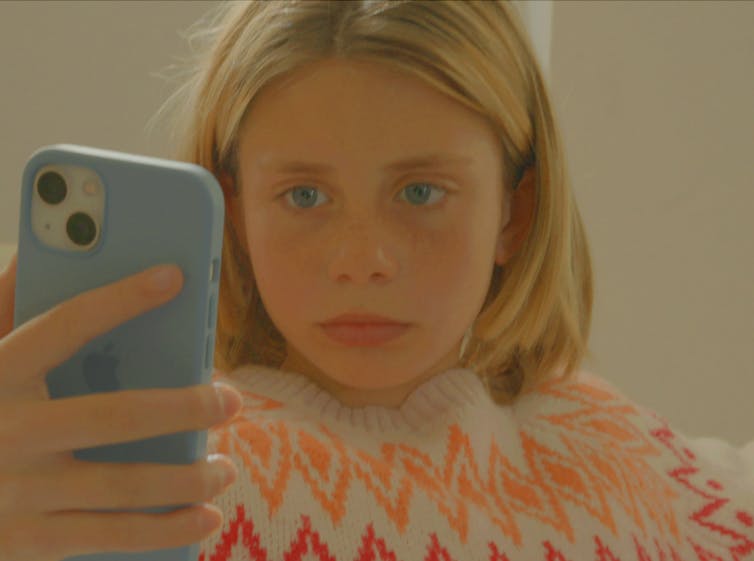
Courtesy of the artist; Altman Siegel, San Francisco. Hoffman Donahue, Los Angeles and New York. © Hotwire Production LLC
Trevor Paglen’s AI-generated image series “Adversarially Evolved Hallucinations” focuses on perceptual instability in machine vision.
The images are created using an early machine learning algorithm known as GAN and printed using a photographic process.
Paglen suggests that these “hallucinations” sit on the edge of what is classifiable and visible. Insights into how algorithms “see” shape our vision.
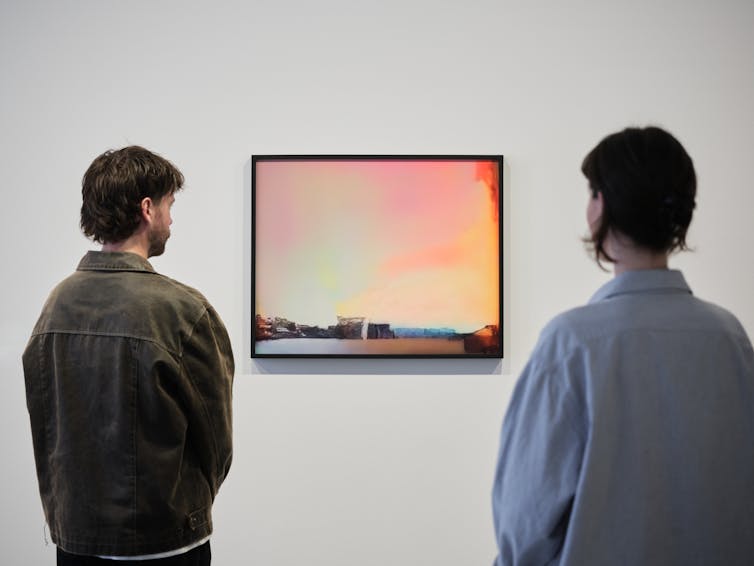
Image courtesy of the artist and the Australian Gallery of Contemporary Art © Artist, photo: Hamish McIntosh
Kate Crawford and Vladan Joler’s Anatomy of an AI System maps the social and material infrastructure of Amazon Echo.
Their diagrams trace the entire life cycle of the machine, with dissected components and raw minerals. This research reveals how AI is deeply embedded in ecological and economic systems, competing for life-sustaining resources and ultimately discarded as hazardous e-waste.
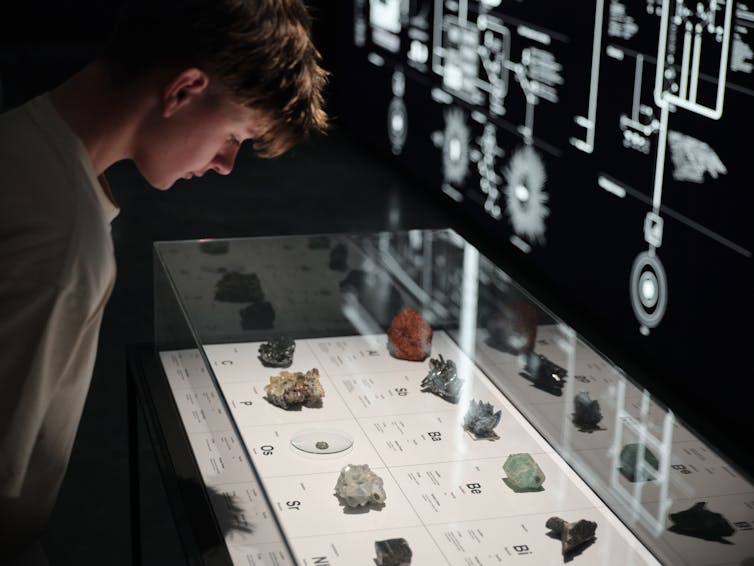
Image courtesy of the artist and the Australian Gallery of Contemporary Art © Artist, photo: Hamish McIntosh
material ecology
We are being asked to consider whether AI could be an ally in our understanding of what intelligence is and what constitutes a generative system.
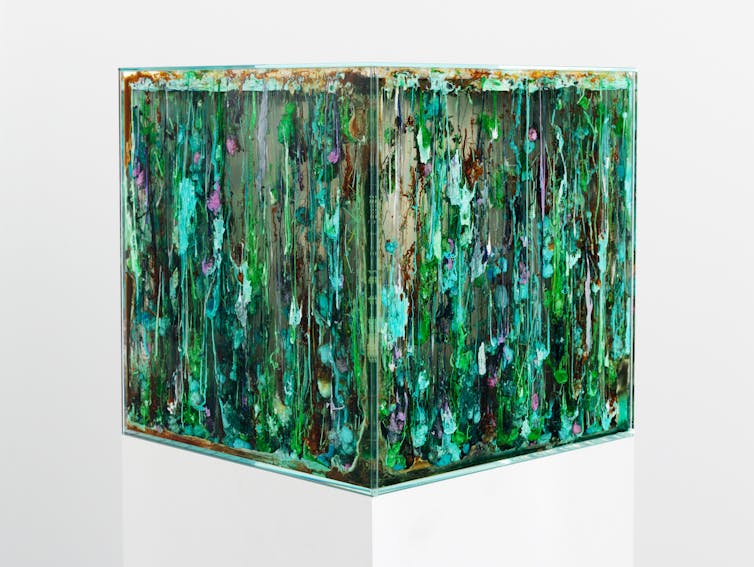
Courtesy of the artist and Marian Goodman Gallery. Photo: Elizabeth Bernstein
Agnieszka Krant’s sculptures and paintings suggest that intelligence is not a strictly human concept. She works with biologists to uncover the origins of life through computation. Her temperature-sensitive copper-colored fields respond to human emotions expressed on social media.
Her work is wild in its premise and execution. They encourage us to understand how machines and minerals extend our view of the world beyond ourselves.
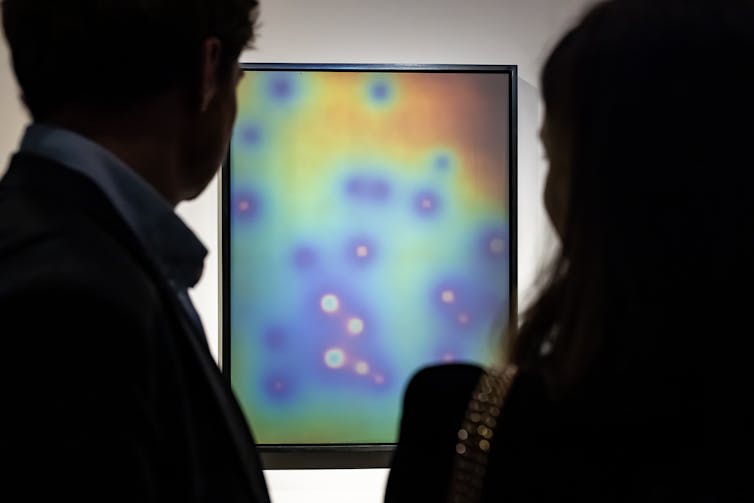
Image courtesy of the artist and the Australian Gallery of Contemporary Art © Artist, photo: Jackie Manning
Annika Yee’s jellyfish-like creatures appear in kinetic sculptural installations and video works generated by AI models trained on her past work. These forms take on a kind of speculative biology, visualizing the earliest forms of life on Earth.
This is reflected in Angie Abdilla’s video installation, which uses machine learning to visualize the Big Bang story alongside the Aboriginal creation story.
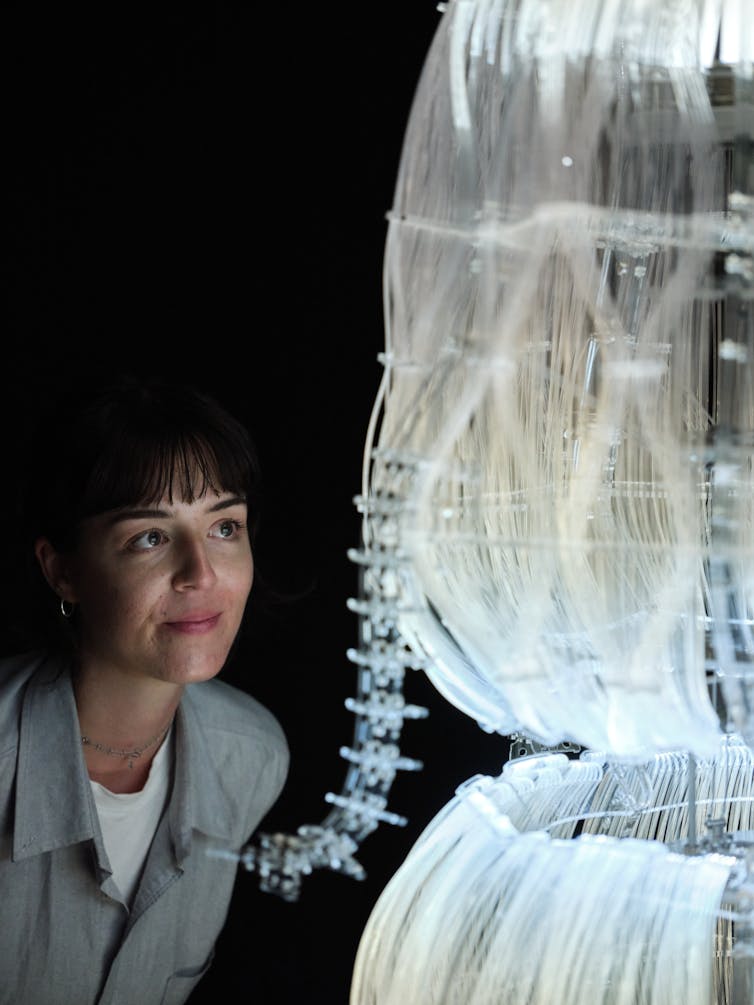
Image courtesy of the artist and the Australian Gallery of Contemporary Art © Artist, photo: Hamish McIntosh
dream of speculative time
The broader question of what it means to dream in this exhibition is how AI is used to visualize history, predict the future, and ask who can do it.
Fabien Giraud’s meditative video work “The Feral” employs AI as the algorithmic custodian of a millennium-old assemblage of artworks. Artists from across generations create “eras” that teach evolving systems how to see.
The current Epoch produced by Giraud is the first of these iterations. This video piece depicts a scene from 1,000 years ago, depicting villagers in the forest contemplating the end of humanity after ingesting psychotropic drugs.
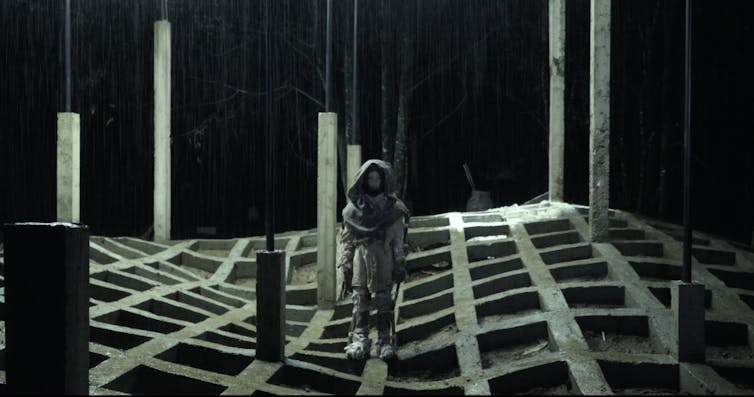
Courtesy of the artist
Giraud deftly points out the enduring importance of language in training AI systems that resonate with mythical notions of what it means to be “human.” AI is employed as a poetic and speculative device, allowing us to think about history and the future while serving as a witness to our evolving humanity.
Christopher Kurendran Thomas’s installation was filmed in parts of mainland Tamil, which are currently off-limits due to government regulations. This work overlays generated footage, deepfakes, and scrapped social media text to write a counterfactual political history.
The work will be installed between reflective screens, and new dialogue and footage will be added during each screening cycle. The video relies on algorithms that aggregate social media for new content, creating an unstable and unpredictable reality that reflects the age of misinformation.
dreaming again
These works prompt consideration of what will happen when our social encounters, and even our sense of time, become increasingly mediated by AI. What happens when you dream?
Here, Breton’s defense of dreams as incorrigible, reified, and resistant to the logic of productivity takes on new meaning.
Defending the act of dreaming may be more a political manifesto than a nostalgic return. This suggests questioning how AI can be used to imagine differently, speculatively and boldly dreaming about possibilities rather than plausibility.
This may be one of the last areas where algorithms resist optimization or tilting.
‘Data Dreams: Art and AI’ will run at the Museum of Contemporary Art, Sydney until 27 April 2026.

