In today’s digital-first world, cyber threats are evolving faster than ever. Traditional rule-based detection tools can no longer keep up with the increasing sophistication of modern attacks. Organizations need a smarter, more adaptive and automated approach. This is important. Anomaly detection using machine learning (ML) comes in.
This technology is at the heart of next-generation security operations centers (SOCs), enabling real-time visibility, faster detection, and proactive prevention. Let’s take a look at how it works, why it’s important, and how it’s done. Seceon’s integrated platform We provide world-class anomaly detection with measurable results.

What is anomaly detection and why is it important?
Anomaly detection is the process of identifying patterns in data that deviate from normal or expected behavior. In cybersecurity, this means discovering anomalous network activity, suspicious user logins, or unauthorized data transfers before these deviations become breaches.
Why it’s important for modern businesses:
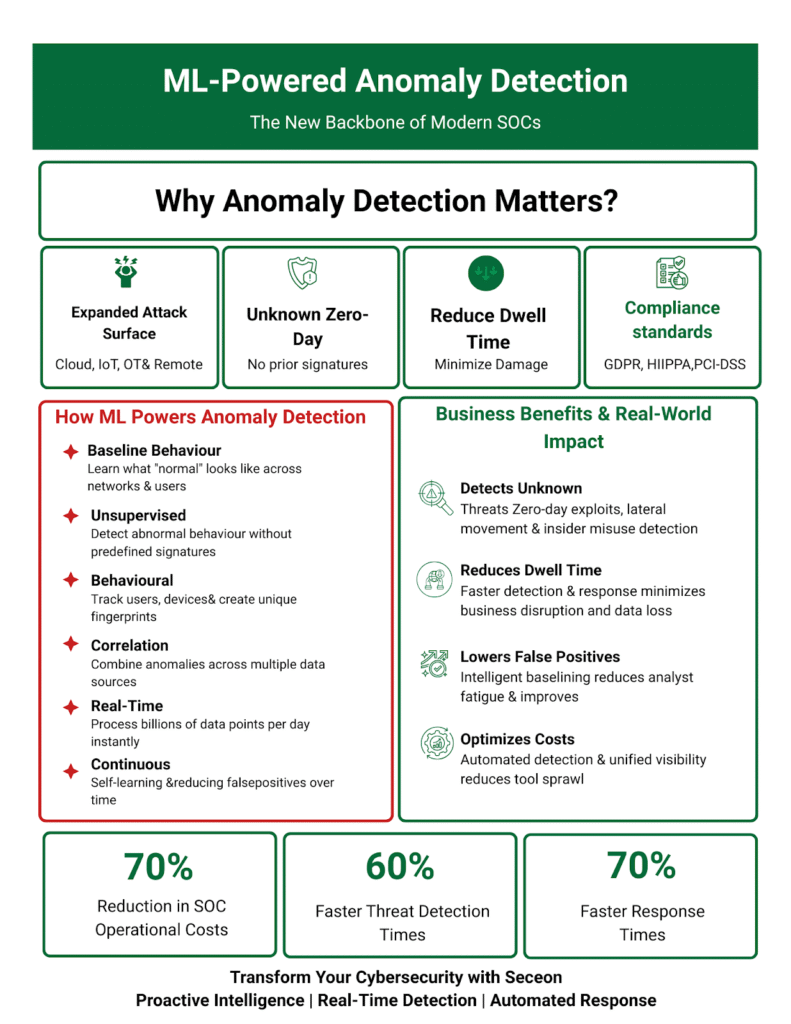
- The attack surface is expanding across cloud, IoT, OT, and remote environments.
- Many cyber threats are unknown or zero-day and have no prior signatures.
- Reducing dwell time (the amount of time an attacker is undetected) is key to minimizing damage.
- Organizations must meet compliance standards while keeping operational costs low.
In short, anomaly detection allows security teams to: Detect unknown threats earlyprotect critical assets and reduce business risk.
How machine learning enhances anomaly detection
ML brings intelligence, adaptability, and automation to anomaly detection. Learn normal behavior across networks, users, and devices and flag deviations.
1. Modeling baseline behavior
Machine learning models analyze large amounts of telemetry data to understand what “normal” looks like. Once a baseline pattern is established, any deviations (such as sudden spikes in data transfers or logins from unknown locations) are flagged as suspicious.
2. Unsupervised learning and semi-supervised learning
Because many attacks do not have labeled examples, ML uses clustering and outlier detection to identify anomalous behavior without relying on predefined signatures.
3. Behavioral analysis and entity analysis
ML tracks user, device, and application behavior and creates unique behavioral fingerprints. Alerts are triggered when entities deviate from normal patterns, giving SOC teams actionable insights.
4. Correlation and Contextual Intelligence
By combining anomalies across multiple data sources (network, endpoint, identity, cloud), ML can recognize complex multi-vector attack patterns that static rules miss.
5. Continuous learning
As new threats emerge and the environment evolves, ML models improve themselves, reducing false positives and increasing accuracy over time.
6. Scalability and real-time detection
ML-driven systems can process billions of data points per day, enabling real-time detection and scoring even on large distributed networks.
Key workflows for ML-driven anomaly detection
- Data ingestion and normalization – Collect logs and telemetry from endpoints, firewalls, cloud, IoT, and identity systems and enrich them with contextual information.
- Baseline modeling – Build statistical and behavioral models from historical data.
- Anomaly scoring – Assign a dynamic risk score to each new event or deviation.
- Correlation and threat modeling – Link related anomalies to identify coordinated attacks.
- Prioritize and respond to alerts – Prioritize high-risk anomalies and take action automatically or manually.
- continuous feedback loop – Feedback from analysts helps fine-tune ML models and reduce noise.
This end-to-end process analyzes raw data into actionable intelligence by analyzing every deviation in context rather than in isolation.
Business benefits and real-world impact
1. Detect unknown internal threats
ML identifies subtle deviations in user or system behavior and helps uncover zero-day exploits, lateral movement, and insider abuse.
2. Reduce residence time
Organizations detect and respond to threats faster, minimizing business interruption and data loss.
3. Reduce false positives
Intelligent baselines reduce unnecessary alerts, reduce analyst fatigue, and improve SOC efficiency.
4. Enhanced compliance and reporting
Continuous monitoring ensures compliance with audit and regulatory frameworks such as GDPR, HIPAA, and PCI-DSS.
5. Cost optimization
Automated discovery and unified visibility reduce tool sprawl and reduce total cost of ownership (TCO).
Why Seceon excels in ML-powered anomaly detection
Unified threat management platform
Seseon’s Open threat management (OTM) platform Deliver a unified view across networks, users, devices, and applications to eliminate data silos and enable comprehensive anomaly detection.
Advanced AI and ML engine
At the core of Seceon is a self-learning AI/ML engine that continuously adapts to evolving threats. It performs detailed behavioral analysis, correlates anomalies across multiple data sources, and automatically detects deviations that traditional tools miss.
Dynamic Threat Modeling (DTM)
Seceon patented Dynamic threat modeling This technology correlates user, network, and endpoint data to provide a real-time risk picture. This allows you to detect multi-stage attacks that unfold gradually across your environment.
Network behavior anomaly detection (NBAD)
Seceon continuously monitors traffic flows, device communications, and application behavior. Detect anomalous outbound traffic, leak attempts, or protocol misuse – key indicators of compromise.
Automated detection and response
Detection is just the beginning. Seceon automates the response process, including isolating infected hosts, blocking malicious traffic, and generating reports for analysts. This ensures faster mitigation with minimal human intervention.
Scalable for enterprises and MSSPs
Whether you’re a large enterprise or a managed security service provider (MSSP), Seceon’s platform is built for scale. Its multi-tenant architecture, flexible deployment options, and predictable licensing model make it ideal for a variety of use cases.
Proven ROI
Organizations using Seceon Reports:
- to Reduce SOC operating costs by 70%
- Threat detection is 60% faster and 70% faster response times
- An integrated platform that replaces multiple disparate tools
These outcomes lead to measurable value such as reduced risk, faster ROI, and increased team productivity.
Best practices for implementing ML-based anomaly detection
- Feed diverse data sources – The more types of data that are integrated, the more accurate the model will be.
- Defining risk context – Assign importance to assets and users for smarter prioritization.
- Allow study period – Give the system time to understand the normal patterns of the organization.
- Take advantage of automation – Integrate automated playbooks for faster response.
- Review and adjustment – Regularly validate alerts, feedback loops, and retrain models.
- Integration with SOC workflow – Ensure seamless connectivity with SOAR and incident management systems.
conclusion
ML-powered anomaly detection is transforming cybersecurity from reactive defense to proactive intelligence. By learning what is normal and quickly identifying deviations, organizations can stop attacks before they cause damage.
Seceon Unified Threat Management Platform We bring this intelligence to life by combining machine learning, dynamic threat modeling, behavioral analytics, and automation to deliver faster, more accurate detections at lower operating costs.
For organizations looking to modernize their SOC and future-proof their cybersecurity operations. Seceon serves as a benchmark for ML-powered anomaly detection.
The post ML-powered anomaly detection: The new backbone for modern SOCs appeared first on Seceon Inc.
*** This is a syndicated blog from Seceon Inc’s Security Bloggers Network written by Pushpendra Mishra. Read the original post: https://seceon.com/ml-powered-anomaly-detection-the-new-backbone-of-modern-socs/