

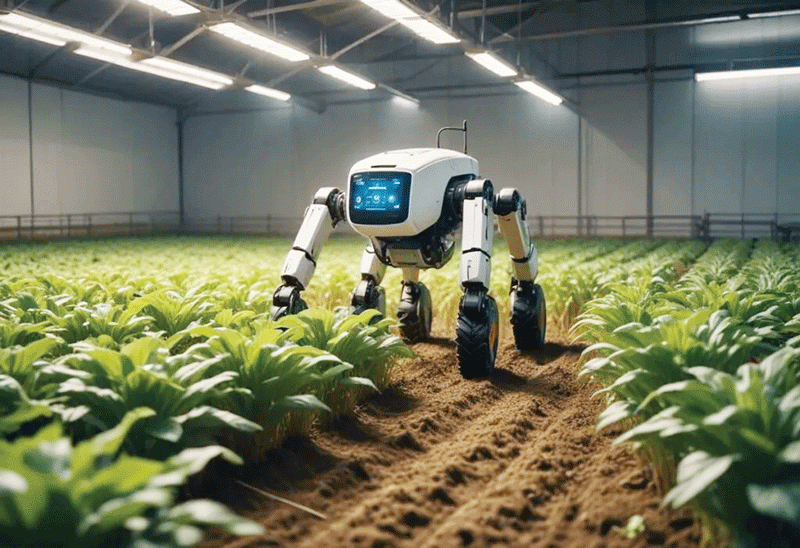
AI can revolutionize fields such as agriculture
The story of Artificial Intelligence (AI) is a fascinating journey that began in the mid-20th century, an era filled with scientific curiosity and exploration to understand human intelligence.
During this period, British mathematician and logician Alan Turing introduced the ideas of machines that can simulate human thought processes.
In his groundbreaking 1950 paper, Computing Machinery and Intelligence, Turing laid the foundations for AI and proposed the Turing test as a measure of machine intelligence.
Over the next decades, interest in AI grew, and researchers explored various paths to creating intelligent machines.
The 1956 Dartmouth Conference is often considered the official birth of AI.
The conference included visionaries like John McCarthy, Marvin Minsky, Nathaniel Rochester and Claude Shannon, who gathered to share the ideas and aspirations of AI.
The event led to the coined term “artificial intelligence” and set the stage for future research.
The 1960s and 1970s marked the first wave of AI, characterized by early success in problem-solving and inference programs.
Notable results include the development of a general problem solver (GPS) by Allen Newell and Herbert a Simon, and the creation of Eliza, a natural language processing program by Joseph Weisenbaum. Eliza demonstrated the potential of machines to understand and manipulate human language. However, the initial excitement was attenuated by the AI winters of the 1970s and 1980s.
These periods were characterized by a lack of funds and decline in profits, as they provided promising AI capabilities.
Despite these set times, the field continued to evolve.
Researchers shifted their focus to the development of rules-based expert systems and machine learning algorithms (MLAs), allowing computers to learn from the data and improve over time.
The revival of AI in the late 1990s and early 2000s was driven by the advent of the Internet, increased computing power, and the availability of large data sets.
This era saw the rise of deep learning, a subset of machine learning inspired by the structure and function of the human brain.
Deep learning led to breakthroughs between image and speech recognition, and promoted AI into the mainstream. Today, AI is an integral part of our lives.
From personal assistants like Siri and Alexa to sophisticated algorithms that drive cars, predict illnesses, and play complex games like chess at Go and Superhuman levels, AI continues to push the boundaries a machine can achieve.
Continuing research in areas such as reinforcement learning, natural language processing, and general AI is committed to further transforming understandings of technology, society, and intelligence itself.
Turing's journey from theoretical machines to today's advanced AI systems reflects notable advances in computational theory, the development of algorithms, and the relentless pursuit of understanding and emulation of human intelligence.
As AI continues to move forward, it has the potential to revolutionize many aspects of life and becomes an exciting field to watch.
Milestones in AI Development
The 21st century is characterized by rapid advances in AI, driven by breakthroughs in big data, increased computational power, and deep learning.
In 2012, Alexnet's victory at Imagenet Competition introduced the power of deep neural networks, sparking a renaissance in AI research and applications.
Openai's GPT model, which began with GPT-1 in 2018, revolutionizes natural language processing, allowing machines to generate human-like text.
AI timelines are dotted with such milestones, each building finally pushing the boundaries of what the machine can do.
AI, AI development in healthcare diagnostics, and integration of AI in everyday devices such as smartphones and home assistants are testament to the ongoing evolution of this field.
The ethical considerations and social implications of AI are also at the heart of discourse, as exemplified by the discussion surrounding the 2023 Llama model.[ Llama (Large Language Model Meta AI, previously written as LLaMA] This basically refers to the family of groups or autoregressive major models (LLMS) released by Meta AI since February 2023.
As AI continues to move forward, it is essential to look back at its history to understand its potential trajectory.
The AI development milestones not only chart courses of technological advancement, but also reflect changes in the relationship between humans and machines.
The critical reflection of AI evolution from the Turing test to the latest generation AI models provides clear evidence for human ingenuity and portrayals of future possibilities.
Zimbabwean ai
In Zimbabwe, the possibility that AI will promote socioeconomic development is immeasurable.
AI can revolutionize areas such as agriculture, healthcare and education, addressing some of the country's most pressing challenges.
For example, AI has the ability to provide solutions with AI-powered in Zimbabwe. This can improve agricultural productivity by providing farmers with real-time data on weather patterns, soil conditions and crop health.
In the healthcare industry, AI can come up with comprehensive and accurate diagnosis and treatment plans, making quality healthcare more accessible to all Zimbabweans.
However, adoption of AI in Zimbabwe is not without its challenges. Limited access to digital infrastructure, a lack of skilled professionals and the need for a robust regulatory framework are major barriers.
Strategies and policies must be devised to overcome these challenges.
The call is aimed at the Zimbabwean government through information and communications technology, postal and courier companies, and academia to collaborate and invest in AI research and development.
Through the development and nurturing of supportive ecosystems for AI innovation, Zimbabwe can leverage the transformational power of AI to promote sustainable development and improve the generality of Zimbabwean citizens.
When we look to the future, it is clear that AI will continue to shape our world in ways that can only begin to imagine our world.
We need to try as much as possible to understand its history and recognize its potential.
Through a carefully structured AI policy framework, Zimbabwe can ensure that AI functions as a force to promote progress and prosperity for all.
- Sagomba is a certified marketer and holds CMKTR, FCIM, MPHIL and PhD. Email: [email protected]. Social Media Handle: LinkedIn: @Dr. Evans Sagomba (MSC Marketing) (FCIM) (MPHIL) (PhD); X: @ESAGOMBA


