
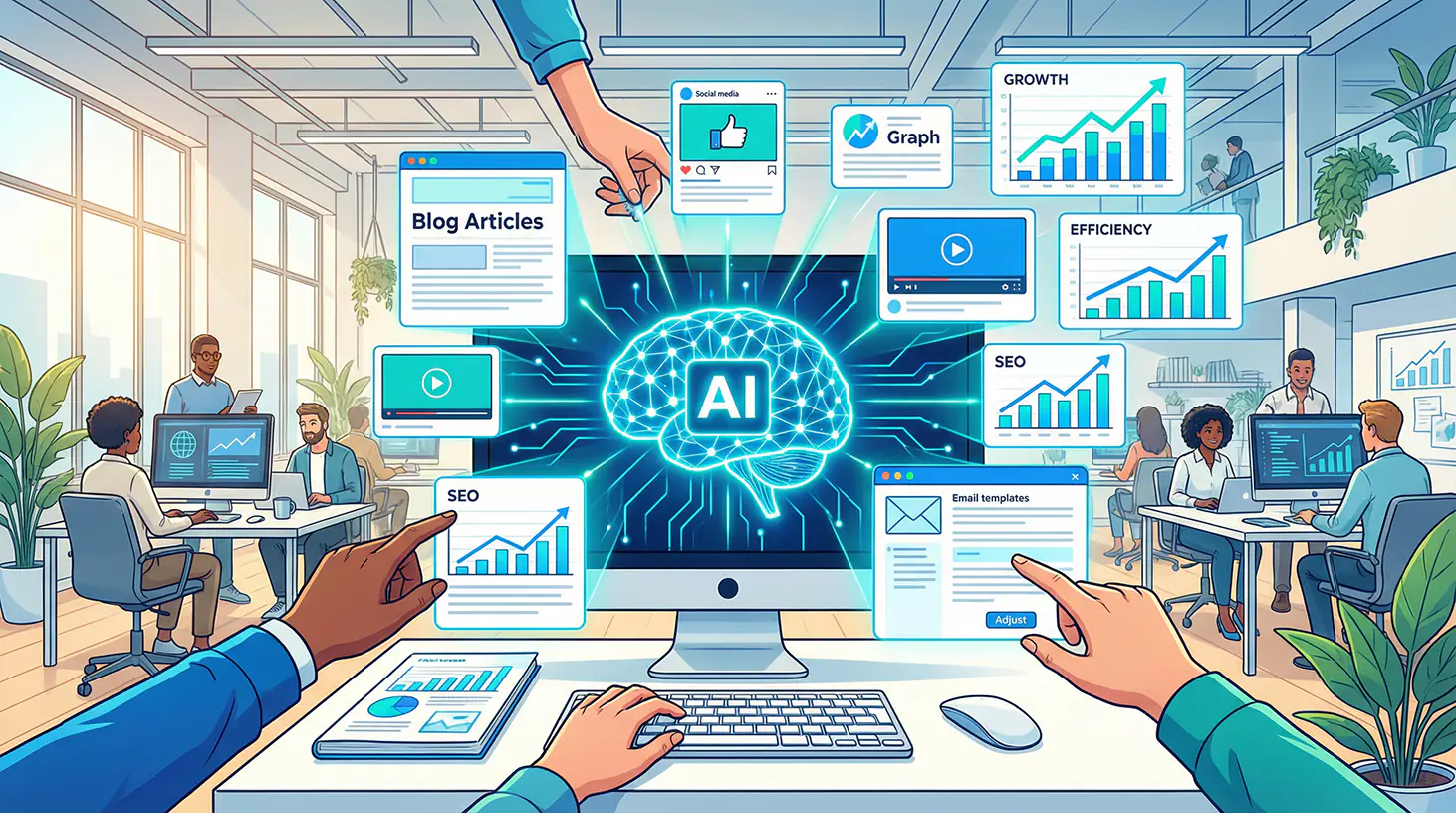
SEO dilemma: AI eats what AI creates
One of the most fundamental changes in content marketing over the past two years has been the advent of AI-powered search results. According to a Semrush study in late 2025, Google’s AI-generated reviews sometimes appeared on up to 25 percent of all search queries. As a result, click-through rates for organic search results for queries with AI-generated reviews decreased by up to 58%.
In layman’s terms, this means that AI is generating large amounts of content and at the same time creating search engine results pages that aggregate this content and serve it directly to users without having to click on the original website. For content marketers who base their strategies on organic search traffic, this poses an existential challenge. Today, those who rely solely on standardized content generated by AI may be creating content that is quickly sucked up by AI algorithms and redistributed without attribution.
Search engine optimization’s answer to this development is the concept of generative engine optimization (GEO). Content should be structured with AI citability in mind, using clear facts, statistical data, and clear definitions that AI can easily extract. At the same time, this content must be very unique and deep, beyond what the AI model can derive from its training data. In this environment, original research, case studies, expert opinion and ground-breaking analysis are more valuable than ever.
Google and other search engines are adjusting their algorithms to give more weight to EEAT signals such as experience, expertise, authority, and trustworthiness. Pure AI content that cannot recognize human expertise will be largely ineffective in search engine optimization by 2026. This is an important correction to the initial hype that AI content could generate rankings indefinitely.
Hybrid approach: humans and machines working together in tandem
The conclusions that can be drawn from all the available research and case studies are clear. The most successful approach to AI-powered content marketing is a smart division of labor between humans and machines, rather than complete automation. AI handles the research, structuring, initial text draft, and formatting. Humans are responsible for the storyline, tone, personal examples, positioning, and final quality control.
This hybrid workflow significantly increases productivity without sacrificing quality. Content teams that consistently follow this approach report a 3-4x increase in content output with the same resources. According to market data, investments in specialized AI tools range from $15 to $500 per month, and this amount has proven beneficial for companies of all sizes.
Strategic questions about which parts of the process should be handled by AI and which should remain in human control need to be answered on a company-specific basis. Management consultancies with complex expertise primarily use AI for research and construction, but require human expertise for actual analysis. On the other hand, e-commerce companies with thousands of product descriptions can automate much of the text creation and only supplement quality control and tone adjustment with AI.
The role of AI in delivery and analysis
The importance of AI is often underestimated, not only in content creation but also in distribution and analysis. AI tools help with scheduling and cross-channel distribution by analyzing when and through which channels specific content will have the greatest impact. Performance metrics are evaluated in real-time, and AI recommends adjustments to campaign parameters based on this data.
In email marketing, AI has taken personalization to a new level. Subject lines, send times, content, and calls to action are dynamically adapted based on individual user behavior. In B2B content marketing, AI also allows for more nuanced segmentation of prospects according to their position in the sales funnel. Content that is relevant to decision makers in the evaluation stage is fundamentally different from content that is aimed at attracting first-time website visitors. AI can make this distinction in real time and manage individual content journeys.
Risks and Limitations: What AI Can’t Do
To fully analyze the use of AI in content marketing, its limitations must be clearly defined. The most obvious limitation lies in originality. AI systems generate content based on training data. They can recombine, summarize, and reformulate existing material, but true creative originality, which comes from personal experience and deep domain knowledge, is not a skill that AI possesses.
Additionally, there are risks regarding factual accuracy. Generative AI models can generate statements that sound stylistically correct and convincing, but are factually incorrect (so-called hallucinations). In content marketing, this can lead to incomplete product information, inaccurate numbers, or misquotes. Therefore, quality control by human experts remains essential.
Another structural risk lies in the homogenization of content. When all marketers use the same AI model with similar prompts, the content produced tends to be homogenized. This is counterproductive to differentiating your brand through content. Algorithms and users increasingly realize that content is generic and interchangeable, and engagement responds with a decline.
Finally, there are legal and ethical issues. These include copyright issues when training AI models using existing content, transparency obligations for AI-generated content, and data protection aspects when processing user data for personalization. Particularly in Europe, where we have GDPR and AI legislation, it is imperative that we approach these issues carefully.
Agent AI changes the game again
The next big change in AI-powered content marketing is already on the horizon. Agenttic AI systems, or AIs that independently pursue goals and make decisions, will increasingly take over mundane content production tasks. Within the next year or two, these systems will be able to largely automate the creation, research, first draft, SEO optimization, and publication of briefings without manual intervention at each individual step.
This will once again change the division of roles between humans and machines. Human roles will shift from business execution to strategic management. Where should content marketing lead your brand? Which topics are truly relevant to your target audience? Which stories can only be told from personal experience? These questions remain the domain of humans, and will be more valuable than ever in a world where all daily tasks are automated.
For content marketing teams, this translates into a clear strategic priority. Investing in human expertise, domain knowledge, personal networks, and strategic storytelling skills will pay off in the long run. AI is a powerful tool, but it’s still just a tool. The strategic thinking behind content must remain human.
Embrace opportunities and understand risks
Overall content marketing trends research and available market data for 2026 paints a mixed picture. AI in content marketing is not just hype or a fringe phenomenon. This is a structural shift that is already changing the daily work of millions of marketing professionals. The adoption curve is steep, efficiency is steadily increasing, and the range of applications is constantly expanding.
At the same time, the numbers show that AI alone cannot create competitive advantage. When 95% of B2B marketers use AI, the use of AI will no longer be a differentiator, but just a prerequisite. The real competitive advantage lies in the quality of human expertise that AI guides, corrects, and enhances authentic knowledge and unique perspectives. Those who understand this and structure their content marketing processes accordingly will benefit from the AI revolution. Those who mistakenly believe that AI will replace human thinking will produce more, but not more.


