Machine learning aims to predict outcomes with greater accuracy and identify trends that humans might miss if relying solely on traditional statistical methods.
For businesses, these capabilities represent a competitive advantage, which is why machine learning (ML) is seeing growing adoption in the enterprise, used in a variety of functions from strategic planning to security. In addition to these horizontal applications, ML can address the specific needs of vertical markets and support digital transformation initiatives.
What is the purpose of machine learning?
Machine learning algorithms look for patterns in data and can improve over time as the algorithm receives more data.
The prospect of better predictions aligns with the data-driven aspirations of enterprises. For such organizations, ML can provide recommendations, forecast customer demand, and support the enterprise decision-making process. The technology is also driving other AI developments that are set to see adoption in the enterprise, most notably generative AI.
Beneficial ways to use machine learning in your business
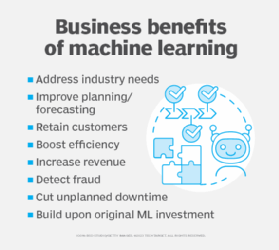
With that in mind, here are eight key benefits of machine learning for your business.
1. Analyze historical data for customer retention
The ability to develop customers is one of the main reasons for adopting ML. Customer churn is a major pain point for businesses. ML helps businesses identify which customers are likely to leave.
“This is by far the biggest problem our customers have, across a range of industries and company sizes, both on long-term and monthly contracts,” said Matt Mead, chief technology officer at SPR, a Chicago-based technology modernization firm.
We found that the greatest financial benefits come from locating analytics as close as possible to key revenue streams.
David FriggeriManaging Director, Slalom
Customer retention is fundamentally a classification problem. Mead said this machine learning task involves looking at the characteristics of a company's customers, i.e. historical information about who churned and who stayed, and their different behaviors. Clients can use that analysis to establish “white glove programs” for potentially at-risk customers, Mead noted. Companies can work to improve customer satisfaction and build stronger relationships, he added.
David Frigeri, managing director of East Coast AI strategy at business and technology consulting firm Slalom, also cites customer retention as a benefit of ML.
“We've found that what pays off most from a financial perspective is when you put analytics capabilities as close as possible to your primary revenue streams,” he said. “So building better customer experiences, improving customer retention and increasing customer lifetime value through better products and services is a horizontal focus that spans all of our major verticals.”
2. Reduce unplanned downtime with predictive maintenance
Another ML application in high demand is predictive maintenance for fixed or long-term capital assets, Mead said, where ML identifies equipment that is likely to fail. Organizations can then use that insight to schedule downtime and make repairs, avoiding costly outages that disrupt clients, Mead said.
According to Vantage Market Research, the global predictive maintenance market is expected to reach $19.3 billion by 2028, growing at a compound annual growth rate of 30%.
3. Implement a recommendation system to increase revenue
Netflix and Amazon provide high-profile examples of using ML to build recommendation systems that suggest new products and services based on customers’ purchase history.
“These are some really interesting, very public implementations of ML in the spirit of personalization,” Mead noted.
This ML use case not only creates greater value for customers, but also creates up-selling and cross-selling opportunities for businesses, thus allowing recommender systems to generate new revenue streams for businesses.
4. Improve planning and forecasting
Since ML is primarily about making predictions, the technology provides a natural platform for planning and forecasting activities.
ML can help companies predict future cost, demand and price trends, making budgeting easier and protecting a company's financial outlook, Mead said. “This is a big area of the work we do for our clients,” he noted.
Within the enterprise, the role of enterprise strategist stands to benefit from the growing adoption of ML: The trends they must consider — and the pace at which they analyze them — are fundamentally different in light of the COVID-19 pandemic, said David Akers, research director in Gartner's Strategy Research Group.
The business benefits of machine learning include customer retention, revenue generation, and cost reduction.
AI technologies can bring additional insights and efficiencies to processes. Yet, according to a Gartner study published in July 2023, only 20% of 200 enterprise strategy leaders surveyed are using tools such as ML. However, adoption appears to be on the rise, with 51% of respondents saying they are investigating ML.
ML predictive modeling can enhance the foresight needed for strategic decision-making and help companies “see ahead,” Akers noted. He cited the importance of unsupervised ML and its ability to “identify new opportunities that are invisible through traditional analytics.”
Unsupervised learning models can discover patterns in unstructured data without the need for humans to train the data sets.
5. Evaluate patterns to detect fraud
ML and its pattern recognition capabilities are helping in fraud detection.
Mead said he sees clients deploying off-the-shelf fraud-detection software, but he also sees a fair amount of custom implementations.Fraud detection is often associated with financial services companies looking for anomalies in credit card transactions.
But Mead noted broader applicability.
“We've worked with clients to identify fraudulent accounts across all industries,” he said, including helping e-commerce companies flag fraudulent orders.
6. Meeting industry needs
While ML has broad applicability, organizations can also leverage the technology to meet vertical market requirements. Here are some example industries to consider:
Financial operations. Companies in this space are also benefiting from a variety of ML use cases. Capital One, for example, deploys ML in its credit card defense, which the company places under the broader category of anomaly detection. In fact, the company uses ML to look for warning signs across its credit cards, auto loans, and lines of credit businesses.
Pharmaceuticals. Drug maker Eli Lilly built an AI and ML model to find the best locations for clinical trials and increase participant diversity, which the company says has significantly shortened the length of clinical trials.
Manufacturing industry. Predictive maintenance use cases are prevalent in manufacturing, where equipment failures can lead to costly production delays. Additionally, computer vision capabilities of ML, an emerging technology in the manufacturing market, allow for inspection and quality control of products coming off the production line.
insurance. Applications of ML in the insurance industry include recommendation engines that suggest options to customers based on their needs and how other customers have benefited from a particular insurance product. Such systems help advisors target the most relevant offers for their customers, facilitating cross-selling.
retail. Computer vision technology plays many roles in retail, including loss prevention, personalization, inventory management, and style and color planning for specific fashion lines. Demand forecasting is another key use case.
7. Build on your initial investment
Another benefit is that initial ML investments can produce multiple benefits—for example, retailers that create data sets to forecast product demand have the opportunity to scale that investment further, Friggieri says—but companies may not be aware of it.
“You create a gentle barrier of low expectations when you think, 'Our demand forecasts are going really well and that's it,'” he said.
But datasets built for demand forecasting can also help retailers predict out-of-stock situations, Frigeli noted. And if a retailer can predict when they'll run out of a particular product, they can build recommendation systems for safety stock — substitute products that can be used as a buffer against a rainy day. Other retail groups, like email marketing, can also use demand forecasting data.
“You can actually get a lot more out of the same amount of investment, but you have to be really careful,” Frigeri said.
8. Increase efficiency and reduce costs
ML-powered automation can help companies save money through reduced labor and increased efficiency.
Customer service is one area where machine learning is likely to reduce costs. Gartner It is estimated that conversational AI, combining ML and natural language processing (NLP), will reduce contact center agent labor costs by $80 billion by 2026.
Mead said organizations are starting to question whether chatbots, powered by additional generative AI, can reduce the number of call center agents and improve call handling times.
Replacing call center agents with chatbots is one possibility. But Mead believes using chatbots to assist human agents and reduce call handling times is a more creative use of the technology. The idea is to have the chatbot listen to the conversation, understand the context, and assess the customer's sentiment. Combining that insight with NLP analysis of previous call recordings, the chatbot can offer advice to the agent interacting with the customer, Mead noted.
Meanwhile, generative AI will open up new avenues of efficiency, said Zakir Hussain, Americas data leader at consulting firm EY, citing research from MIT and Microsoft that shows it can achieve 44% time savings in specialized writing tasks and 55% reductions in programming time.
The advent of generative AI will change the nature of programming, he said.
“It's not about coding anymore,” Hussain said. “We've moved into an era of coding with AI, and then it's about what you do with it. [output] To make sure that what is being generated is actually correct.”
In this scenario, Hussain predicts that many developers will become “data wranglers.”
But Friggieri said automation, while important, shouldn't overtake the ability of machine learning to deliver new customer experiences.
“Automation has had a huge impact on many organisations in terms of increasing productivity, but it's first and foremost about the customer,” he said.