Many company leaders are considering integrating AI into their business processes to gain a competitive advantage in their industry, and generative AI could help optimize key supply chain processes.
Generative AI (GenAI) is an emerging technology that is gaining popularity across a variety of business sectors, including marketing and sales. By analyzing an organization's data, GenAI has the potential to improve operational efficiency and supply chain resilience.
However, users should be aware of concerns about a phenomenon known as AI hallucination, which could hinder GenAI's ability to improve supply chain operations.
Learn more about generative AI and its specific use cases in supply chain.
What is generative AI in supply chain?
At the consumer level, the GenAI process consists of entering commands or questions into text, image, or video fields, prompting the AI to generate new content. GenAI models are typically trained on large data sets, and when a user inputs new data, the application uses the new data and previously learned knowledge to create new content.
Users can train GenAI with data covering all aspects of their supply chain, including inventory, logistics, demand, etc. By analyzing an organization's information, GenAI helps improve supply chain management and resilience.
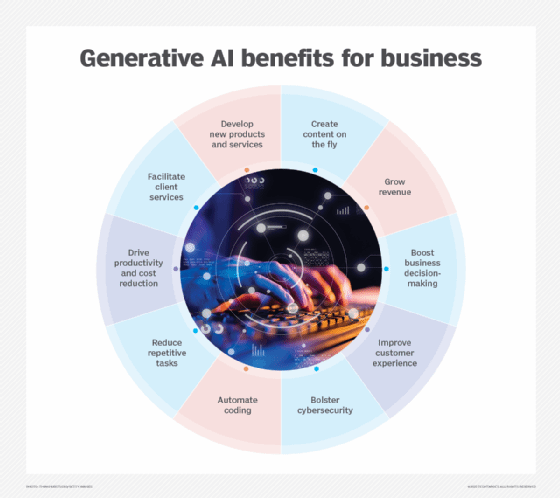
7 Use Cases for GenAI in Supply Chain
Before adopting GenAI applications in their supply chains, supply chain leaders should consider which GenAI capabilities align with their company’s goals and evaluate the applicable benefits and limitations.
Here are some potential use cases for supply chain management.
1. Demand forecast
The early days of the COVID-19 pandemic saw consumers shift spending from services to goods, creating rapid shifts in demand and unpredictable supply chain operations, demonstrating how important it is for businesses to anticipate shifts in demand.
Organizations can use GenAI models based on historical sales data, market trends, and other factors to simulate potential demand and supply scenarios to improve the accuracy of their demand forecasts. By tracking demand patterns, organizations can mitigate disruptions and avoid inventory issues.
2. Inventory Valuation
GenAI could also help improve inventory management.
Trained on key data such as stock levels, warehouse capacity, and production times, GenAI can help reduce excess inventory by suggesting ways to optimize inventory processes, including recommending when to replenish or reduce stock. Storing excess product costs companies money, so reducing excess inventory can save money.
3. Communication with suppliers and customers
Frequent communication between companies and suppliers, and companies and customers, is key to an efficient supply chain, but making that communication as effective as possible can be difficult.
GenAI can automatically send messages, eliminating the need for employees to do so. Large-scale language models and natural language processing allow the GenAI chatbot to notify suppliers of risks by ingesting data from sources such as market events that may affect suppliers or traffic delays related to specific shipments. The GenAI chatbot can also handle some customer inquiries, such as processing returns or tracking deliveries.
4. Operation
New technologies and fluctuating demand can lead to operational challenges, but GenAI may be able to suggest ways to improve.
GenAI can evaluate aspects of operations, such as supplier performance or production speed, and suggest ways to optimize procedures. These optimizations can provide companies with a range of benefits, including cost savings.
5. Logistics
Logistical disruptions can cause a variety of problems: traffic accidents can delay shipments, or extreme weather can create unexpected shortages that make it difficult to maintain expected shipping schedules.
Armed with data like historical weather patterns, traffic maps, and fuel prices, GenAI models can identify optimal travel routes and highlight upcoming disruptions and alternative routes if needed, ensuring orders aren't delayed, keeping shipments on schedule and improving customer service.
6. Sustainability and Scalability
Sustainability is now a big focus for many organizations, and GenAI could highlight areas where there is room for improvement.
Training GenAI models based on a company's current material use and market forecasts for renewable materials can provide insights into how to make processes more sustainable while considering cost-efficiency and long-term scalability.
7. Analysis
GenAI can run simulations and potential what-if scenarios, assess risk, and compile findings into a report.
As with all other use cases in the GenAI supply chain, GenAI and the models that underpin it are still evolving, so caution is advised when using the technology. Current concerns include inaccurate data and incomplete output, also known as AI hallucinations, which can hinder effective use.
Jacob Roundy is a freelance writer and editor specializing in a variety of technology topics, including data centers and sustainability.