
According to the survey, 61.2% are currently using AI or machine learning in live environments.
According to the Money 20/20 whitepaper, generative artificial intelligence (AI) is moving from pilot projects to real-world use across the Asia Pacific (APAC) financial sector, with 61.2% of organizations already implementing AI or machine learning technology.
A further 35.3% are still considering it, and 3.5% have not yet adopted the technology, the report “2026: The Future of Fintech in APAC” found.
Machine learning has been used for years in areas such as credit scoring, fraud detection, and anti-money laundering, but now generative AI is expanding the way financial institutions manage data, customer interactions, and internal processes.
Generative AI systems are increasingly used to analyze unstructured data, support natural language conversations with customers, and orchestrate complex workflows.
The technology is also evolving into “agent AI,” where systems can plan and execute tasks rather than just generating text.
One example highlighted in the report involves OCBC Bank. A customer filed a complex complaint that previously required staff to manually categorize the issue and create a response.
The bank’s generative AI system, called “Listen and Respond,” processed the feedback in real-time and provided an immediate response.
The bank said the system has improved its Net Promoter Score by 20-30%.
Mizuho Bank is also using AI to improve internal operations and customer service.
The bank introduced internal tools that allow service agents to quickly access customer history and find answers more efficiently.
Multimodal AI systems are also being tested to process audio, video, and emotional data simultaneously, giving staff a broader view of customer needs.
Despite widespread adoption, financial institutions remain wary of the risks associated with AI decision-making. Industry participants expressed concern that basing credit decisions solely on historical data could reinforce gender stereotypes and historical biases.
Some respondents expressed concerns about the lack of transparency in generative AI systems and the challenges of meeting evolving regulations.
To manage these issues, banks are increasingly using regulatory and supervisory technology tools to support compliance and risk management.
These systems use AI to help institutions meet regulatory requirements while continuing to develop new services.
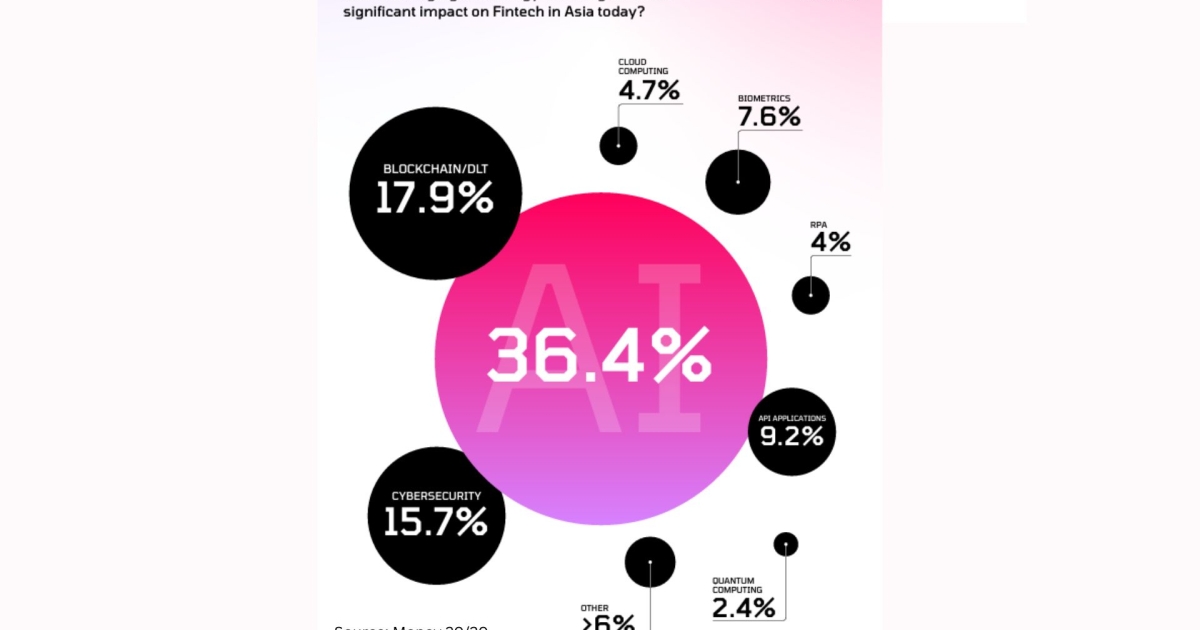
The report also asked respondents which emerging technologies are having the biggest impact on fintech in Asia today.
AI ranked first with 36.4%. Blockchain and distributed ledger technology followed with 17.9%, followed by cybersecurity with 15.7%. 9.2% of respondents cited API applications and 7.6% cited biometrics.
Cloud computing accounted for 4.7%, robotic process automation 4% and quantum computing 2.4%. Other technologies accounted for just over 6%.
The report concludes that the financial industry is moving from AI as a chatbot tool to AI as autonomous systems capable of performing tasks.
However, many respondents believe that the most significant effects of this technology are still yet to be seen.


