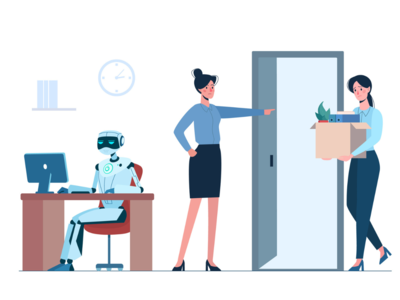
In a world where the new normal is competing for artificial intelligence, former Google X executives are asking questions they want to face. Will your job still exist in five years?Mo Gawdat, former chief business officer and author of Google X, has become an honest voice on the ethics, risks and future of AI. In a recent interview shared on YouTube, Gawdat provided a grounded but calm assessment of how white-collar and blue-collar jobs are redefine, often erased by machines, which are thinkers and not tools anymore.“Machines replaced the labor force,” he said. “And we're going to replace the human brain.”He argues that this change is not hypothetical. It's already been unfolded.
The quiet collapse of white-collar certainty
Gawdat points out that for decades, the Western economy has been intentionally moved from manual labor and manufacturing, due to outsourcing to developing countries. The idea was to create a “service economy” that was strengthened by information workers, analysts, designers, consultants and content creators.But in his words, “A knowledge worker is someone who uses information to click on the keyboard and move the mouse to sit in a meeting.” And now, “Everything we produce can be produced by AI.”He gives examples of hits that are close to home for many experts. Imagine someone being given a plot of land and asking AI to design a villa. AI takes into account land coordinates, user preferences, light requirements and desired materials. It returns a complete architectural plan in seconds.“What does an architect do?” he asks. “The best and best architects use AI to generate it, or you consult them. But how many of them will remain?” This is at the heart of his argument. AI not only makes workers faster, but it completely replaces many of them.
Two phases: Enhancement and exchange
To better explain the path ahead, Gawdat distinguishes between two eras: Extended intelligence and mastery of machines.In the first phase, AI supports human productivity. Assistants, interns and experts use AI tools to generate reports, brainstorm ideas, and reduce manual tasks. “Now, the more tasks you have, the more bandwidth and ability to do tasks like caring for your dog or meeting guests,” Gawdat says. These are tasks based on human connections rather than data.However, the second phase is more destructive. In the age of machine learning, AI completes jobs from end to end, with no humans in the loop. At that point, Gawdat believes that work will disappear on a massive scale. “This job is done entirely by AI with no human in the loop,” he said.This transition can occur much faster in white-collar roles than physical work.
Why do blue-collar jobs survive longer?
Although AI has already surpassed many white-collar workers, robots have yet to completely replace human physical abilities. According to Gawdat, this is not due to lack of ambition, but to a design bottleneck. “I don't think they're ready because the robotics community is stubborn about making humanoids,” he said. “It takes so much time to complete human-like behavior at the right speed.”He points out that self-driving cars are already operating in parts of California, but the robotics of warehouses and homes are still behind. Replacing manual labor could take another four to five years, and still there is a delay in the production of sufficient robots.“That cycle takes time. Blue collars stay longer,” he says. But it will never be spared.
What about entrepreneurship?
One of the most obvious moments in the Gawdat interview is when we challenge the assumption that everyone can simply mature or become an entrepreneur.He recalls conversations with Peter Diamandis and others who said the American people would pivot through resilience. “Seriously? Are you looking for a truck driver who will replace self-driving trucks to become an entrepreneur?” he asks. “Store yourself in real people's shoes.”His point is not only about skills, but also about economic justice. “Do you expect a single mother with three jobs to become an entrepreneur?” he says. “If our society is sufficient, that single mother should not need three jobs.”
What do you need to change now?
The ultimate attraction of Gawdat is not to slow down AI development, but to give boundaries. “The best thing I can do is put pressure on the government to not regulate AI and establish clearer parameters regarding the use of AI,” he says.He believes that all AI products need to be designed with an ethical mirror. “Don't invest in AI that doesn't want your daughter to be on the receiving end,” he says, speaking directly to technology leaders and investors.He also wants to be accountable for the content. “If someone creates an AI-generated video or content, they must mark it as AI-generated.”
Ultimately, the future is personal
Beyond policy, his message is back to something deeper. As intelligence becomes artificial, the value of being human must become more intentional. “I'll leave the phone and go outside and meet people,” he urges. “Touch someone you know.”And when the truth itself feels like it's being rewritten by an algorithm, Gawdat reminds us to go back to a timeless ethic. “Treat other people the way you like being treated,” he says. “That's the only truth. Everything else has not been proven. ”For today's experts, students and institutions, his message is not about fear, but about preparation. There hasn't been an AI shift. here it is. Whether or not your job will survive depends on its ability to no longer depend on your degree and to maintain a useful and ethical humanity.TOI Education is currently available on WhatsApp. Follow us here.