

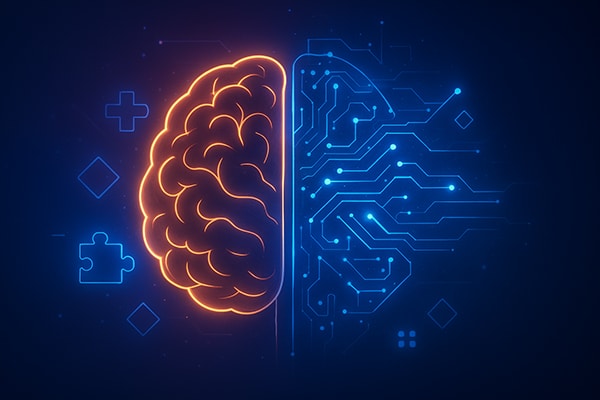
By combining the structure of symbolic AI with the flexibility of statistical AI, hybrid inference reduces hallucinations and allows AI systems to provide more accurate and reliable answers.
Today we are surrounded by AI. New terms appear all the time, but many disappear quickly. But every once in a while, a concept emerges that deserves attention. In my opinion, hybrid reasoning is one such concept.
When I first encountered this word, I wondered about its true meaning. Was it just a technical term? The deeper I dug into it, the more I realized that it was directly related to how humans think and make decisions every day.
Understanding human reasoning through examples
Let's explain this with a scenario. You're at work, doing routine tasks, when your manager says, “I have an urgent problem. Can you help me solve it?” I agree without hesitation and resolve it. This rapid and almost automatic response represents a type of reasoning.
Now let's consider another scenario. Late Friday night, your boss presents you with a new task: a request from the CEO. You stop, consider your options, and choose your response carefully. This slow, deliberate thought process represents another type of reasoning.
Hybrid inference combines these approaches. That is, fast, rule-based responses and slower, statistical, probability-based inferences. When applied to artificial intelligence, something powerful emerges.
Evolution of artificial intelligence
Before exploring hybrid inference further, I believe that understanding the evolution of AI provides important context.
Artificial intelligence has been around since the 1950s. Early systems were rule-based and operated with fixed logic. Credit card fraud detection has flagged a transaction that doesn't meet certain criteria. Spam detector blocked emails from certain domains. These were completely symbolic, logic-driven systems.
Then, we moved beyond fixed rules and ushered in the era of machine learning. Instead of predetermined logic, the system learned from the data and inferred patterns and relationships through statistical, probability, and regression models. This allows us to work with unstructured data and discover patterns that our rules could not capture.
The past 15 years have ushered in the era of deep learning. Scientists asked, “How can machines think like humans?” Inspired by the structure of the brain, they created an artificial neural network with multiple layers of connectivity. In other words, it is called “deep” learning, which refers to layered processing.
This evolution led to the emergence of today's large-scale language models and hybrid inference.
Solving the mysteries of large-scale language models
Large-scale language models (LLMs) have become a popular term through platforms like ChatGPT and Claude. But what exactly is an LLM?
I think of LLM as a large-scale statistical engine trained on vast amounts of internet text, from GitHub to Wikipedia. Learn patterns of relationships between words and phrases. In the LLM world, these building blocks are tokens, the smallest units of text such as words or word parts.
For example, if you ask an AI system to fill in the blank with “Bengaluru is ___”, the AI system looks at all the contexts in which “Bengaluru” appears in the training data. This determines “city” as the most likely next token, but it may also respond with something poetic like “capital of Karnataka”, “Silicon Valley of India”, or “romantic”, all based on probability.
This means that LLMs do not truly understand language as well as humans. Generate responses based on statistical token relationships. The authors admit that they work like black boxes, but no one fully understands how a particular output is produced.
Challenge to illusion
One of the big challenges of the LLM is hallucinations. Because these models rely on probabilities, they can produce information that appears to be correct but is actually incorrect. Early GitHub Copilot versions often generated non-existent code snippets, leaving developers wondering when such code was published.
This is where a rule-based system comes in handy. You can reduce illusions by adding a symbolic layer that enforces rules and constraints. This combination of statistical and rule-based inference is the essence of hybrid inference.
How hybrid inference works
From my perspective, hybrid inference combines the structure of symbolic AI with the flexibility of statistical AI. Symbolic AI provides rules and constraints, while statistical AI provides adaptability. Together, they provide more accurate, reliable, and context-appropriate output.
Hybrid inference includes two components.
- Quick thinking: A rule-based symbolic system that executes immediately, whether or not the rules are satisfied.
- slow thinking: Statistical inference that splits complex queries into subproblems, analyzes them, and combines the results.
When a query is received, the system determines whether both thinking types are needed and combines them in the final response.
real world applications
Let me give you a practical example that shows the value of hybrid reasoning.
Consider working with large legacy codebases, as every change risks breaking something else. Relying solely on LLM can generate statistically likely but contextually incorrect suggestions. However, introducing symbolic reasoning through rules and knowledge graphs provides constraints that improve accuracy.
Another example involves sensitive queries. Certain LLMs, such as DeepSeek, avoid controversial political questions. When asked directly about the failures of political leaders, they refuse to answer. However, with hybrid inference, you can design workflows that reshape queries and elicit fact-based responses without breaking rules.
I believe that the value of hybrid inference lies in integrating symbolic inference, statistical inference, and search techniques like RAGs to ensure that the output is accurate, contextual, and tailored to the user's needs.
Main benefits
In my experience, hybrid inference has some clear advantages.
- Improved accuracy: Combining symbolic and statistical approaches reduces illusions and provides more factually correct answers.
- Improved trust: Symbolic reasoning increases transparency and increases the reliability of the system, allowing users to understand how the output is derived.
- Increased efficiency: Instead of endless prompt repetitions, hybrid reasoning yields better responses in fewer trials.
- Increased flexibility: The system adapts to a variety of situations, whether dealing with sensitive political topics or the technical challenges of legacy systems.
Challenges and limitations
However, hybrid inference is not without its challenges.
- Increased complexity: Adding system layers means symbolic inference, statistical inference, and RAGs need to work together seamlessly.
- Data quality dependencies: If the input data is poor, the output will also be poor. This is the classic “garbage in, garbage out” principle.
- Computationally expensive: More layers require more processing and increase the cost of queries.
These challenges make optimization and fine-tuning essential in real-world applications.
future
This field is rapidly evolving in several promising directions.
- Agent-based AI: Specialized bots handle certain tasks more efficiently.
- Neurosymbolic AI: Stronger synergy between rule-based and statistical systems.
- Quantum learning: Early explorations combining quantum computing and machine learning.
- Ethics and governance: A stronger framework to ensure responsible use of AI.
I believe that hybrid inference is not just a buzzword, but a meaningful step forward in AI evolution. By combining the strengths of symbolic and statistical inference, we can build more accurate, reliable, and flexible systems.
Whether solving coding challenges, mitigating hallucinations, or addressing sensitive queries, hybrid inference provides a balanced path. It reflects how humans think. Sometimes we rely on intuition and rules, and sometimes we stop and weigh probabilities and scenarios.
For me, the excitement isn't just about the technology, but the possibilities it offers. If a system designed to avoid controversial answers can provide nuanced insights through hybrid reasoning, imagine its potential for enterprises, legacy systems, and everyday workflows. This is why I think hybrid inference deserves to be understood and adopted as AI innovation advances.
This article is based on Laxminarayan Chandrashekar, a technical architect at Siemens Technology, who gave a keynote at AI DevCon titled “Harnessing the Power of Hybrid Reasoning.” Transcribed and supervised by OSFY journalist Vidushi Saxena.


