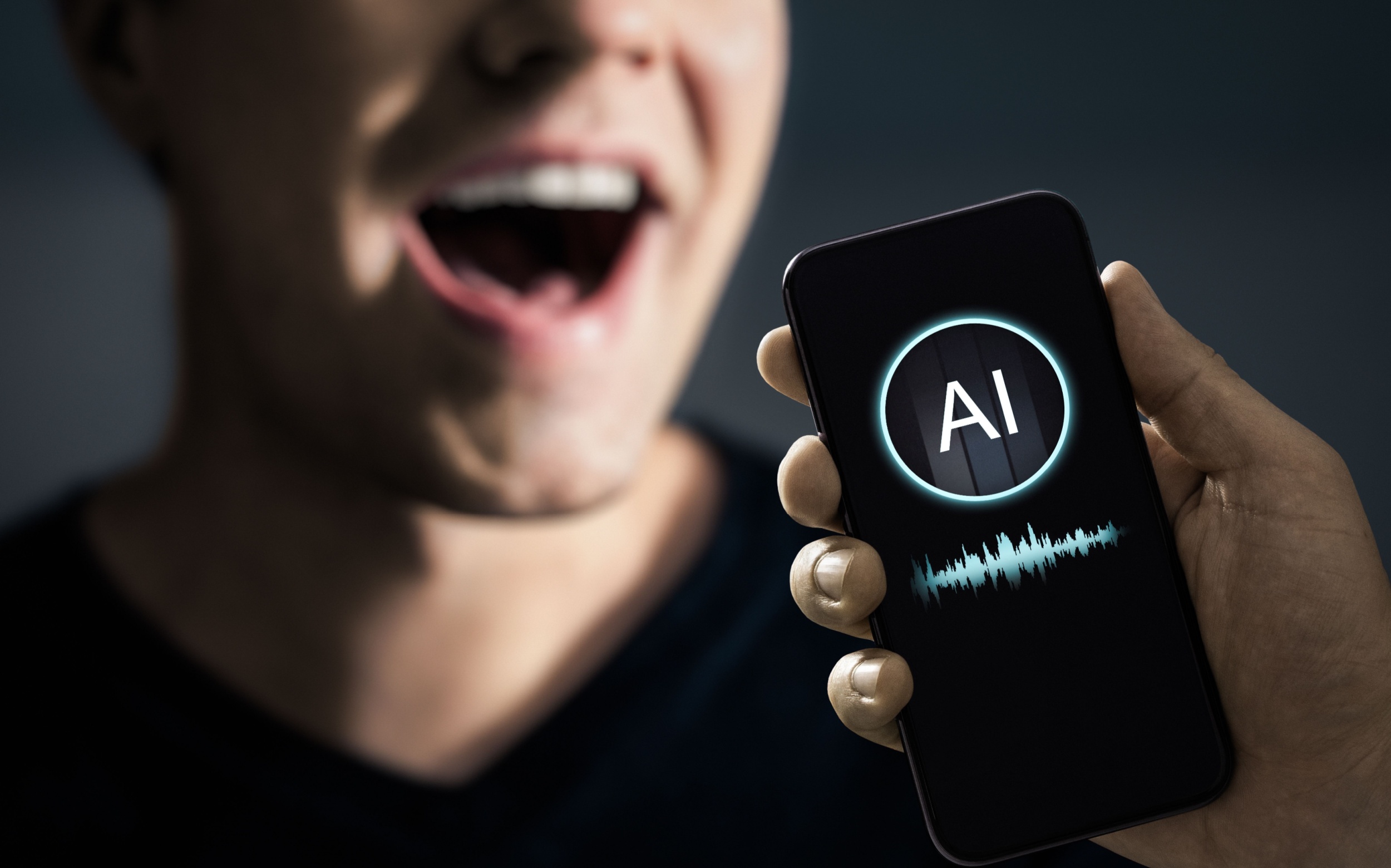
Synthetic voices are already ubiquitous everywhere from virtual assistants to automated customer service calls. But new research suggests that the latest kind of artificial voices may have unexpected advantages over real humans.
In noisy situations, a voice clone may be easier to understand than the human voice it is copied from.

Researchers from University College London and the University of Roehampton investigated how well listeners can understand human and cloned voices in background noise.
The results surprised even the researchers. Rather than sounding worse or more jerky, the cloned voices consistently came out forward.
How does AI copy human voice?
Voice clones are not exactly the same as the old synthetic voices most people know from Siri, Alexa, or satnav systems. These traditional voices typically rely on hours of recording by voice actors.
In contrast, voice cloning can recreate a near-human voice from just a few seconds of speech, making the technology much easier to use and more scalable.
This also means that the number of possible voices suddenly increases significantly. You no longer need to spend hours in a studio hiring professional speakers because you can copy almost anyone’s voice from a very short sample.
This opens the door to all sorts of uses, from accessibility tools to entertainment and even more sinister applications like identity theft and fraud.
Testing speech intelligibility in noise
However, the research itself focused on a narrower scope: simple comprehension. How easy would it be for the average person to understand these cloned voices? Researchers expected the clones to struggle. That would have made intuitive sense.
Machine-generated copies of speech, especially those constructed from short samples, sound unnatural and are difficult to understand. However, this was not the case.
“I initially thought that voice cloning would be less familiar and therefore less understandable,” said study co-author Patti Adanku, professor of speech recognition and speech production at UCL.
“We found that the voice clones were up to 20% more audible, which was quite shocking. A small part of our paper talks about that experiment, but the bulk is me and my collaborators desperately trying to figure out what makes those voice clones more audible.”
Test your AI voice
To investigate this question, researchers compared human voices and cloned versions of them in noisy listening environments.
They compared 10 human voices and 10 clones across four different signal-to-noise levels in an online experiment with 80 participants.
The results showed that cloned voices were easier to understand, with as much as a 20% improvement in intelligibility.
What’s particularly interesting about this is that the effect didn’t disappear even when the researchers changed the audience or listening conditions.
Cloned voices are easy to understand
After the first round, the researchers repeated the work with older volunteers to see if the patterns changed with hearing loss.
Since the first group was British, they repeated it with American listeners, and then tested a filter intended to mimic cochlear implants.
In both cases, the cloned voice was easier to understand. It’s this consistency that makes this finding difficult to dismiss as a fluke.
The explanation would be simpler if the cloned voice only performed better in one narrow setting. However, this advantage was maintained across different groups and conditions.
This suggests that there is something systemic going on in the way these voices are produced.
Where AI voice can help
At first glance, this may sound like an interesting technical result, but nothing more. However, synthesized speech is actually very important as it is rapidly becoming a part of everyday life.
If a clone’s voice is clearer than a human’s voice even in noisy environments, it could be attractive for public announcements and as an aid. Navigation systems and communication technologies designed for people with hearing loss may also be improved.
At the same time, the same benefits can make the clone’s voice seem more convincing and authoritative than it really is.
Audio that cuts through noise more effectively will feel smoother, more controlled, and may even be more believable in some situations.
That raises a different kind of question. The newspaper doesn’t really answer that question, it remains quietly in the background. If AI voices are easier to understand than humans, how much of our listening environment will shift to AI?
Why AI sounds better
The results also tell us something interesting about human speech itself. Authentic voices come in all kinds of variations. They are shaped by hesitations, breaths, emphasis, accents, roughness, and countless small imperfections.
Voice cloning can quietly smooth out some of the annoying details that make real voices difficult to hear in poor listening conditions, while still fully preserving the identity of the original speaker.
Although it hasn’t been proven yet, it could be one reason why clones may be better than human voices. This last point is an inference based on reported findings and is not conclusively established by research.
The mystery of artificial voice
At this time, researchers still do not have a definitive answer as to what is causing the effect. That uncertainty is part of what makes this study so compelling.
“I’ll try to reproduce it now. [the effect] We can understand this better by studying how synthesizers work and how digital signal processing is used to generate sound,” Adanku said.
So the surprise is no longer whether the clone’s voice matches the real one. In this study, they seemed to perform better.
The real mystery is why. If researchers understand this, they might learn something not only about artificial voices, but also about what kinds of sounds make it easier for the human ear to trust and follow them in the first place.
This research Journal of the Acoustical Society of America.
—–
Like what you read? Subscribe to our newsletter for fascinating articles, exclusive content and the latest updates.
Check us out on EarthSnap, the free app from Eric Ralls and Earth.com.
—–