/file/dailymaverick/wp-content/uploads/2025/10/label-Op-Ed.jpg)
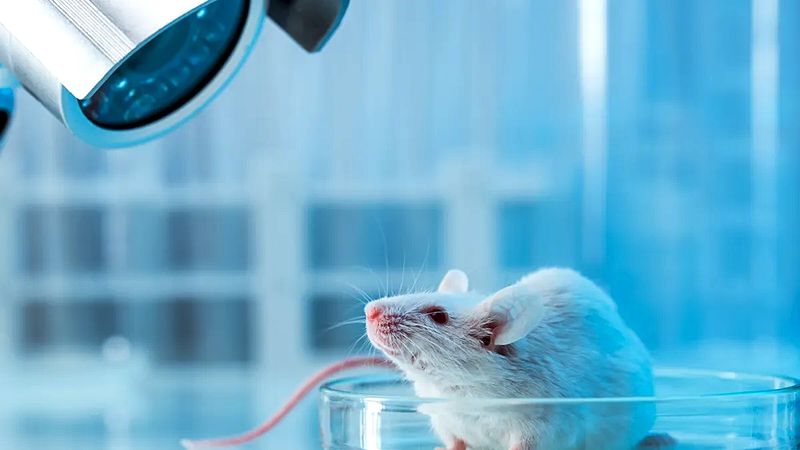
Every 24 hours, between 100 and 200 million animals die brutally in laboratories around the world. Mice, rats, rabbits, dogs, and primates are being exploited in the name of science and progress. For years, we have been told that their suffering is “necessary” to keep our medicines and cosmetics safe. But this is just a mistake. The future of medical testing is no longer cowering in a cage. It’s written in code.
Artificial intelligence models can now predict drug toxicity, organ damage, and chemical hazards with accuracy comparable to (and in some cases greater than) non-human animal experiments. The moral basis for animal testing has always been clear, but now the scientific basis has also collapsed.
Machine learning models trained on molecular structure and biological data can now predict acute oral toxicity with 80% to 92% accuracy (Allen et al, 2019). An AI system that analyzes cardiac tissue data predicts six major types of drug-induced cardiac damage with 79% accuracy for known drugs (Mamosina et al, 2020). For skin allergy, one of the most common safety tests, a consensus AI model approved by the Organization for Economic Co-operation and Development (OECD) achieves 80% accuracy and completely eliminates the need for specific animal assays (Imamura et al, 2026).
Traditional animal testing has always been a crude substitute. Rats are not humans. Beagles’ livers do not process drugs like human livers. Rabbit eyes also tell us little about how chemicals affect human eyes. The so-called “gold standard” has always been fool’s gold.
AI offers the ability to learn from vast datasets of human biology, real-world drug outcomes, and molecular interactions at a scale that cannot be replicated in the lab. Researchers at the forefront of computational toxicology built Tox-GAN (a generative AI system) to generate highly realistic synthetic liver tissue data that matched real biological samples with 99.7% similarity (Chen et al, 2022). There was no need for non-human animals.
AI, machine learning, organ-on-a-chip systems, and computational biology have opened the door to a future where medical advances no longer require piles of animal carcasses.
For years, advocates of non-human animal experimentation have hid behind regulatory requirements, claiming that the law “requires” these experiments. However, the OECD (the body that sets international testing standards) now explicitly accepts AI-driven approaches to skin sensitization testing (Imamura et al, 2026). The US Food and Drug Administration, once the world’s most conservative drug regulator, announced a roadmap in 2025 to support alternatives that “strategically reduce the use of animals while increasing their relevance to humans” (Dinç et al, 2025). Even the European Union has incorporated computational methods into its chemical safety framework. Virtual control groups (AI-generated comparative data that replace live control animals in experiments) have been validated across 20 studies and have been shown to significantly reduce animal use without compromising scientific rigor (Lofti et al, 2026). Explainable AI platforms like KidneyTox allow chemists to predict kidney damage from drug candidates and understand why molecules are toxic, enabling better designs from the start (Amin et al, 2026).
Why Africa must lead, not follow
For African countries, this technological revolution should be seen as an opportunity. Our continent has long been a passive recipient of pharmaceutical research from the Global North, a testing ground for medicines developed elsewhere, with little say in how those medicines are evaluated. We also inherited a regulatory framework built on animal testing, not because it was optimal, but because it was traditional.
Africa can leapfrog outdated models in the same way it bypassed mobile landlines. By investing in AI-driven toxicology platforms, training computational biologists, and advocating for regulatory acceptance of non-animal methods, we can create a medical testing infrastructure that is more ethical, more accurate, and more aligned with 21st century science. With a growing technology sector and research universities, South Africa is uniquely placed to lead this transition on the continent.
Building and maintaining animal facilities is expensive. Breeding, housing, and caring for laboratory animals depletes computational infrastructure, data science training, and resources that could fund human-related research. Once developed, AI models scale with near-zero marginal cost. A single validated algorithm can be deployed across dozens of facilities, democratizing access to cutting-edge safety testing in a way never possible in animal laboratories (Durai et al, 2026).
Will we cling to old ways and perpetuate cruelty through inertia? Or will we embrace tools that balance compassion with scientific rigor?
But we have to keep in mind that more than science or economics, this is actually about suffering. Every mouse that is injected with a test compound, every rabbit that has chemicals dripped into its eyes, every beagle that is forced to inhale toxic gases, and every primate that undergoes invasive neurological experiments is an individual that feels pain, fear, and distress. The fact that violence against non-human animals is normalized does not make it acceptable.
Philosopher Peter Singer once wrote that the question is not whether animals can reason or speak, but whether they can suffer. The answer is always yes. The question now is whether we will continue to inflict that suffering. Science has given us an outlet. AI, machine learning, organ-on-a-chip systems, and computational biology have opened the door to a future where medical advances no longer require piles of animal carcasses. Getting through that door will require political will, regulatory courage, and a willingness to challenge stereotypes and interests – from breeders, contract research organizations, and researchers who have built their careers on animal models.
Will we cling to old ways and perpetuate cruelty through inertia? Or will we embrace tools that balance compassion with scientific rigor? Our government should require all publicly funded research to explore non-animal alternatives. Our universities need to train the next generation of toxicologists in computational methods. Our regulators need to work with international organizations moving towards AI-driven safety assessments to ensure African patients can benefit from human-related tests. And each of us, as citizens, as consumers, as moral agents, should demand better. You should ask pharmaceutical and cosmetic companies what they are doing to phase out animal testing. We need to support organizations that are developing and validating alternatives. We should buy products that are certified not to be tested on animals. We should refuse to accept “it’s always been done that way” as a justification for suffering.
The algorithm will be displayed. It’s time to let go of the animals. DM
Catherine Botha is Professor of Arts, Culture and Technology in the Faculty of Philosophy at the University of Johannesburg.