Artificial intelligence (AI) has become a part of many Americans’ daily lives, including at work, school, and healthcare. As AI becomes more widespread, the public remains wary but somewhat open to its potential benefits.
Based on five years of Pew Research, here are 13 findings about how Americans use and view AI, and where they see the promise and risks.
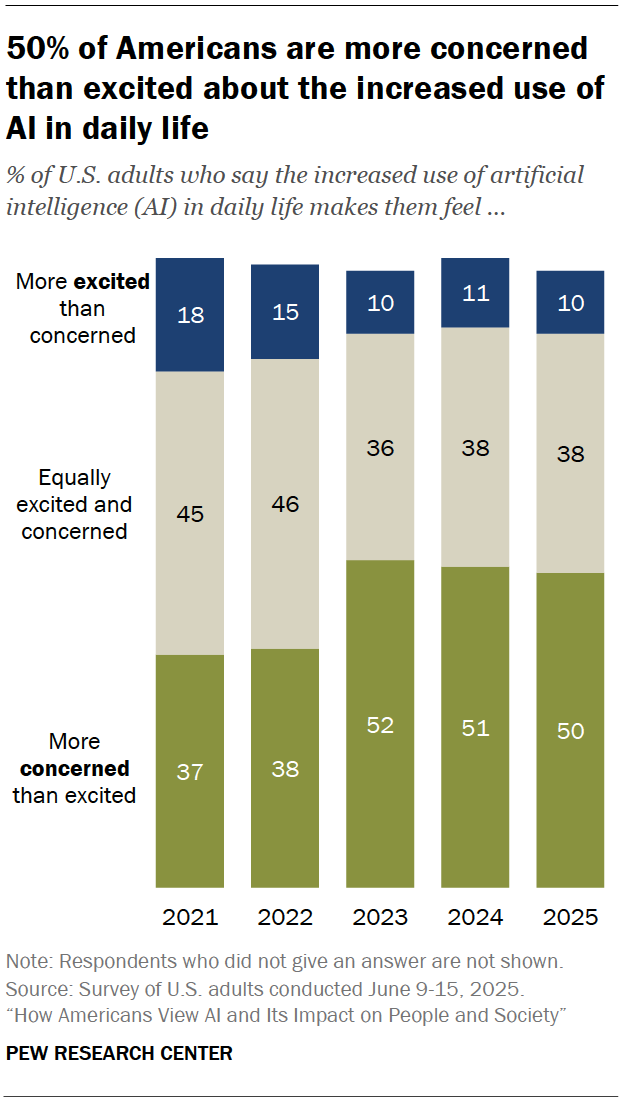
Americans remain wary of the impact AI will have on their daily lives. According to a June 2025 survey, half of U.S. adults say the increased use of AI in their daily lives makes them feel more anxious than excited. Only 10% said they were more excited than anxious. Another 38% said they were equally concerned and excited.
More Americans are concerned now than when we first asked this question in 2021. At the time, 37% said they were more concerned than excited.
In contrast, concerns about AI are low in many of the other 24 countries we surveyed.
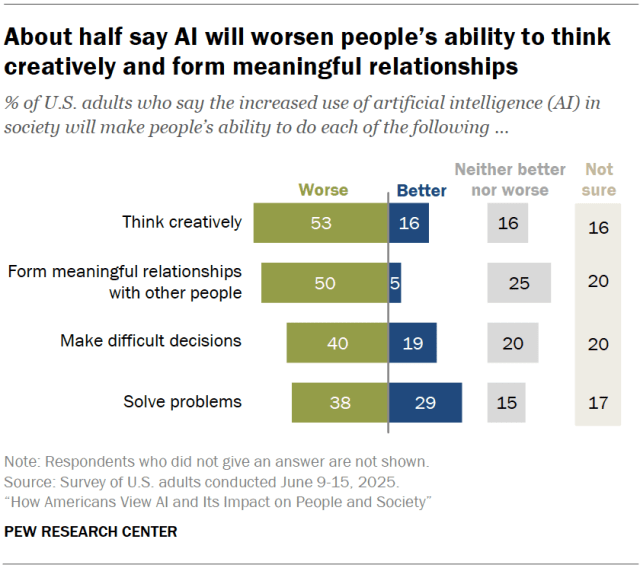
U.S. adults are generally concerned about the impact of AI on creativity and relationships, but are open to using AI for data analysis. In a June survey, nearly half of Americans said AI would worsen people’s ability to think creatively and form meaningful relationships with others. Far fewer say AI will improve these things.
However, Americans tend to be more open to AI playing a role in data analysis tasks such as weather forecasting.
Americans are optimistic about AI in healthcare but pessimistic about its impact on education and employment.
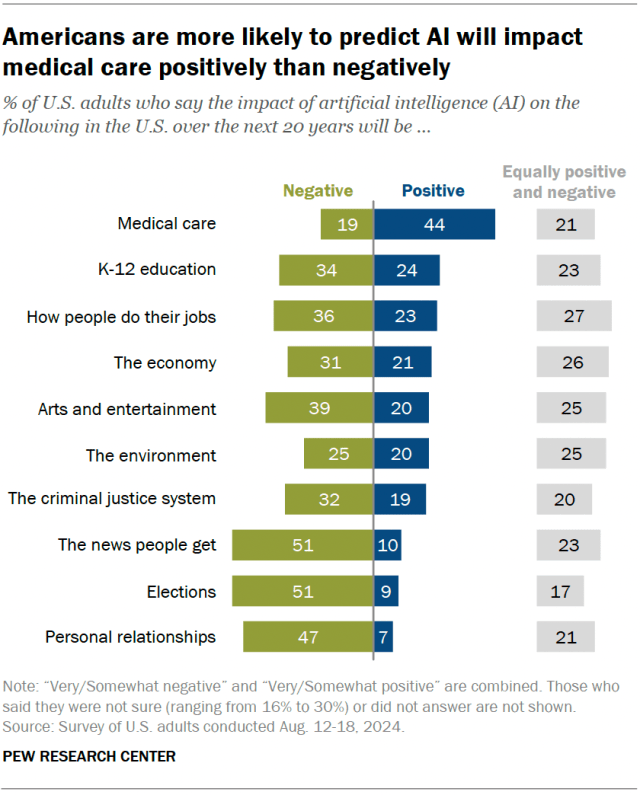
In an August 2024 survey, Americans were more likely to say AI will have a positive (44%) than negative (19%) impact on U.S. health care over the next 20 years.
Opinions were more negative in other areas we asked about. For example, only about a quarter say AI will have a positive impact on education (24%) and the way people work (23%).
Across the sectors we asked, between 16% and 30% said they don’t know what impact AI will have.
The majority of teens are using AI chatbots. According to a Fall 2025 survey, nearly two-thirds (64%) of U.S. teens ages 13 to 17 say they have used an AI chatbot.
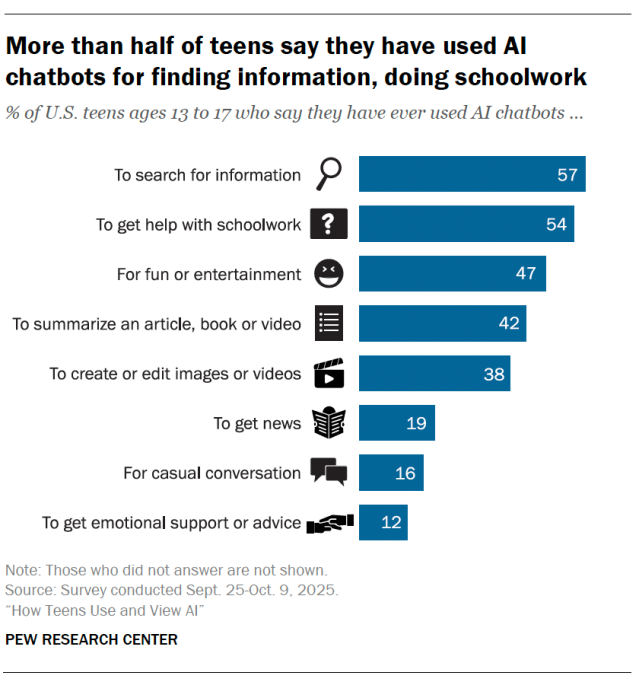
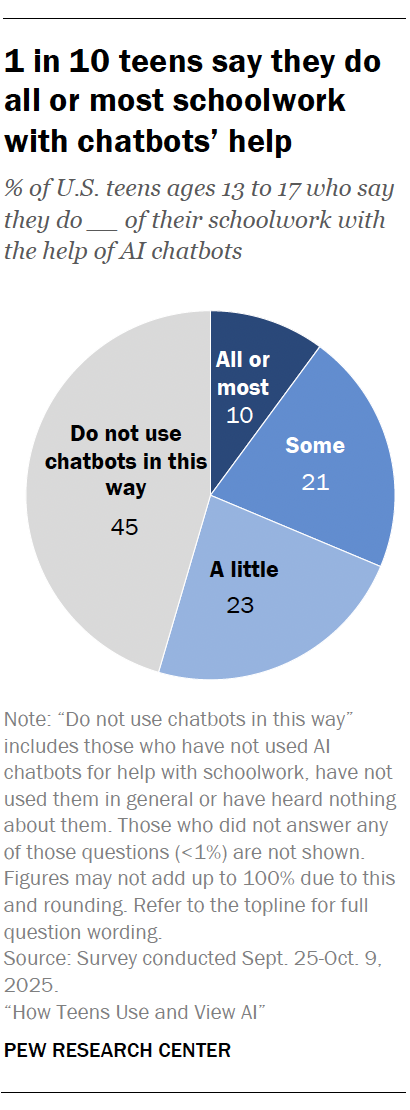
Teens use chatbots for a variety of reasons, but the most common uses we asked about are finding information and getting help with schoolwork. More than half of teens say they use a chatbot for these reasons, and one in every teen reports using a chatbot to help with all or most of their schoolwork.
Additionally, about four in teens say they use chatbots to summarize text or video (42%) or create or edit images or videos (38%). Fewer people say they use chatbots for more personal reasons, such as casual conversations (16%) or emotional support or advice (12%).
Most teens say using chatbots to cheat on their schoolwork is common at school. About 6 in 10 say students at their school use chatbots to cheat at least some of the time. This includes about a third of people who said it happens very often or very often.
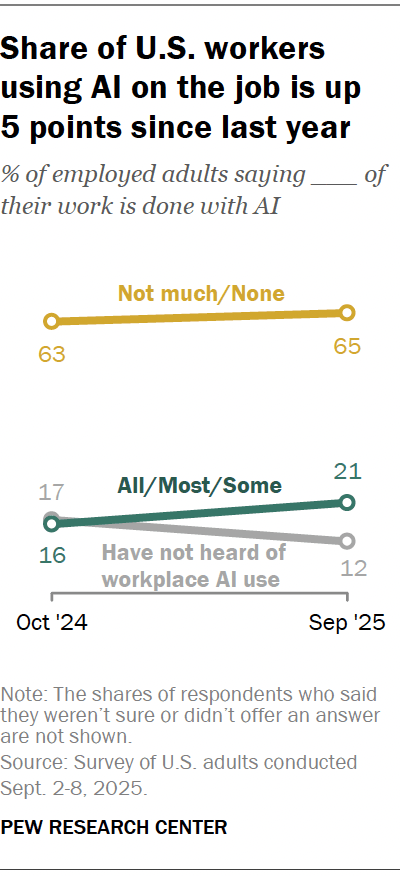
A growing share of U.S. workers say at least some of their jobs are performed by AI. This percentage rose from 16% in 2024 to 21% in the September 2025 survey. However, a majority of U.S. workers (65%) still say they use AI very little or not at all at work.
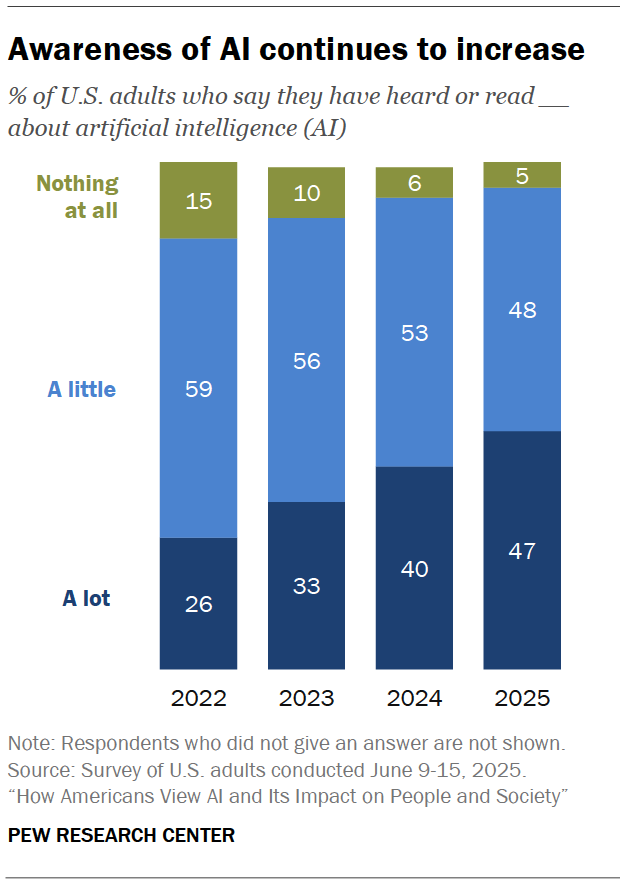
Public awareness and use of AI continues to grow. Nearly all Americans say they have heard or read at least a little about AI, with 47% saying they have. a lot We looked into that in our June 2025 survey. The latter is up 21 points from 2022, when 26% said they hear a lot about AI.
Additionally, 31% of Americans say they interact with AI at least several times a day, up from 22% in February 2024.
Younger adults are more likely to recognize and use AI than older Americans.
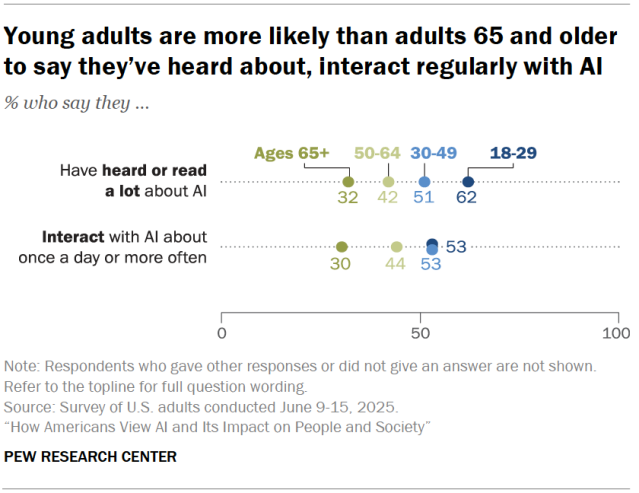
Almost half of adults under 50 say they interact with AI at least once a day. According to a June survey, a smaller percentage of people over 50 gave similar answers.
A similar pattern is seen in the percentage of employed Americans who have used ChatGPT at work. According to a survey conducted from February to March 2025, 38% of employed people between the ages of 18 and 29 said they had such experience, but this drops to 30% of those aged 30 to 49 and 18% of those aged 50 and over.
When asked about the increasing use of AI in daily life, younger adults are slightly more excited than older adults. Still, the majority of young people are wary of AI’s impact on things like human creativity and forming meaningful relationships.
The use of AI-assisted devices starts early for some children. The May 2025 survey asked parents of young children about their children’s use of technology. Approximately 1 in 10 said their children between the ages of 5 and 12 use an AI chatbot.
Additionally, 11% of parents with children under 12 said their child uses a smartwatch with AI-assisted features. Among parents with children aged 11 or 12, this percentage rises to 21%.
Parents of older children are also more likely than parents of younger children to say their child uses a voice-activated assistant like Siri or Alexa.
11% of parents say their child uses a smartwatch, and a similar proportion of older children say this about chatbots
% of U.S. parents with children age 12 and younger said that, to their knowledge, their child had used or interacted with:
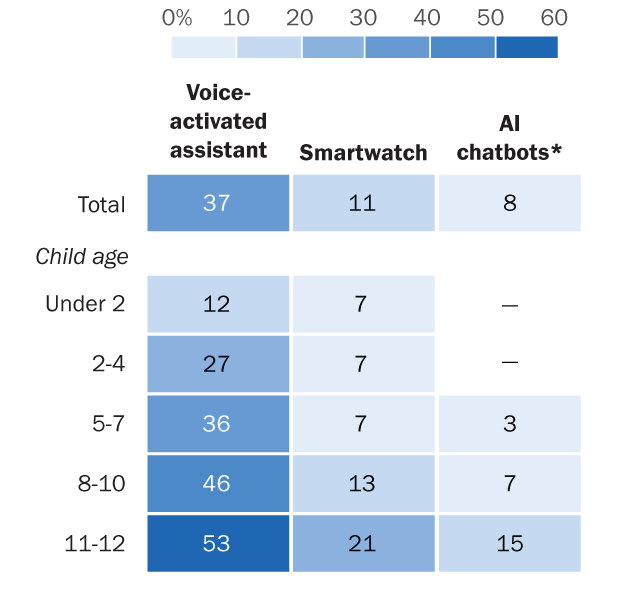
*Based on parents of children ages 5-12.
Note: See the survey for complete question wording and response options. Parents with two or more children under the age of 12 were asked about one randomly selected child, although they may have children in other age groups. Not all differences shown are statistically significant. Those who did not respond or gave other responses will not be displayed.
Source: Survey of U.S. parents conducted May 13-26, 2025.
Pew Research Center
11% of parents say their child uses a smartwatch, and a similar proportion of older children say this about chatbots
% of U.S. parents with children age 12 and younger said that, to their knowledge, their child had used or interacted with:
| voice activated assistant | smart watch | AI chatbot* | |
|---|---|---|---|
| total | 37 | 11 | 8 |
| Children under 2 years old | 12 | 7 | Not applicable |
| From 2 to 4 years old | 27 | 7 | Not applicable |
| 5~7 | 36 | 7 | 3 |
| 8~10 | 46 | 13 | 7 |
| 11~12 | 53 | twenty one | 15 |
*Based on parents of children ages 5-12.
Note: See the survey for complete question wording and response options. Parents with two or more children under the age of 12 were asked about one randomly selected child, although they may have children in other age groups. Not all differences shown are statistically significant. Those who did not respond or gave other responses will not be displayed.
Source: Survey of U.S. parents conducted May 13-26, 2025.
Pew Research Center
AI experts are far more enthusiastic about AI than the American public, but both groups want more control.
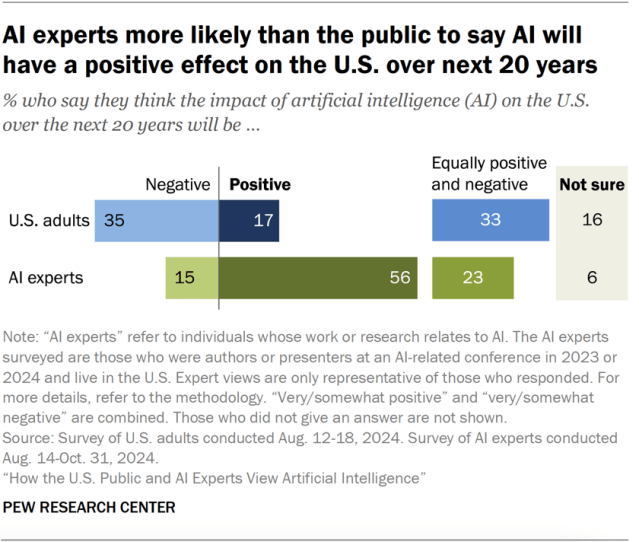
In 2024, we surveyed the American public and experts in the AI field about their views on AI and its impact on society. About 56% of AI experts believe AI will have a very or somewhat positive impact on the United States over the next 20 years, compared to just 17% of the general public.
However, almost half of both groups said they had little or no control over the use of AI in their lives, and more than half wanted more control.
Few Americans get their news from AI chatbots, and even those who do have mixed opinions about their accuracy.
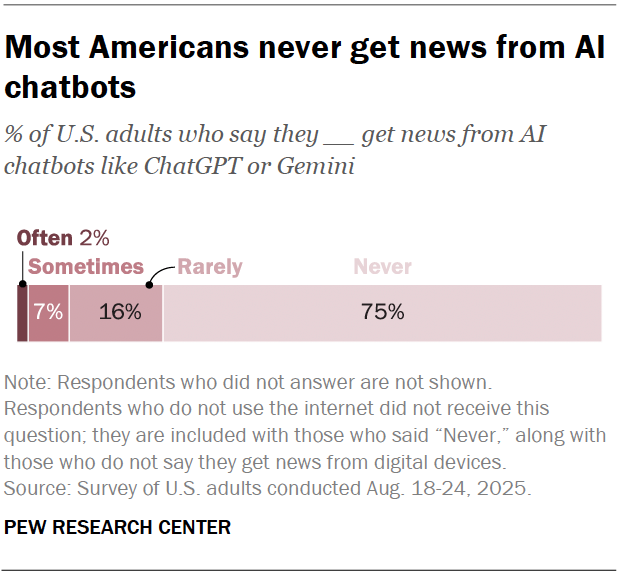
According to an August 2025 survey, just 9% of U.S. adults say they get their news from an AI chatbot at least sometimes. Most (75%) say they don’t get their news this way.
Chatbots also often display inaccurate information. Almost half of adults who receive news from AI chatbots say they encounter news that they believe to be inaccurate at least sometimes. This includes 16% who said this happens often or very often.
Americans are more likely to say that certain groups are better represented than others in AI design.
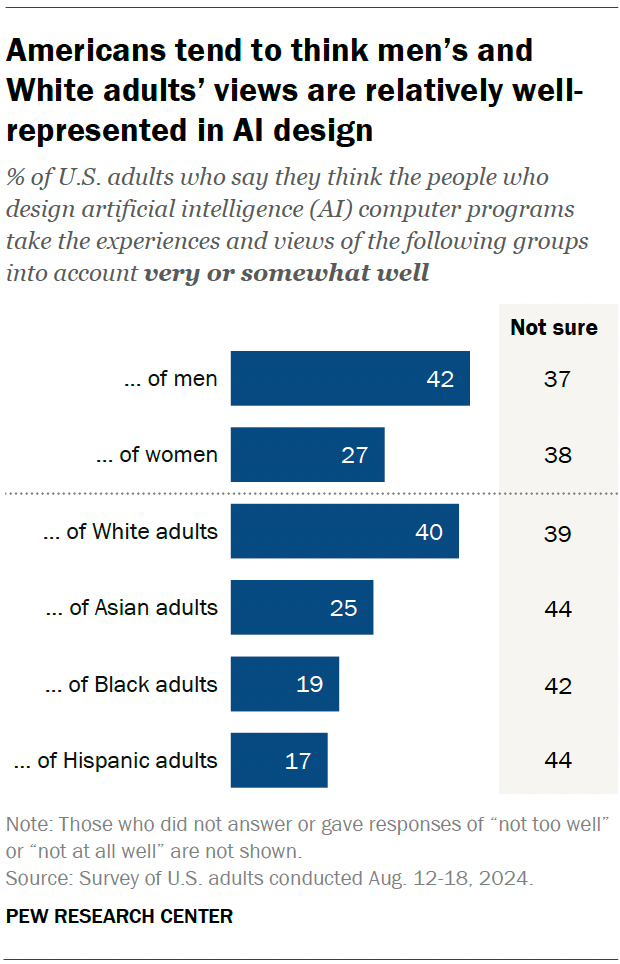
A 2024 survey found that four in 10 U.S. adults say those designing AI give at least some good consideration to the experiences and opinions of white adults. Fewer people say the same about Asian (25%), Black (19%) and Hispanic adults (17%).
The general public is also more likely to say that men’s perspectives are well considered in the design of AI than those who say the same about women’s perspectives.
Still, a sizable percentage, between 37% and 44%, say they don’t know how well these groups are represented.
A March 2025 survey found that in the United States, Democrats have less trust than Republicans when it comes to regulating AI.
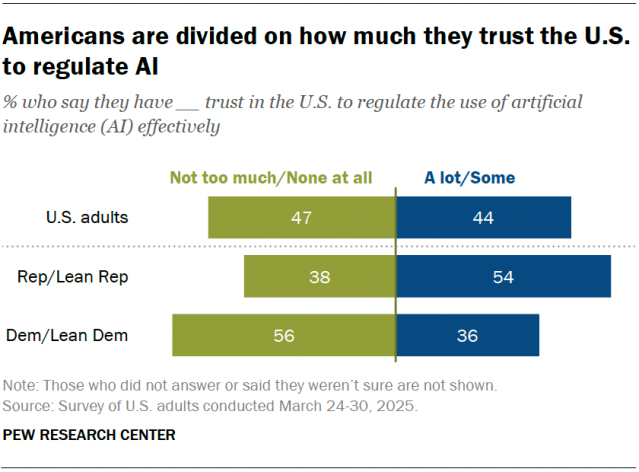
Americans are divided on how much they trust the country to adequately regulate the use of AI. 44% have a lot or some trust, while 47% have little or no trust.
However, this varies by political party. 54% of Republicans and Republican-leaning independents have a lot or some confidence in the U.S. regulating AI, compared to 36% of Democrats and Democratic-leaning voters.
Note: This is an update of a post originally published on November 21, 2023. Original Research Associate Director Alec Tyson is a co-author of the original post.