
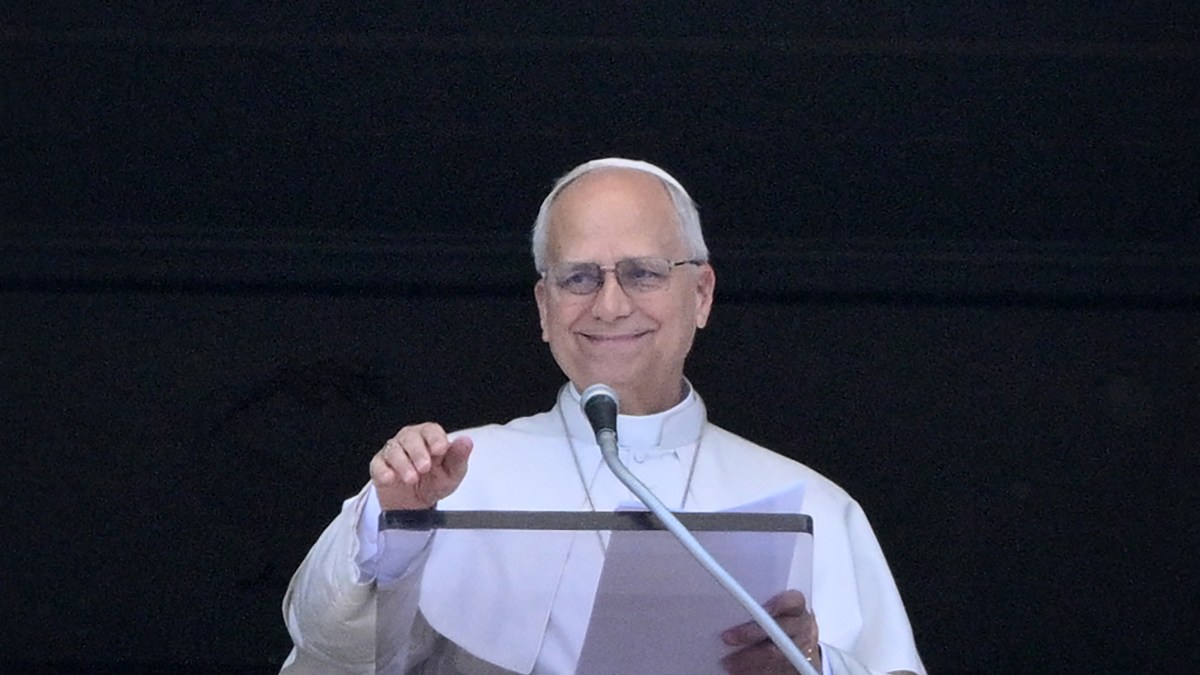
Pope Leo XIV said artificial intelligence must be “disarmed” as world leaders and private companies increase the use of technology in many human activities, including warfare.
On Monday, the Pope, in the Holy See’s first encyclical entitled “Magnifica Humanitas: On the Protection of Humanity in the Age of Artificial Intelligence,” warned against “the race for ever more powerful algorithms and ever larger data sets” driven by “the desire to secure geopolitical or commercial advantage.”
Recommended stories
list of 3 itemsend of list
Catholic Church leaders presented the encyclical at the Vatican along with AI experts including Christopher Oler, co-founder of US-based AI giant Anthropic.
An encyclical is a letter written by a pope and addressed to Catholic bishops. In recent decades, they have become some of the greatest teachings from the pope to the church’s 1.4 billion members.
What did the Pope say in his first encyclical and why is it important? Here’s what we know.
What did the Pope say about AI?
Since his election in May 2025, Leo has made the theme of artificial intelligence a cornerstone of his pontificate.
According to Vatican News, he spoke in November about how technology needs to be used responsibly in the medical field. A month later, he said AI should not hold back a new generation, adding that it was important to “restore and strengthen young people’s confidence in the human ability to guide the development of new technologies such as artificial intelligence” and not to think that this development would follow an inevitable path.
But by making AI the focus of his first encyclical, the pope turned his concerns into religious guidance that speaks to the entire world’s largest Christian denomination, home to half of the world’s Christians.
In a nearly 43,000-word encyclical, the pope argued that AI should not be left in the exclusive hands of individuals and called on policymakers to protect workers’ rights and protect children from technology. He also urged AI companies to cool down the competition.
He issued a “special appeal” to AI developers, saying that “developers have a special ethical and spiritual responsibility because every design choice reflects a vision of humanity.”
“What is needed is more active political engagement that can slow things down when everything is accelerating,” Leo said.
Speaking at the encyclical’s launch, Ola said AI companies operate “within a set of incentives and constraints that are sometimes at odds with doing the right thing.” He acknowledged that AI developers need to focus on ensuring there is no widespread job loss due to the technology and grapple with open questions about how to interpret the behavior of increasingly complex and sometimes opaque systems.
The Pope called for “a strong legal framework, independent oversight, informed users and a political system that does not abdicate responsibility.”
“Artificial intelligence now demands to be disarmed and freed from the logic that turns it into an instrument of domination, exclusion and death,” he says. “Like nuclear energy, it must serve everyone and the common good.”
The Pope also warned that AI is making war the norm.
The US military confirmed in March that a “variety” of AI tools had been used in the US-Israel war against Iran, amid growing concerns that civilian casualties would rise in the conflict. In 2024, Al Jazeera and other media revealed that Israeli-related AI systems such as Lavender and Gospel were helping generate thousands of military targets in Gaza.
“For this reason, the development and use of AI in warfare must be subject to the strictest ethical constraints, in order to guarantee respect for human dignity and the sanctity of life and to avoid a race to develop such weapons,” the Pope wrote.
He also warned against AI-based weapons, saying “lethal” decisions cannot be left to technology.
The pope has also repeatedly clashed with the White House over the US and Israel’s war against Iran and the use of religion to justify the conflict.
The “just war” theory recently proposed by President Donald Trump’s administration is “outdated,” Leo wrote, adding that “no algorithm can make war morally acceptable.”
How important are the Pope’s views on AI?
Silicon Valley has made major investments in AI in recent years. Amazon, the second-largest private employer in the United States after Walmart, laid off 16,000 workers in January, the latest in a wave of AI-driven layoffs. In October, the New York Times reported that the company plans to “replace more than 500,000 jobs with robots.”
In addition to job losses, AI data centers that train and run AI models to perform tasks also threaten to force people from their homes in countries like India.
Additionally, according to UNICEF, “the increasing prevalence of AI-powered image or video generation tools that generate child sexual abuse material indicates a significantly increased risk to children through digital technologies.”
Against this backdrop, the warning about AI marks the first time a pope has placed opposition to Big Tech at the center of an entire encyclical.
Successive popes have mentioned technology in some of their conferences and encyclicals.
Pope Francis devoted a section to technology in his 2015 encyclical focused on the environment and climate change, talking about how technology can benefit the world and avoid deepening division and inequality.
Francis, who spoke via video from the Vatican in October 2021 at the World Congress of Popular Movements, also said: “It is clear that technology can be a tool for good, and indeed technology is a tool for good, and that dialogues like this one and others Technology can never replace the contact between us. Technology can never replace the community that keeps us rooted and ensures that our lives are fruitful.”
“In the name of God, we ask big tech companies to stop exploiting human weaknesses and people’s vulnerabilities for profit, never mind the proliferation of hate speech, grooming, fake news, conspiracy theories and political manipulation,” Francisco added.
Pope Benedict XVI also considered technological development in one section of his 2009 encyclical, warning that it should not promote dehumanization.
What else did Leo say?
Although Leo’s encyclical focused primarily on AI, it also addressed the Catholic Church’s role in slavery and “sincerely asked for forgiveness” in the name of the Vatican.
The Vatican has always maintained that it has upheld the dignity of every human being as a child of God. However, a series of directives issued by the Vatican in the 15th century gave the Portuguese sovereign power to conquer Africa and the Americas and enslave non-Christians.
Successive Popes have apologized for Christian involvement in the transatlantic slave trade. But no pope has publicly acknowledged or apologized for the role of previous popes in tolerating colonization and enslavement by European rulers.
“When I think of the immense suffering and humiliation that so many have endured, in stark contrast to their immense dignity as persons infinitely loved by the Lord, I cannot help but feel a deep sadness,” Leo wrote.
“For this reason, in the name of the Church, I ask for your forgiveness,” he added.
“This is a stain on the memory of Christians and it is inconceivable that we can be divorced from it,” he added.
Shannen Dee Williams, a historian at the University of Dayton in Ohio and author of Subversive Habits, a 2022 history of black American Catholic nuns, hailed the apology as “a monumental step towards essential truth-telling and reparations that many Catholics have prayed for and strived to witness.”
“The Catholic Church has never been an innocent bystander in the history of white supremacy,” Williams told The Associated Press.
“Black Catholics have long waited for the Vatican to be honest about the church’s leading role in the transatlantic slave trade and chattel slavery, and by extension, the systems of anti-black racism that perpetuate in today’s world.”


