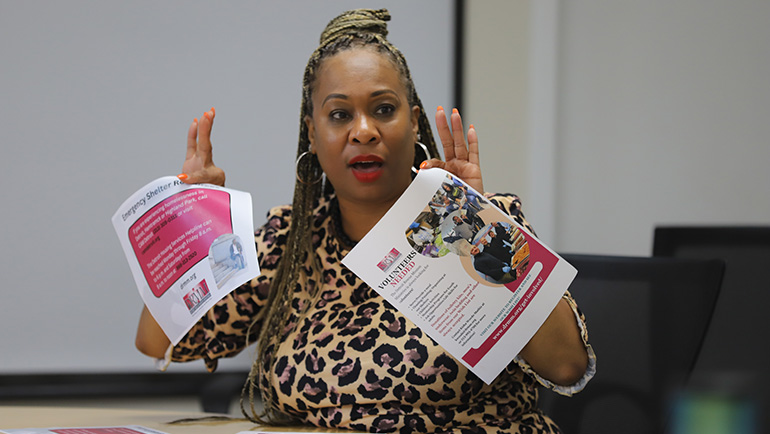

Chiara Clayton, director of communications for Detroit Rescue Mission Ministries, discusses the opportunities and challenges of artificial intelligence with students in Wayne State University’s Artificial Intelligence and Communication Work course.
DETROIT — This spring and summer, Wayne State University students will have the opportunity to explore how artificial intelligence (AI) is reshaping the communications profession through a new hybrid course taught by Dr. Rahul Mitra, director of graduate studies and associate professor of organizational communication.
“Artificial Intelligence and Communications Work” begins this spring semester and examines how AI is changing industries such as public relations, journalism, advertising, and media production, while encouraging students to think critically about the ethics, credibility, and future of communications work.
Mitra said the course is not just designed to teach students how to use AI tools, but to help them better understand how those tools are changing professional identities and workplace expectations.
Wayne State University’s course comes at a time when news organizations are grappling with how to use AI ethically and responsibly. In May, reporters at several McClatchy newspapers, including the Miami Herald, withheld their bylines in protest of AI-generated articles from the reporters’ original articles, highlighting the growing debate over media trust, credibility, and transparency.

“I think the communications industry is probably where you can really see a lot of the impact right now, whether it’s PR or writing or even the creative industry,” Mitra said. “It’s not just about ethics and work ethic, it’s about credibility.”
Mitra said the course does not focus only on technical skills, but also emphasizes critical thinking, situational knowledge and interpersonal communication.
Students will also hear directly from professionals in communications, marketing, and entrepreneurship who are already integrating AI into their daily work. Guest speakers will include Nick Mattar, a Wayne State University alumnus, associate director of marketing at Wayne State Graduate School, and founder and CEO of marketing 1080, a digital marketing startup. and Nina Knauf, owner of a public relations agency.
In addition to classroom discussions, the course includes a service-learning component in partnership with the Detroit-area nonprofit organization Detroit Rescue Mission Ministries (DRMM). Students will use AI tools while working on organizational communications projects and reflect on the process and results.
During a recent visit to DRMM, students heard from Chiara Clayton, the organization’s director of communications, about how nonprofits are balancing the benefits and risks of AI. Clayton discussed a wide range of topics, from the efficiency of AI-generated content and communications to ethical concerns surrounding AI-generated images and the importance of maintaining an organization’s authentic voice.
Clayton also encouraged students to think critically about the increasing use of AI-generated images and content, noting that organizations need to balance efficiency with reliability and ethical responsibility. This discussion gave students a hands-on look at how communications professionals are leveraging AI in their daily work.

“I think that consideration of what this actually means for our work and the outcomes it produces is what this particular class is trying to accomplish,” Mitra said.
Mitra said one of the biggest misconceptions students often have about AI is believing that the technology eliminates the need for human thought.
“I think students have this assumption that it’s easy, that it doesn’t necessarily require a lot of work or thought, and it’ll just work,” he says. “Experts know that’s simply not true.”
This course also explores how communication itself plays a central role in effectively using AI systems.
“For me, agile engineering is essentially communication,” says Mitra. “It basically communicates with the technology to make sure it does what it needs to do.”
Beyond classroom instruction, Mitra hopes students leave the course thinking more deeply about how technology should serve people and communities.
“We don’t want people to become cogs in the economic machine,” he said. “We want people to become thoughtful, considerate, civic-minded citizens who can make important decisions about technology and issues around the world.”
Sascha Raiyn, a fourth-year journalism major who also reports on education, children and families for WDET-FM, enrolled in the course to better understand both the promises and pitfalls of AI as it becomes increasingly incorporated into the communications profession.
“Most of the things I hear about AI make me nervous. I wanted to learn more about what to fear and what benefits there are from using AI,” said Lane. “I feel like what I’ve learned so far is probably a little more scary than I expected. I’m also more interested in learning how to use it well.”
Raiyn said the course emphasized the importance of understanding AI rather than avoiding it, especially for future communications professionals who will have increased exposure to technology during their careers.