
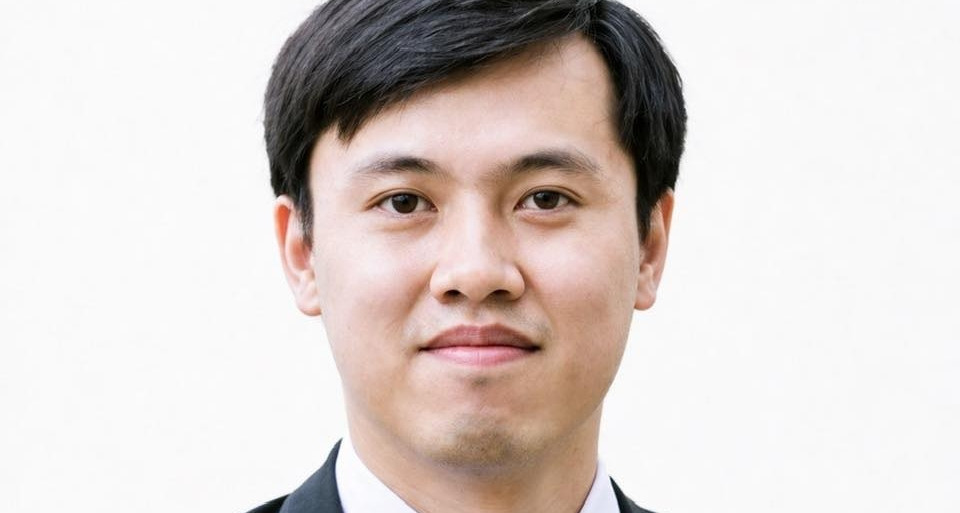
Within the U.S. science system, the NSF CAREER Award is widely recognized as one of the most prestigious awards for young scientists. This not only recognizes outstanding research, but also reflects the awardees’ confidence in their long-term scientific potential. The award includes funding of US$600,000.
“In other words, this is a national investment in a spirit that is expected to lead new research directions in the coming decades. At a time when artificial intelligence is reshaping the world, it has special significance for a young scientist from Vietnam to receive this award in the field of AI and machine learning. This shows that Vietnamese intelligence is fully involved in the major trends of global science,” said Dung.
Scientist born in 1987 with deep expertise in AI
Born in 1987, Hoang Trong Nghia is a former student of the High School for the Gifted and graduated from the College of Science with a Talent Track Bachelor’s degree in Information Technology. Previously, he was a lecturer at the University of Information Technology affiliated with Vietnam National University, Ho Chi Minh City.
He earned his PhD in computer science from the National University of Singapore, one of Asia’s leading AI research hubs.
After completing his doctoral studies, Nghia continued his research career at major global institutions, including a postdoctoral position at the Massachusetts Institute of Technology, a role as a principal investigator at the MIT-IBM Watson AI Lab, and a stint at Amazon Web Services AI Labs.
In 2023, he returned to academia and established an AI research group at Washington State University.
His research focuses on fundamental challenges in modern machine learning, particularly in building AI systems that can understand uncertainty. One important direction is to develop models that can assess the reliability of predictions, known as uncertainty-aware machine learning.
For many AI systems, especially in medical and automation environments, it is important not only to make accurate predictions, but also to know when those predictions may be wrong. Such research improves the reliability of AI in complex environments with incomplete data.
Another major area of his work is federated learning. This is a way to train AI models on distributed data without having to centralize all your data. This approach is especially important for sensitive domains such as medical data, personal information, and connected smart devices.
His research has introduced new methods that allow machine learning systems to operate effectively even when data is distributed, heterogeneous, and incomplete, while optimizing complex systems.
Nghia also made significant contributions to black-box optimization, an important field in which scientists need to optimize systems that are too complex to be fully described by mathematical models. These algorithms have applications in areas such as novel materials design, optimization of microchips and electronic systems, large-scale AI, biomedicine, prediction of adverse drug interactions, and analysis of complex biological data.
Mr. Hoang Trong Nghia is the son of Professor Hoang Van Kiem, former chairman of the National Information Technology Professors Council and a leading expert on AI applications in Vietnam.
Le Fen


