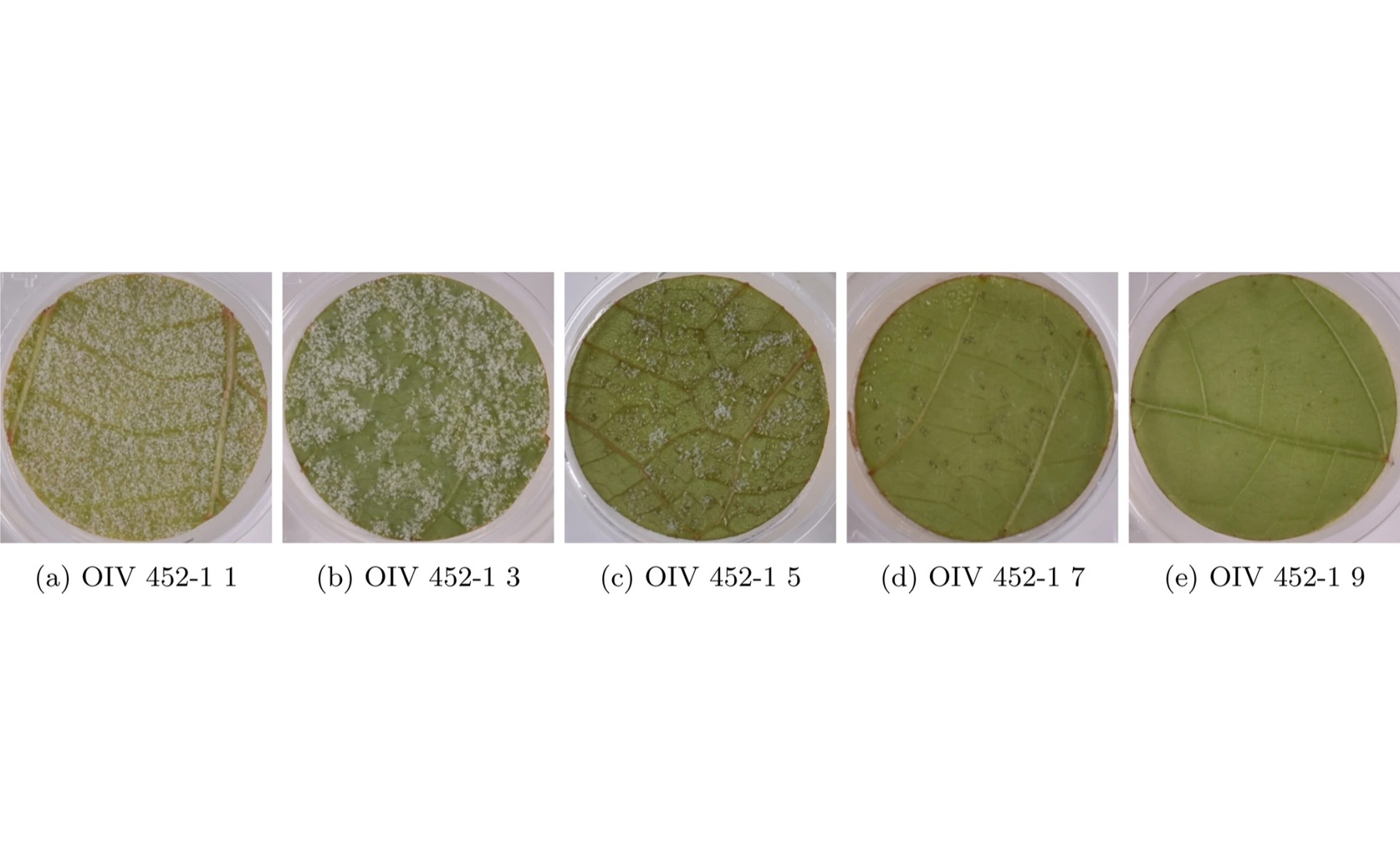
Image source: Natural Science News, 2024
Key findings
- Researchers from INRAE, CNRS and the University of Toulouse have developed a machine learning method to identify resistance to downy mildew in grapevine.
- The method automates resistance assessment using images of infected grapevine leaf discs and neural networks.
- The Swin transformer model achieved an accuracy of 81.7% for resistance prediction and 97% for identifying genotype differences, and was significantly faster than human experts.
Downy mildew, caused by the oomycete Plasmopara viticola, is a major threat to European grapevine (Vitis vinifera) and causes significant economic losses in viticulture. Traditionally, the disease has been managed by repeated applications of fungicides, but this method is unsustainable due to environmental issues and the emergence of fungicide-resistant pathogen strains.[2][3]A promising alternative is the development of grapevine varieties with natural resistance to downy mildew, but the effectiveness of these resistant varieties may be compromised by virulent pathogen strains that overcome the resistance loci.[4]To address this challenge, researchers from INRAE, CNRS and the University of Toulouse developed a high-throughput machine learning phenotyping method to identify new resistance loci.[1]The study used images of grapevine leaf discs infected with P. viticola, annotated with OIV 452-1 values. This standard scale, used by experts to visually assess resistance, takes into account two variables: sporulation (production of spores) and necrosis (death of tissue). The researchers aimed to automate and speed up the phenotyping process by training a neural network with this annotated dataset. Various machine learning models were tested, with the Swin transformer encoder achieving the best results. This model showed an 81.7% accuracy in predicting resistance based on the annotated images. Even more impressive, it reached 97% accuracy in identifying differences between genotypes, matching human observers while at 650% faster throughput. This innovative approach addresses several limitations of traditional visual assessment, which is time-consuming, has low throughput, and relies on expert judgment. By automating the phenotyping process, the method the researchers developed could significantly speed up the identification of new resistance loci and facilitate the breeding of more resistant grapevine varieties. The findings build on previous research that has highlighted the need for sustainable disease control methods in viticulture. For example, the historical reliance on copper-based fungicides and the emergence of fungicide-resistant strains highlight the importance of developing alternative strategies.[2]Furthermore, the spread of P. viticola from its native North America to Europe and beyond demonstrates the global nature of this pathogen and the need for concerted efforts to manage its impacts.[5]Moreover, this study's use of machine learning for high-throughput phenotyping is in line with a broader trend of incorporating advanced technologies in agricultural research. Leveraging neural networks and annotated datasets, researchers can now process large amounts of data quickly and accurately to identify resistance genotypes that may have been overlooked using traditional methods. In conclusion, the development of a machine learning phenotyping method by INRAE, CNRS, and the University of Toulouse represents a major advance in the fight against grapevine downy mildew. By automating the assessment of disease symptoms, the method will accelerate the breeding of resistant grapevine varieties, providing a more sustainable and effective solution to a long-standing challenge in viticulture. Integrating this technology with existing knowledge and breeding programs is expected to increase the persistence of resistance and ensure the long-term survival of viticulture.
Agriculture Biotechnology Plant Science
References
Main Research
1) Phenotyping resistance to downy mildew in grapevine: deep learning as a promising tool to assess sporulation and necrosis.
Issued on June 13, 2024
https://doi.org/10.1186/s13007-024-01220-4
Related Research
Related article
Source link



