US Machine Learning Market: Enterprise Adoption, Growth Drivers, and Future Opportunities
Machine learning has become one of the most influential technologies shaping the modern business environment. Organizations across the United States are using machine learning tools to analyze large amounts of data, improve operational processes, automate repetitive tasks, and support decision-making. As companies continue to invest in digital transformation initiatives, machine learning is playing an increasingly important role in keeping businesses competitive.
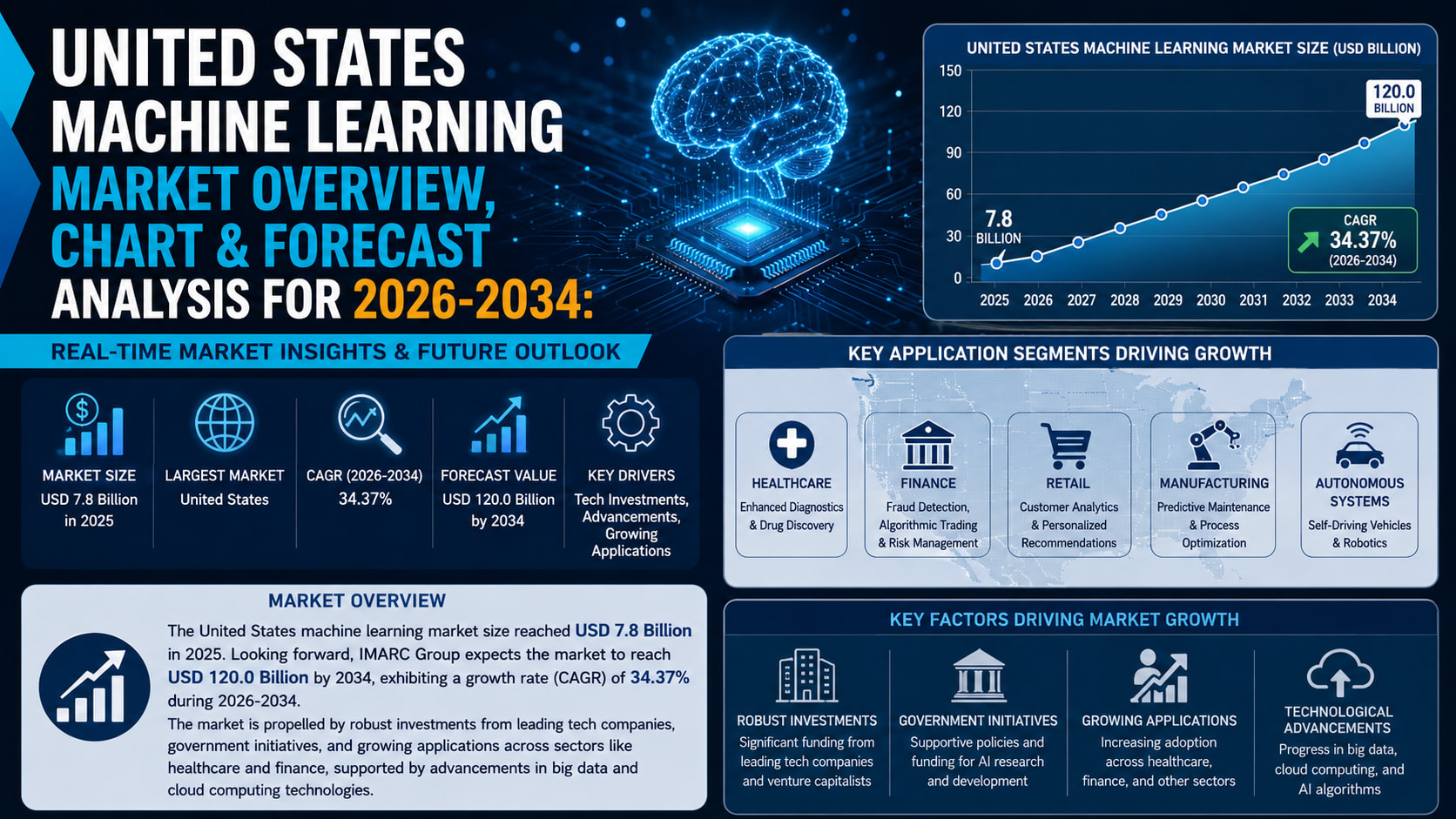
According to industry estimates, the US machine learning market will reach USD 7.8 billion in 2025. The market is expected to grow significantly in the coming years and reach approximately USD 120 billion by 2034, at a CAGR of 34.37% from 2026 to 2034. Growth is supported by increased corporate investment, advances in cloud computing, expanding data availability, and increased adoption across multiple industries.
Request a sample report with the latest 2026 data and forecasts:
Why machine learning is becoming a strategic priority for U.S. companies
Today’s businesses generate vast amounts of information through digital transactions, customer interactions, connected devices, and operational activities. Traditional analytical approaches often have difficulty processing this data efficiently. Machine learning allows organizations to identify patterns, predict outcomes, and gain insights from complex datasets in a fraction of the time required with traditional methods.
Many companies now view machine learning as a strategic investment rather than a technology experiment. Organizations are integrating machine learning capabilities into customer service operations, supply chain management, cybersecurity systems, and financial planning processes. This technology supports faster decision-making while helping businesses increase productivity and resource utilization.
Key Factors Driving US Machine Learning Market Growth in 2026
Several factors are contributing to the expansion of the machine learning market in the United States. One of the most important drivers is the increasing availability of structured and unstructured data. Businesses are collecting information from websites, mobile applications, cloud platforms, sensors, and connected devices, creating opportunities for advanced analytics.
The proliferation of cloud computing is also accelerating the market growth. Cloud infrastructure allows organizations to access scalable computing resources without making large investments in physical hardware. This makes machine learning solutions more accessible to companies of all sizes.
Additionally, continued investment from technology companies, venture capital firms, and government-backed innovation programs continues to support research and development activities. Increases in computing power and algorithmic efficiency are further enhancing machine learning capabilities across industries.
How companies use machine learning to improve operational efficiency
Organizations are increasingly deploying machine learning solutions to streamline operations and improve efficiency. In manufacturing environments, machine learning models can help identify equipment issues before failures occur, reducing maintenance costs and minimizing production disruption.
Retail companies use predictive models to predict demand, optimize inventory levels, and improve customer experience. Financial institutions apply machine learning algorithms to detect anomalous transactions, assess risk profiles, and support fraud prevention efforts.
Our customer service team also uses machine learning technology to analyze support interactions, identify common concerns, and improve response times. These applications help businesses allocate resources more effectively while improving overall operational performance.
Machine learning applications transforming healthcare, finance, retail, and manufacturing
The adoption of machine learning is growing in various sectors of the U.S. economy. In the medical field, machine learning supports medical image analysis, patient risk assessment, treatment planning, and optimization of administrative workflows. Healthcare providers are increasingly using data-driven tools to improve patient outcomes and operational efficiency.
Financial institutions are using machine learning for credit scoring, fraud detection, algorithmic trading, and customer analytics. These applications support faster, more informed decision-making while enabling organizations to manage financial risk.
In retail, machine learning contributes to personalized recommendations, pricing optimization, and demand forecasting. Manufacturers use predictive maintenance systems, quality control applications, and production planning tools to increase productivity and reduce operating costs.
The versatility of machine learning technology continues to create opportunities for both traditional and emerging industries.
The growing role of predictive analytics and intelligent automation
Predictive analytics has become one of the most valuable applications of machine learning. By analyzing historical data, organizations can identify trends and more accurately predict future results. This feature helps businesses make informed decisions related to inventory management, customer engagement, workforce planning, and financial forecasting.
Intelligent automation is another area of rapid adoption. Companies are combining machine learning and automation technologies to reduce manual workload and improve process consistency. Automated systems can analyze information, identify patterns, and perform routine tasks with minimal human intervention.
As organizations continue to prioritize efficiency and cost optimization, predictive analytics and intelligent automation are expected to remain key investment areas.
Investment trends and corporate spending patterns in the US AI ecosystem
Enterprise spending on artificial intelligence and machine learning technology continues to increase as organizations look to enhance their digital capabilities. Companies are investing in cloud-based machine learning platforms, data infrastructure, software solutions, and talent development initiatives.
While large enterprises often focus on integrating machine learning into existing business processes, smaller organizations are increasingly adopting cloud-based services that reduce implementation complexity. Technology vendors, consulting firms, and software providers are expanding their offerings to meet growing market demands.
Growing recognition that data-driven decision-making can contribute to long-term business growth and operational resilience is also driving investment activity.
Challenges organizations face when implementing machine learning solutions
Despite the potential for significant growth, organizations face several challenges when implementing machine learning technology. Data quality remains a major concern as machine learning models rely on accurate and reliable information to produce meaningful results.
Many companies also face challenges around employee skills and talent retention. Developing, deploying, and maintaining machine learning systems often requires expertise in data science, engineering, and analytics.
Other challenges include regulatory compliance, data privacy requirements, cybersecurity considerations, and integration with existing technology systems. Successfully addressing these issues is essential for organizations looking to maximize the value of their machine learning investments.
New opportunities for technology providers and AI service vendors
The continued expansion of machine learning adoption is creating opportunities for technology companies, software developers, cloud service providers, and consulting organizations. Companies increasingly need support with implementation strategy, data management, model development, and continuous optimization.
Industry-specific solutions are also gaining traction as organizations seek tools designed for specific operational requirements. The healthcare, manufacturing, financial services, logistics, and retail sectors each offer different opportunities for solution providers.
As the adoption of machine learning technology increases, the demand for professional services, training programs, and managed solutions is expected to increase.
Future outlook for the US machine learning market until 2034
The outlook for the US machine learning market remains very positive. Continued growth in data generation, cloud computing adoption, and enterprises’ digital transformation efforts are expected to support market expansion over the next decade.
Organizations are increasingly recognizing the value of data-driven decision-making and automation technologies. As machine learning capabilities continue to evolve, companies are likely to identify new applications that increase efficiency, support innovation, and improve the customer experience.
Machine learning is expected to remain a key component of the broader technology ecosystem, with the market expected to grow from USD 7.8 billion in 2025 to USD 120 billion by 2034. Companies that successfully incorporate machine learning into their operations may be well-positioned to adapt to changing market conditions and evolving customer expectations.