
The data center boom is accelerating.
A Business Insider analysis of US data center permits reveals a staggering escalation in data center power use. Data centers across the US are growing in number and in size. If all data centers permitted through 2025 come online, they will use between 224.3 terawatt-hours and 358.8 terawatt-hours of electricity annually, an increase of 50% over the previous year across the range, Business Insider’s analysis found.
At the midpoint, that’s more than all the electricity used by any one US state in 2024, except Texas.
The vast majority of this power use is driven by hyperscale data centers, mammoth facilities that use 40 megawatts or more each, Business Insider estimates.
Tech giants have an insatiable appetite for more computing power to fund their AI ambitions. In 2025, permits were issued for 176 new data centers across 34 states — the most new permits in one year since the first was issued in 1976, Business Insider found. Many of them are mammoth facilities destined for rural areas — enormous complexes blanketing prairies, green spaces, and farmland.
Amazon’s planned 14-building data center complex in Ridgeland, Mississippi, would transform nearly 800 acres of rural woodland. In the village of Mount Pleasant, Wisconsin, Microsoft’s nine data center buildings would command a collective footprint of over 5.2 million square feet built on a property nearly the size of New York City’s Central Park, according to planning documents. And just outside Eagle Mountain, Utah, QTS — one of the nation’s biggest data center operators — is building one that is expected to demand between 1.9 and 3 terawatt-hours a year once fully online, according to Business Insider’s estimate. On average, that’s the same amount of electricity used by 227,000 US homes.
The race by tech companies to reach ever-greater AI ambitions has sparked a sweeping backlash from local residents and state and local officials wary of data center impacts on the environment, economy, and communities. And development-friendly lawmakers could face a reckoning in this year’s midterms, in which data centers are emerging as a key issue for many voters.
‘Digital roots in rural soil’
Kaitlyn Gruenbacher lives on a third-generation farm in Sedgwick County, Kansas. Farms quilt the vast majority of the state. From the window of her home, she can see a cattle pasture and her neighbor’s tilled fields stretching far into the horizon.
Developers see something entirely different. Access to necessary infrastructure, cheap power, plentiful land, and available water make south-central Kansas attractive to prospectors looking for new data center sites. It’s the perfect state, one academic wrote in a 2025 presentation at an economic forum, to set “digital roots in rural soil.”
Travis Heying for BI
Early this year, Gruenbacher learned that a developer had proposed a data center site across the road from her home. It had purchased or signed sale agreements for more than 300 acres, according to property records. Gruenbacher was first shocked, then furious. A data center like that would devastate her way of life, she told Business Insider.
The developer didn’t respond to requests for comment.
The news exploded into Gruenbacher’s community, she said. In fiery town halls, neighbors opposed the data center near Gruenbacher’s property and two more proposed in nearby locations. As little as 30 feet below the soil, the Equus Beds Aquifer feeds crop irrigation and drinking water to residents across southcentral Kansas. Sedgwick County residents feared the data centers would threaten the fragile aquifer amid a yearslong drought, drive up electricity bills, jeopardize their health with noise and air pollution, and displace multigenerational farming families.
Data centers like those proposed in Kansas are extremely resource-intensive; some of the largest use up to several million gallons of water a day and as much electricity as a small city. Nationwide, their water and electricity draws have decreased neighbors’ water pressure, strained electric grid systems, and increased reliance on heavily polluting fossil fuels, such as natural gas or, as in Nebraska, coal. States and local governments have also granted large tax exemptions to data center developers, some amounting to more than a billion dollars in forgone annual tax revenue. In Ohio, for example, a recently suspended state-level data center tax exemption totaled nearly $1.6 billion in lost tax revenue in 2025, the state reported.
Their expansion could also increase electricity costs, multiple analyses have shown. Utilities scrambling to meet data centers’ skyrocketing power demands are investing billions of dollars in new grid infrastructure and power generation. Some utilities have recouped that cost by raising electricity prices for all their ratepayers, including residential customers.
Travis Heying for BI
At PJM Interconnection — which operates an electric grid serving 67 million people across 13 states and Washington, DC — data centers contributed to a 76% increase in wholesale power costs in the first quarter of 2026, compared to the year-earlier period, according to a May 2026 report by Monitoring Analytics, PJM’s independent market monitor.
“Customers are already bearing billions of dollars in higher costs as a direct result of existing and forecast data center load,” the Monitoring Analytics report found.
PJM said it is working to establish new rules to integrate data centers without unfair impacts on consumers.
Amazon, Google, Meta, OpenAI, and other Big Tech companies pledged in late 2025 to pay their fair share for future grid investments needed to support their data centers, so residential customers wouldn’t have to foot the bill.
Gruenbacher said she and her neighbors worry about the impact data centers could have on their land and their livelihoods. “They’re going to take our finite resources,” Gruenbacher said. “And what are we getting in return? Nothing.”
Proponents of data centers say build-out is crucial for US economic growth, both for the country’s AI advances to remain competitive on the world stage and for the number of jobs created in their construction. In Kansas, supporters see data centers as an opportunity to garner local tax revenue and high-wage construction jobs. A developer of a 290-acre data center project in De Soto, Kansas, for example, agreed to pay more than $460,000 a year to the city in lieu of property taxes and, once operational, is expected to pay a 3.75% franchise fee on all electricity used, amounting to an estimated $1.5 million in city revenue a year, according to a report commissioned by the Wichita-Sedgwick County Metropolitan Area Planning Department.
The AI arms race
Amazon, Meta, Microsoft and Alphabet, the parent company of Google, are in an artificial-intelligence arms race. Collectively, they are set to spend over $600 billion in 2026, funneling most of that capital expenditure into even more data center build-out.
Amazon and QTS criticized Business Insider’s methodology, which was developed in close consultation with industry and academic experts and is the same methodology used for an award-winning series published by Business Insider last year. Microsoft said it is working with utilities to plan energy use and invest in grid infrastructure so it can bring data centers online “without taking resources away from local customers or driving up electricity prices.”
Business Insider’s power-use estimates for Meta and Google are likely understatements. Our calculations are based on permits for backup generators installed at each facility. As of 2025, Meta had permits for four data centers with their own dedicated power plants, including two that disclosed no plans to install backup generators, so they aren’t represented in Business Insider’s analysis. And, for four of Meta’s 38 data centers and 17 of Google’s 53 data centers, the companies had their permits fully or partially redacted under public disclosure exemptions for trade secrets.
Business Insider’s analysis of permits shows that Meta had 38 US data centers at the end of 2025, a figure that Meta says is too high. Meta says it currently has 28 data centers in the US, and that some of the permitted facilities in Business Insider’s analysis are offices. Offices could have backup generators for small, on-site servers. Business Insider included these facilities because they received air permits issued with federal industry codes associated with data centers. These facilities represent 0.2% of Meta’s total data center power use, according to Business Insider’s estimate.
Power hungry
Data centers have transformed into a bipartisan political flashpoint.
Fights have erupted in communities across the country. “Shark Tank” investor Kevin O’Leary in early June pledged to roughly halve the size of his proposed 40,000-acre data center in Box Elder County, Utah, after backlash from community members and lawmakers concerned about electricity prices, water use, and environmental damage.
In Nebraska, lawmakers are considering a mandate that all new data centers proposed in the state must build their own dedicated power generation sources, such as large natural gas turbines. These efforts are meant to prevent electricity price hikes and ensure Big Tech pays its share for grid improvements made to support data centers’ relentless power draw.
This requirement, while expensive, has been largely embraced by Big Tech companies. Business Insider identified at least 20 permits issued to developers through the end of 2025 for power plants intended to serve data centers. Far more have been announced, are in various stages of planning, or received their permit in 2026. Cleanview, an energy data company, identified 46 data centers that plan to build their own power generation sources.
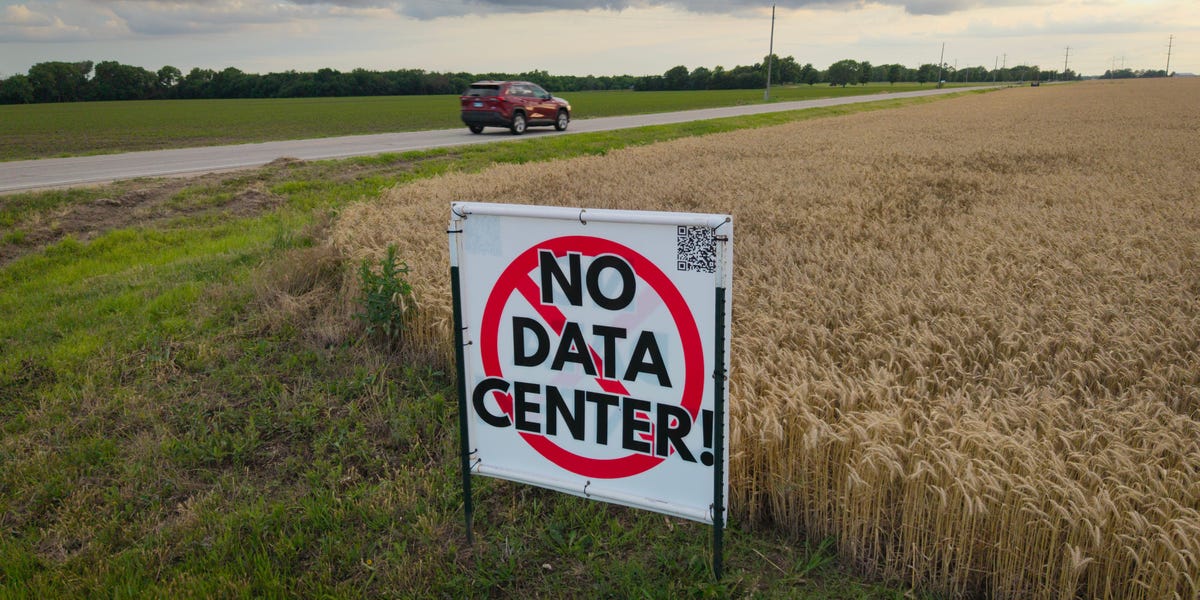
In Nebraska, Gruenbacher and her neighbors used social media to share news articles, analyses, and videos of Kansans speaking out at community meetings against proposed data centers. In their crop fields and along rural county roads, they staked signs reading: “No data center!”
Travis Heying for BI
Gruenbacher now spends hours each day writing to state officials and coordinating with grassroots activists in Barber, Miami, and Leavenworth counties, where residents have packed town halls and city council meetings to oppose proposed hyperscale data centers.
In her own county, she and her neighbors recently notched the latest in a series of wins. Bending to community pressure, Sedgwick County leaders in May voted to extend the study period on new data center applications for another 90 days.
Our methodology:
To investigate the rapid proliferation of US data centers, Business Insider filed requests with all 50 states and Washington, DC, for the air permits issued through 2025 that regulate backup generators installed at data centers. Business Insider used data in these permits to identify data center location and ownership, and estimate facility power use. (Read more about Business Insider’s methodology here.)
Data center power use varies based on factors including the types and frequency of use of servers, cooling systems, and other infrastructure. To account for this, Business Insider calculated a range of estimated annual data center electricity use. In our data visualizations, we used the midpoint of that range for clarity.
Business Insider’s analysis is dependent on estimating data centers’ electricity use based on the number and type of backup generators installed at each facility. Where developers are building entire power plants, some are forgoing installing backup generators altogether. As a result, Business Insider’s electricity estimates are certainly an undercount, as facilities known to be huge and built with dedicated on-site or nearby power generation, such as xAI’s data center complex in Memphis, Tennessee, or Meta’s Hyperion Campus in Richland Parish, Louisiana, appear far smaller in Business Insider’s analysis, due to a lack of permitted backup diesel generators.
Amazon said Business Insider’s methodology is misleading because it includes a range of electricity estimates. QTS said the company’s current electricity use is lower than our estimates, which project future use. Equinix says it had 79 data centers either built or under construction at the end of 2025. Business Insider identified permits for 56 Equinix data centers.
Have a tip or a question about our reporting? Reach out to Business Insider’s enterprise team at investigations@insider.com.