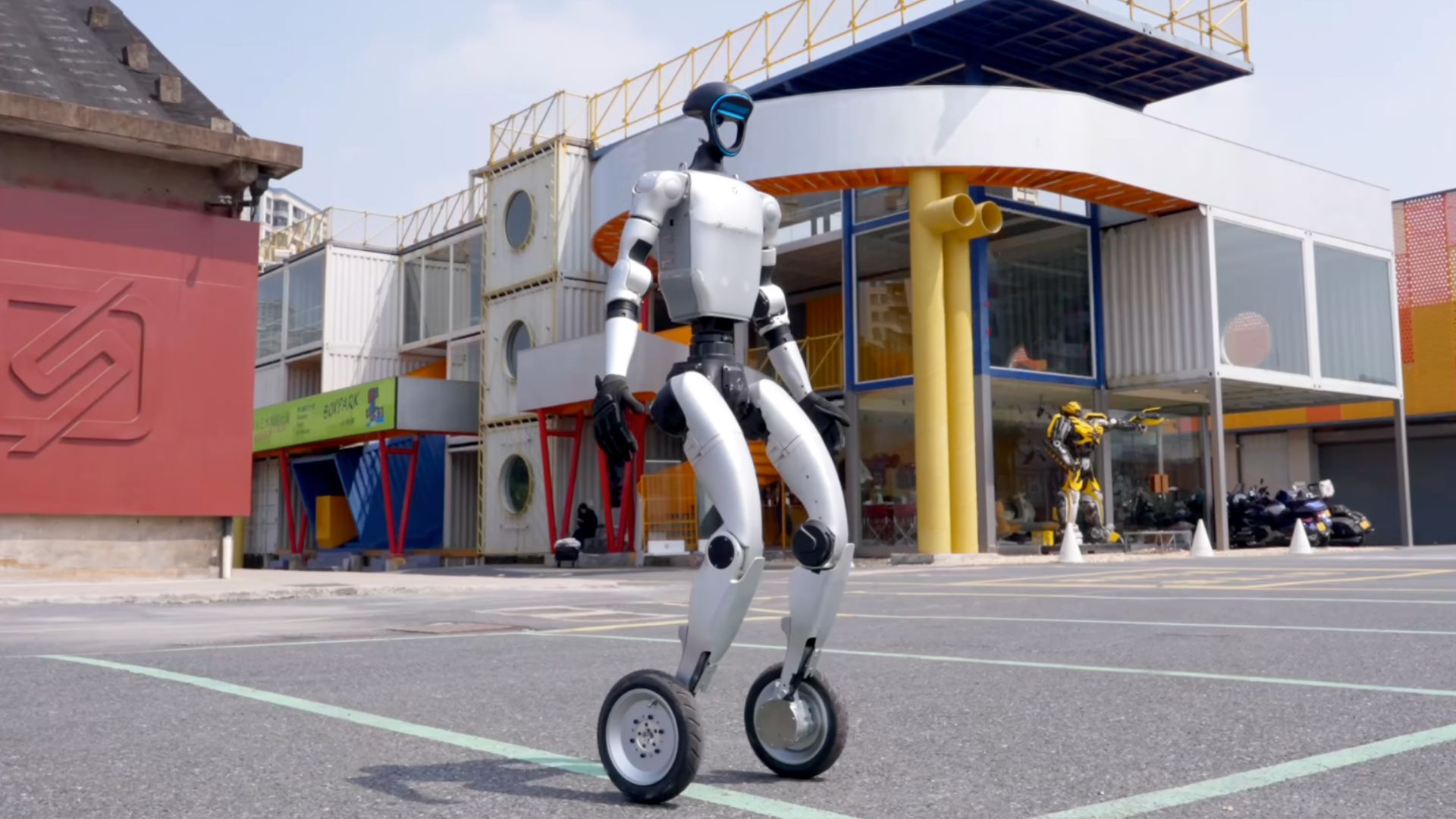
Robot mobility is entering a new phase as Unitree Robotics unveils an impressive demonstration of its G1 humanoid.
The released video shows a wheeled legged robot gliding on roller skates or ice skates while maintaining balance through coordinated control of its wheels and legs.
The Chinese company says it can continuously perform dynamic movements such as 360-degree rotations, one-legged spins, and even front flips.
“Humanoid robots are the ideal form of general-purpose robots (ideal for general AI and human-derived data). They can work without wheels, but you can add them if you want. Whatever works,” says the YouTube video description.
In November 2025, Unitree launched G1-D, the first wheeled humanoid robot designed to collect data, train AI models, and perform tasks in real-world environments.
wheel and leg contact
Unitree’s new video pushes humanoid mobility into the uncharted territory of wheels and ice.
A video released on April 23 shows the company’s wheeled leg G1 platform performing a series of highly dynamic movements that blur the line between robotics and sports. The robot smoothly transitions between rolling and stepping, and performs ice skating and roller skating maneuvers with coordinated control of both its wheels and articulated legs.
It’s not just the movement that stands out, but the accuracy. G1 performs continuous movements such as 360-degree turns, one-legged spins, and even front flips while maintaining balance and posture.
These feats highlight significant advances in stability, real-time control, and hybrid locomotion, areas that have historically limited humanoid robots. The ability to combine the efficiency of wheels with the adaptability of legs reportedly allows the system to respond to a variety of terrain and operational demands more effectively than traditional designs. bread daily.
Experts suggest the demonstration also reflects broader industry trends. While earlier balance machines, such as those inspired by the Segway, relied solely on wheels, modern humanoids lean toward human-like limbs. Unitree’s approach is a blend of both philosophies, supported by advances in simulation training and AI-driven motion control, Tech Radar reports.
According to the company, such a platform is key to developing general-purpose robots that can operate in human environments, where flexibility and efficiency must coexist.
Humanoid becomes mobile
Unitree recently announced G1-D, a wheeled humanoid robot built for data collection, AI training, and performing real-world tasks. The system integrates hardware and software into a full-stack platform for managing AI workflows from data acquisition to deployment.
The G1-D is offered in standard and flagship versions. The standard model is fixed, while the flagship has a differential drive wheelbase capable of speeds of up to 1.5 m/s. Both versions range in height from 49.5 to 66 inches and weigh up to 176 pounds (80 kg). The robot offers 17 degrees of freedom in the standard version and 19 degrees of freedom in the mobile version, with each arm offering 7 degrees of freedom and a payload of 6.6 pounds (3 kilograms).
The flexible hip joint supports up to 155° of movement along the Z-axis and -2.5° to 135° along the Y-axis, allowing a vertical working range of 2 meters. Vision is handled by a head-mounted binocular camera and an additional wrist camera for close-range recognition.

The robot supports multiple end effectors, including two- and three-finger grippers and a five-finger dexterity hand. The flagship model is powered by Nvidia Jetson Orin NX modules, delivering up to 100 TOPS and up to 6 hours of battery life. An integrated software stack supports data annotation, simulation, and distributed AI training.