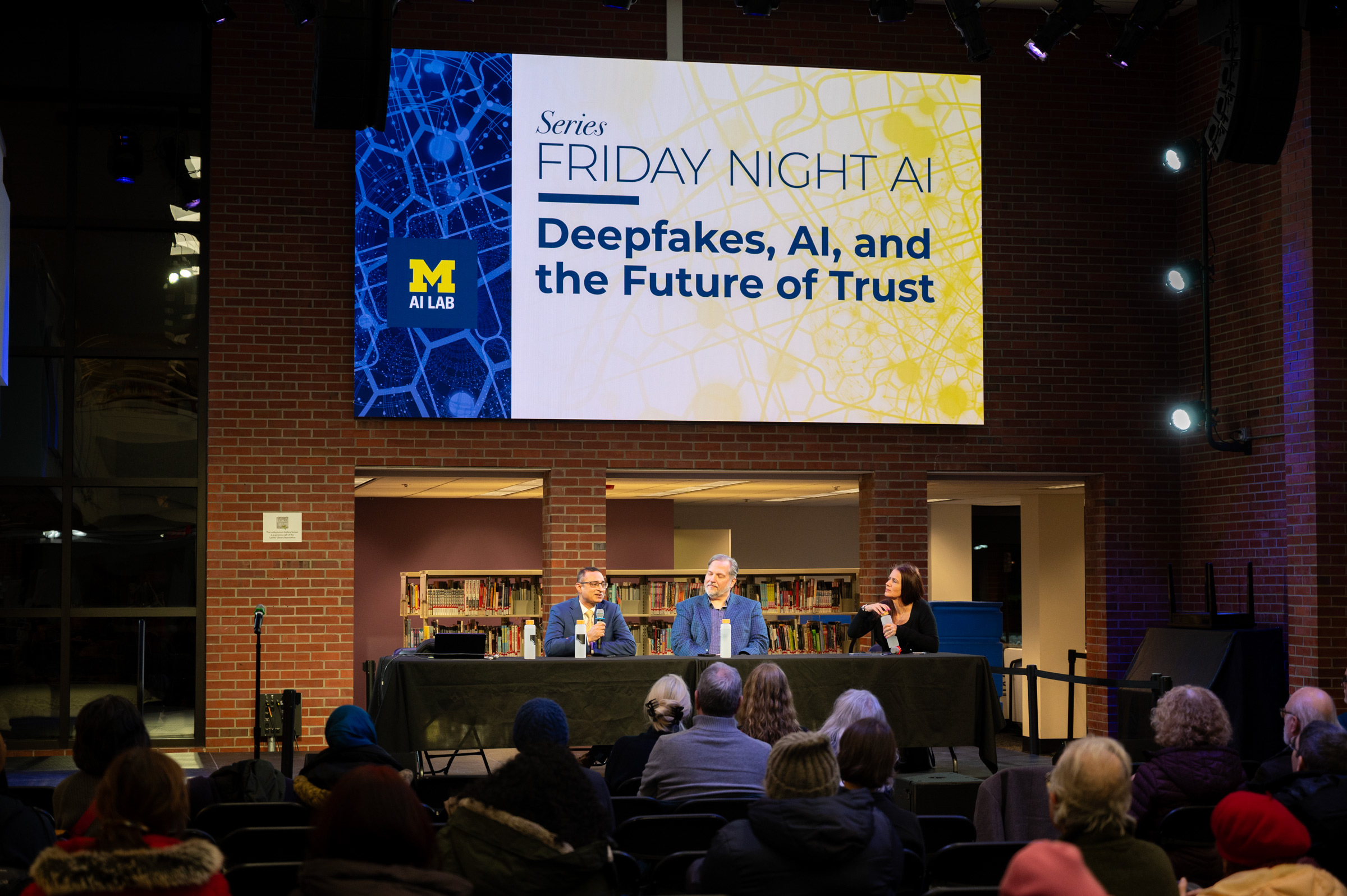
The University of Michigan Artificial Intelligence Institute, in collaboration with UM-Flint’s School of Innovation and Technology and School of Information, Friday Night AI: Deepfakes, AI, and the future of trust January 23, as part of the 8th Annual AI Symposium Series. The event was open to the public at the Ann Arbor District Library’s Downtown Branch and drew more than 40 students and community members. Panelists answered questions about the changing landscape of AI and informed the public about the dangers of deepfakes (artificial images and videos developed by machine learning algorithms).
The event’s speaker, Rackham student Yara El Tawil, began by leading an interactive activity featuring two sets of photos and videos depicting real people. Audience members were asked to analyze and decide which pairs of near-identical photos and videos were real and which were deepfakes. Eltawill said the impact of deepfakes on society is likely to manifest itself in a variety of ways.
“Many researchers in this field are trying to figure out the most ethical way to develop and use AI,” Eltawill said. “It remains to be seen how this technology will impact education in Michigan, much less everything else.”
Cliff Lampe, professor and associate dean for academic affairs in the School of Information Studies, began the panel discussion by discussing how learning about AI can benefit students’ understanding of the job market.
“Students may see jobs that existed five years ago or last year taken over by AI, but new jobs will be created,” Lampe said. “Most students will want to learn how to use AI tools to supplement their careers in some way.”
Panelist Khalid Malik, professor of computer science and director of cybersecurity at the University of Flint’s School of Innovation and Technology, said deepfakes have advanced significantly in recent years as the technology improves.
“Deepfakes are definitely becoming more and more viable,” Malik said. “Even if you hide half your face, a model can imitate your face perfectly.”
Malik said researchers are developing new ways to enable human-controlled technology to detect AI-generated media fabrications and embed signals in AI-generated media.
“Many of us are working to solve this problem, but anyone who says we have solved this problem is not telling the truth,” Malik said. “There are two types of communities looking for solutions. One is poison for poison, which uses AI to detect deepfakes and explains how human intelligence is used to determine if they are fake. On the other hand, there are efforts towards watermarking and problem-based techniques.”
Lampe discussed the crimes being committed using deepfake technology, including the rise of AI-fabricated nude images, especially of young girls. He said that when deepfake images go viral or spark controversy, people have a hard time looking for the actual truth.
“As someone who studies the quality of information, it’s very interesting to me when people come forward about images that are being discussed and say that the fact that the image is fake doesn’t matter,” Lampe said.
Lampe said fraud and fraud, some of the most harmful uses of deepfakes, continue to permeate online consumption, making deepfakes more difficult to detect.
“Deepfakes are the most sophisticated technology we’re seeing today,” Lampe said. “How we investigate this is very important, because it’s like an arms race between the detectors and the new models that elude detection.”
Daily staff reporter Reese Kizy can be reached at: reesekiz@umich.edu.