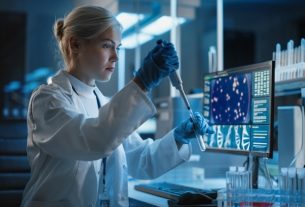
A new advanced artificial intelligence (AI) system has demonstrated world-leading accuracy and speed in identifying protein patterns within individual cells. Developed at the University of Surrey’s Human-Centric AI Laboratory, the new system could help scientists understand the differences between cancer tumors and identify new drugs for the disease.
In a study published in Communications Biology, part of Nature Portfolio, researchers found that HCPLs (hybrid intracellular protein localizers) decipher the location of proteins within cellular structures and their behavior within different cells. We have demonstrated a method that requires only partially labeled data to learn the method.
The research team tested HCPL on the Human Protein Atlas* and found it to be the most accurate tool for localizing proteins within individual cells.
Professor Miroslaw Bober, HCPL project leader at the University of Surrey, said:
“To understand how proteins function in cells, scientists need to study where they reside, which can be a time-consuming and complex process. HCPL makes this process easier.
“This program uses deep learning models to rapidly and accurately identify the subcellular structures in which proteins reside within individual cells. We hope that it will help us study and develop new treatments for the disease.”
Spatial proteomics is a research field that combines experimental techniques and computational approaches to study the distribution of proteins within cells or tissues. Fluorescence microscopy is a common method in this field in which proteins are physically tagged with fluorescent markers. AI maps proteins to individual cellular compartments (subcellular structures or organelles). This helps scientists understand the roles and functions of proteins and uncover the complex inner workings of cells.
HCPL was developed in partnership with ForecomAI, an R&D company with world-class expertise in machine learning and deep learning, providing healthcare and bioscience solutions.
ForecomAI Director Dr. Amaia Irizar said:
“Proteins play a key role in most cellular processes essential to our survival. Elucidating the distribution and interactions of proteins within individual cells is essential to understanding their function.” and is essential for the development of new therapeutics.
“Working with the University of Surrey will allow this process to be scaled up and break new ground. I did.”
The University of Surrey is a research-intensive university, producing world-leading research, transforming lives and delivering educational innovations to change the world for the better. The Human-Centric AI Laboratory at the University of Surrey combines his 30+ years of technical excellence and interdisciplinary research in the field of machine learning to create a technical, ethical and governance framework to make the future of AI truly human-centric. answering the question of . As a result of its focus on world-changing research, Surrey is ranked 55th in the world in the Times Higher Education (THE) University Impact Rankings 2022, which measures the performance of more than 1,400 universities against the United Nations Sustainable Development Goals it was done. (SDGs).