
With millions of people now using generative AI to complete tasks large and small, there is considerable uncertainty about how this technology will impact the future of work. Are jobs at risk right now because of AI? What is the right approach to integrating AI into the workplace? Optimism or skepticism?
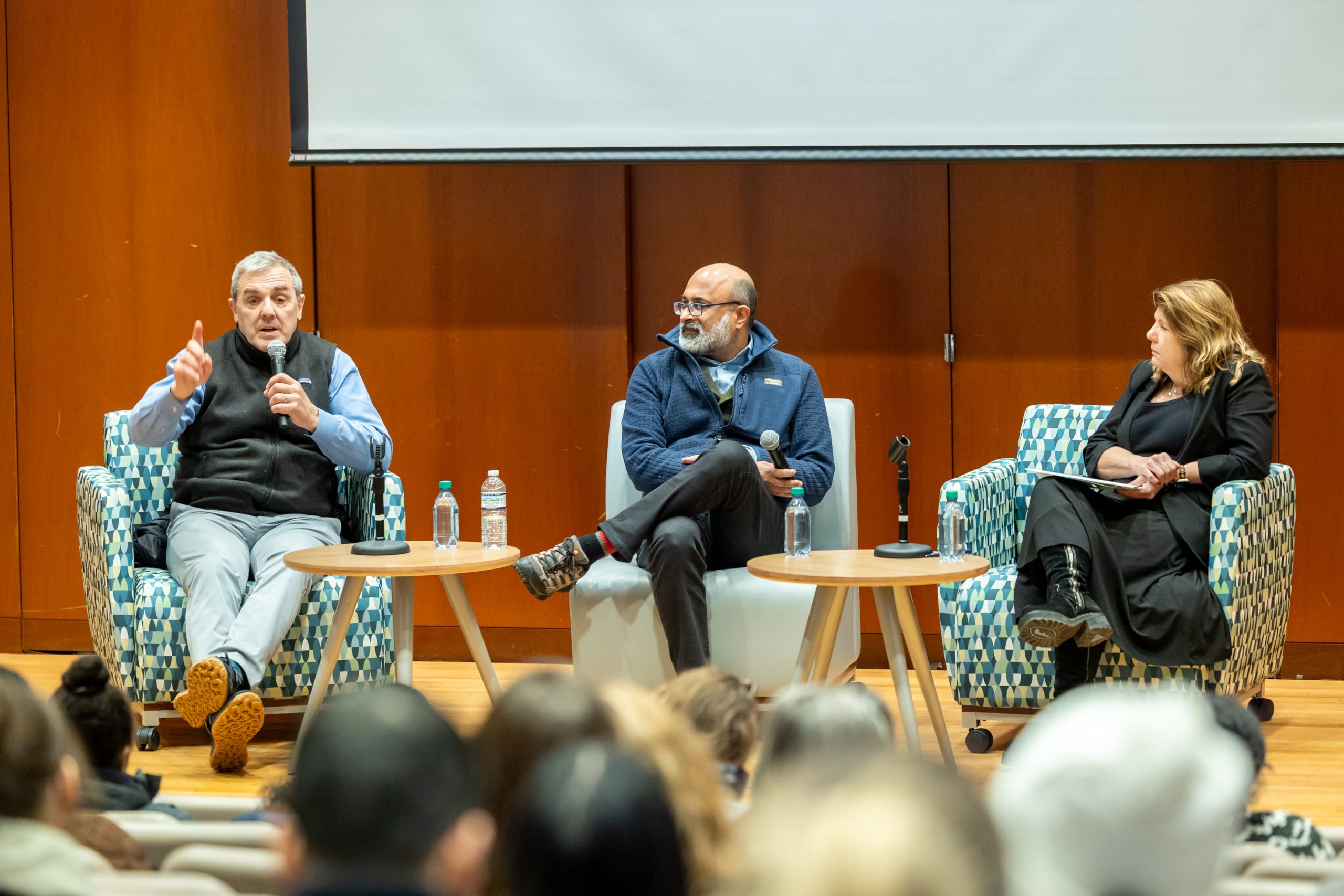
A recent panel co-sponsored by the UConn Humanities Institute (UCHI) and the University of Connecticut Professional Employees Association (UCPEA) union sought to answer the pressing question: “Will AI replace us?”
The panel brought together three speakers, including experts in various aspects of technology and AI.
Sachin S. Pandya, Roger Sherman Professor of Law at UW School of Law, spoke from a legal professional perspective. Pandya researches U.S. work and anti-discrimination law, as well as the use of computational tools in legal environments. In his opening remarks, he discussed how different states in the United States are proactively addressing AI and jobs issues. New York state, for example, passed a 2025 law that protects the employment rights of public servants (from being replaced by AI) for at least three years. Conversely, Montana passed a “Right to Compute” law that limits the government’s ability to regulate the use of AI by private individuals and companies.
Pandya’s example highlights how political questions (Is it more important to protect public safety and security or individual freedom?) are already shaping the legal landscape in which AI will thrive. The decisions we make now will determine how and to what extent AI will interact with our lives in the coming years.
Speaking on the issue, state Sen. James Maloney arrived before the panel online, having just attended Gov. Ned Lamont’s speech at the beginning of the 2026 legislative session.
“I’m thinking about this question [‘Will AI Replace Us?’] When it comes to the state of Connecticut,” Maloney said, adding that his office is focused on protecting Connecticut residents.
Maloney, who is nationally recognized for her work on high-tech legislation, cited housing and employment as areas of particular concern. Recently, he said, landlords and employers alike have embraced the controversial practice of using AI tools to scrape external data on prospective tenants and employees, often without the knowledge of applicants.
“So many businesses and landlords are using these tools that we want to give them an opportunity to see what they’re based on and fix anything that’s wrong,” Maloney said.
Maloney also spoke about employment equity issues raised by AI. For example, he said the jobs currently most threatened by AI, including administrative assistants and customer service representatives, tend to be held by women, often women of color. These are also important entry-level positions in which you can build a career, Maloney said.
UConn Interim Chief Information Officer Ted Laskaris shared perspectives from the Information Technology Services team, which oversees and coordinates the university’s vast information technology systems – all the hardware and software that makes learning, research and communication possible at UConn.
Laskaris emphasized that adapting to changing technology has long been an important skill in the workplace.
“A year from now, if you’re still working the same way you’re working now, you’re going to be doing something wrong, and your manager is going to be doing something wrong,” he said.
He also highlighted the opportunities created by AI. Rather than thinking of generative AI as a one-stop shop to replace human work, Lascaris said it should be recognized that its output should be subject to human review. Human expertise is still required to ensure the accuracy and effectiveness of AI output. For example, someone who tests AI-generated code for quality assurance before making it available to users.
“I’m not scared. [AI]”I don’t think there will be as much cannibalism as we think. To the extent that there will be cannibalism, that automation will create a lot of other jobs,” Lascaris said.
The second half of the event featured a question-and-answer session in which members of the UConn community asked questions about the environmental impacts of AI and how people can work to uphold the discipline of critical thinking in the university environment, which is important for promoting literacy and responsible use of AI.
The afternoon’s conversation reflected important themes laid out in UCHI Director Anna Mae Duane’s foreword.
Duane, an English professor, pointed out the active voice used in the construction “Will AI replace us?” — rather than the passive “Will we be replaced by AI?” The phrasing was intentional, she said. It emphasizes agency and avoids the idea that we do not have the power to decide or shape what work is, what it means, and why we work.
“Now is a time when university engagement is needed more than ever,” Professor Duane said. “It will take each of us to ensure we move toward a future that is consistent with our values.”
“Will AI replace us?” This panel was one iteration of the ongoing “AI Café” series hosted by UCHI, based on the institute’s groundbreaking research on the human side of AI. Please see the UCHI website for details.


