Another talented person from Tsinghua University has joined OpenAI!
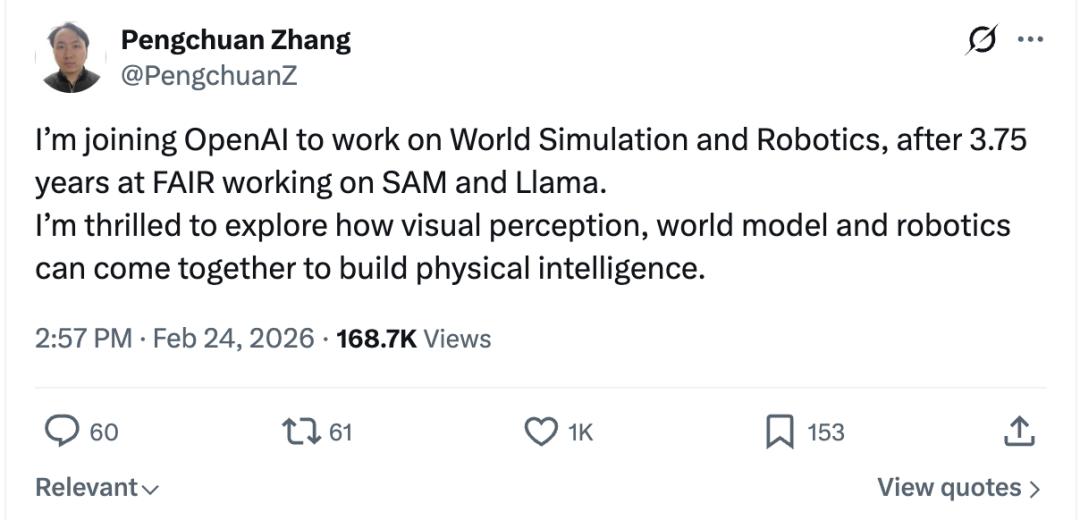
Recently, researchers Zhang Peng RiverA graduate of Tsinghua University’s Department of Mathematics, he worked at Meta FAIR for three and a half years, leading several core projects. Sam and llamaannounced his resignation.
His next stop is OpenAI, where he will work on research in the following areas: World simulation and robotics.
He wrote on Twitter that he is very excited to explore how visual perception, world models, and robotics can be integrated to build true “physical intelligence.”
Aditya RameshOne of the leaders of OpenAI’s world simulation direction and a senior leader of the Sora project, he was also quick to leave a welcoming message.

The transition from a visual understanding to an underlying world model is in itself very important.

So, who exactly is this researcher who has been at the core of SAM and Llama?
Who is Zhang Pengchuan?
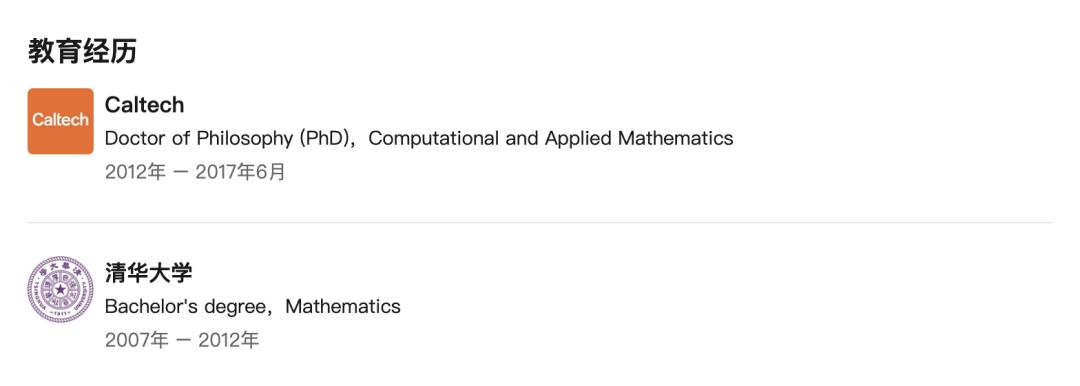
In 2007, Zhang Pengchuan graduated from Nankai High School in Chongqing and entered Tsinghua University, majoring in mathematics.

After graduating from undergrad, he entered the doctoral program at the California Institute of Technology (Caltech) in the United States and received a doctorate in applied mathematics in 2017.
During his doctoral studies, he focused on the theory and applications of machine learning and began exploring the potential of deep learning in the field of vision.
After graduating with a Ph.D., he joined Microsoft Research and was a Principal Research Scientist at Microsoft Research Redmond.

During this period, he led research in computer vision and multimodal intelligence at Redmond Research Institute.
He also drove computer vision and multimodal intelligence projects across various organizations within Microsoft, including directives such as Alexander Multi-Modal and Florence.
It is worth noting that he also joined the University of Washington in 2021 and has since served as an adjunct assistant professor in the Department of Electrical and Computer Engineering.

From 2022, I transferred to Meta FAIR (currently Meta Super Intelligence Research Institute) to conduct research on computer vision and multimodal intelligence, with a total of nearly 4 years of work experience.
During this period, he led multiple groundbreaking projects including:
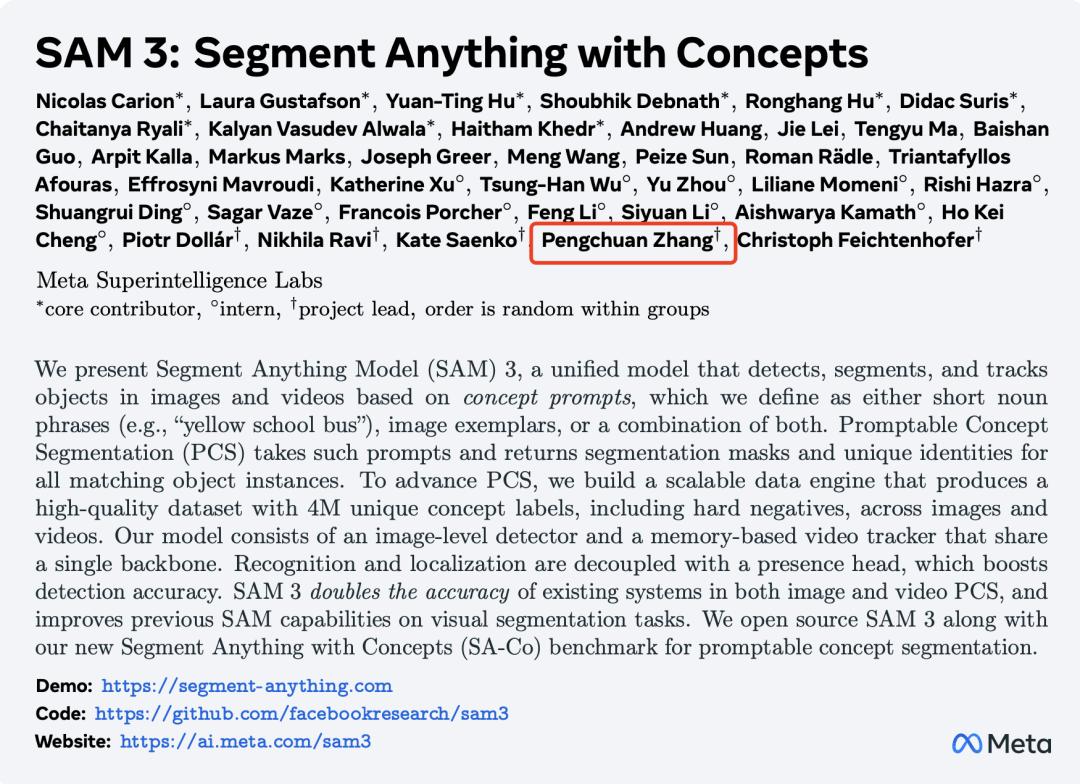
Serve as project leader for Anything Segment 3 (SAM 3): SAM 3 is an integrated framework that enables detection, segmentation, and tracking of objects in images and videos.
As the latest version of the SAM series (November 2025), this model introduces a unified framework that supports object detection, segmentation, and tracking in images and videos, and provides zero-shot generalization to arbitrary objects and scenarios.
Serve as project leader for Llama 3 Visual Groundinghe led the development of visual grounding features on the input side, making Llama 3 the first open source model to reach human-level performance on the Visual Commonsense Reasoning benchmark.
Serve as project leader for Visual Grounding of Rama 4He built on the benefits of Llama 3 and further enhanced the expert-level image fundamentals, such as pixel-level positioning and complex scene understanding, which are considered the key differentiators of Llama 4 compared to GPT-4o.
These efforts not only strengthened Meta’s competitive position in generative AI, but also contributed high-impact tools to the open source community.
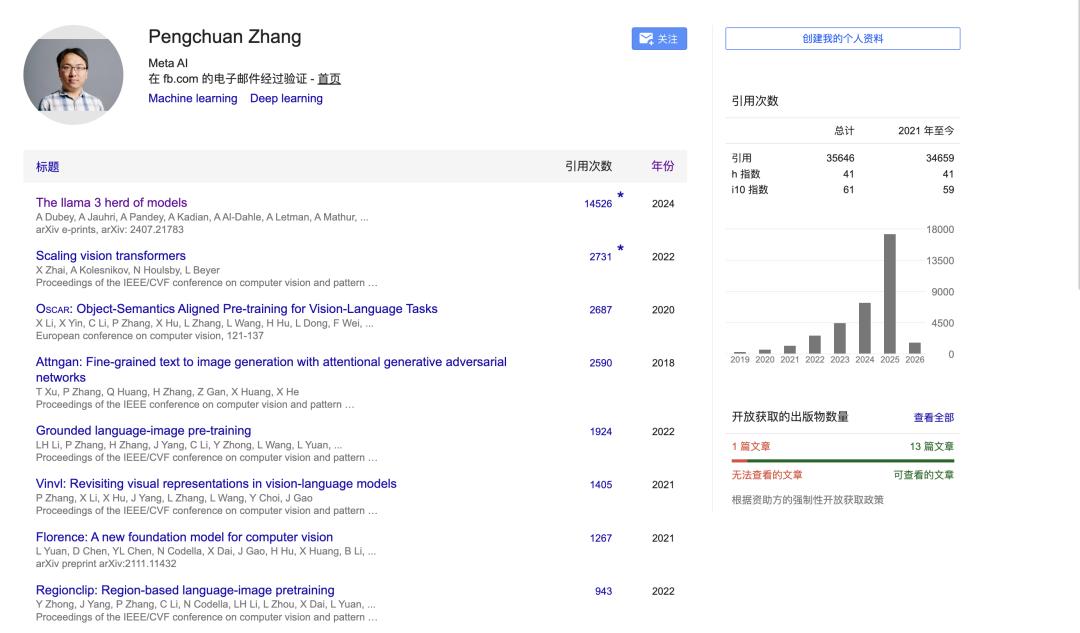
As of now, Pengchuan Zhang has 34,659 Google Scholar citations.
One more thing
Under Pengchuan Zhang’s Twitter post, a netizen couldn’t help but ask:
Why is everyone suddenly joining OpenAI? I’m so excited, but why?

This question is not out of place.
Since the end of 2025, many big names in the industry have joined OpenAI one after another.
Including top-notch personnel Lijie Chen From Yao class, Arvind KCRoblox Executive, Brendan Greggauthor of System Performance: Enterprise and Cloud, and Barrett Zoff, luke mets, Sam Schoenholtz and others who have returned from the Thinking Machine Institute.
Meanwhile, the recent wave of departures from xAI has left many wondering –
Will OpenAI be the next destination for these top researchers?
To this, netizens in the comments section answered very frankly.
Because[OpenAI]has Sora level computing power and world modeling infrastructure. Without these two, it will be nearly impossible to build truly advanced robotic systems by 2026.

If this judgment is true, Pengchuan Zhang’s choice may be more than just a personal career shift.
This is also a bet on OpenAI’s “world model + physical intelligence” approach this year.
We look forward to seeing Pengchuan’s success at OpenAI!
Reference links:
[1]https://pzzhang.github.io/pzzhang/
[2]https://scholar.google.com/quotes?hl=zh-CN&user=3VZ_E64AAAAJ&view_op=list_works
[3]https://x.com/PengchuanZ/status/2026189659228012558?s=20
This article is from the WeChat official account “QbitAI”. The author focuses on cutting-edge technology and this article is published with permission from 36Kr.