
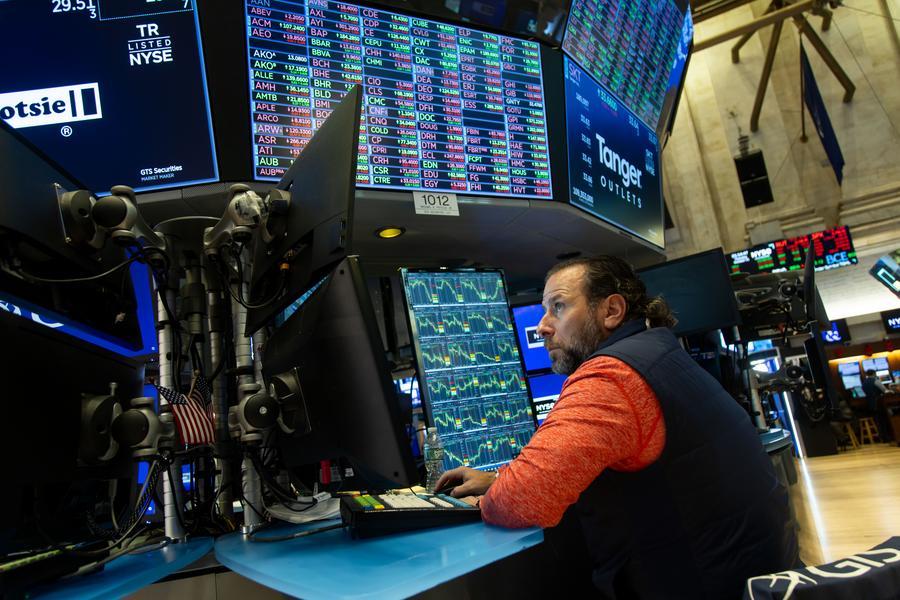
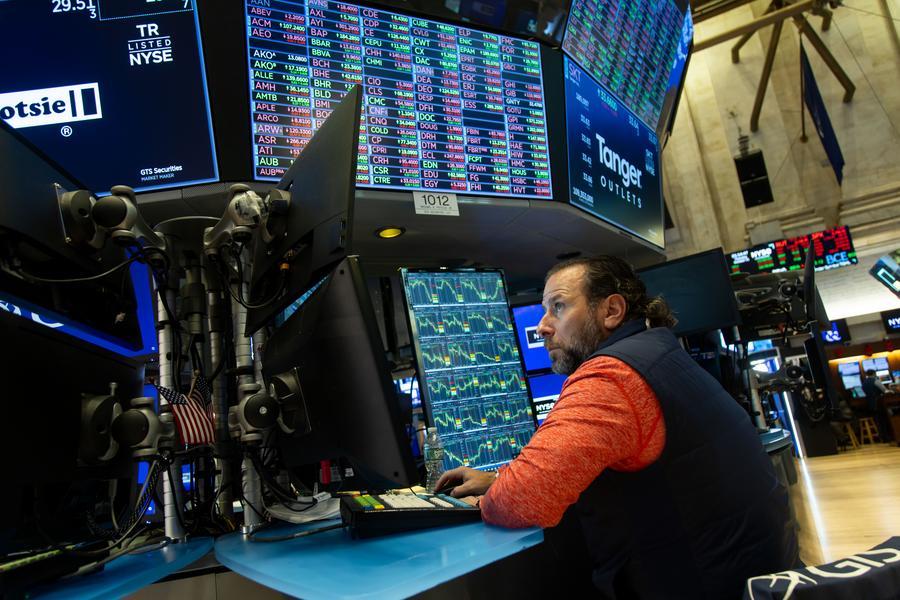
Industry experts remain wary as the financial world enters an era known as the “Agent Age,” featuring autonomous AI assistants.
LOS ANGELES, Feb. 16 (Xinhua) — Heavy losses in the U.S. technology sector this month have sparked an international debate among regulators and experts over the potential risks of artificial intelligence (AI) promoting groupthink in financial markets.
As of Friday, Microsoft stock was down about 17% since the beginning of the year, wiping about $613 billion from its market capitalization. Amazon has fallen about 13.85% so far this year, wiping out about $343 billion in market capitalization and leaving the company worth about $2.13 trillion.
The S&P 500 Software and Services Index lost about $1 trillion in market capitalization from January 28 to early February, according to data reported by Investing.com.
While some investors question whether big spending on AI will generate enough returns to justify lofty valuations, other market analysis links the selloff to a specialized legal AI tool announced by AI company Anthropic on February 3.
Some market commentators said the release could trigger a sudden exit from software and services stocks amid concerns that the limited AI models used by traders could contribute to groupthink in the financial sector.
Groupthink refers to the phenomenon in which group members prioritize consensus over independent judgment. In financial markets, such behavior can lead to a herd of investors adopting similar strategies at the same time, amplifying volatility.
Some observers warned that if most analysts relied on the same few AI models to interpret data, it could reduce the diversity of opinion needed for a healthy market. Bloomberg Opinion columnist Palmy Olson described this risk in a recent article as “market monoculture.”
“If market participants are all utilizing the same models trained on roughly the same historical data, they are likely to not only miss black swan events that have never occurred before, but also reach similar conclusions and investment strategies,” Olson wrote.
The Financial Stability Board (FSB), the international organization that oversees the global financial system, warned in a November 2024 report that the homogenization of training data and model architectures is increasing vulnerabilities.
The FSB said the widespread use of common AI models and shared data sources could increase the correlation between trading and pricing. Such uniformity could amplify market stress and exacerbate liquidity strains during a crisis, the report said.
In December 2025, the European Systemic Risk Committee published a report identifying model homogeneity as a key factor that can increase financial instability, explaining that when many companies deploy similar AI models, they can create correlated exposures and make financial institutions vulnerable to the same shocks at the same time.
Academic research also supports concerns about declining diversity of thought. A 2024 study published in the journal Science Advances found that while AI can help individuals produce more sophisticated work, it can reduce collective novelty.
In an article published last July by the Yale School of Management, Jeffrey Sonnenfeld, director of the Yale Institute for Chief Executive Officers, warned that chatbots’ vulnerability to manipulation, susceptibility to groupthink, and inability to recognize basic facts should be a warning to all users about the growing reliance on chatbots as core research.
However, some research suggests that AI may also contribute to market stability. A research paper published by the Federal Reserve in September compared AI agents to human experts and investigated how AI influences swarm behavior.
The study found that the AI model makes rational decisions between 61 and 97 percent of the time, depending on the specific model and experimental settings. Human rationality rates in similar tests ranged from 46 to 51 percent.
The paper suggests that AI could help curb the emotional and irrational behavior that often fuels asset bubbles. However, the researchers also note that AI agents could be guided to optimally swarm if explicitly instructed to prioritize profit maximization.
Industry experts remain wary as the financial world enters an era known as the “Agent Age,” featuring autonomous AI assistants.
Richard Kramer of Arete Research Services reported that Olson said that while AI will increase analyst productivity, it is unlikely to resolve deep-seated incentives to follow a consensus view. Experts say healthy financial markets require a diversity of opinions to ensure accurate pricing and prevent system-wide panic.
“It should increase the productivity of good analysts, but it doesn’t replace 50 analysts all competing to ‘congratulate management,’ ‘interpreting’ conference calls, or trying to end conflicts of interest that bias ratings almost entirely towards ‘buy,'” Cramer said. ■


