
The race to implement artificial intelligence across the enterprise has become impossible to ignore. New tools are being introduced, employees are being trained, and leaders are under pressure to show results. But for many organizations, the impact remains overwhelming, especially given the promise of AI.The problem, industry leaders said in a Times Techies Talks session held as part of Publicis Sapient’s “AI Built to Deliver” series, is that most companies are trying to make people faster, rather than rethinking the very way they do work.“If you just train people with AI, you just make faster caterpillars. To become a butterfly, you have to change jobs, workplaces, and workers all together,” said Shefali Sharma Garg, chief talent officer for India at Publicis Sapient.
expert opinion
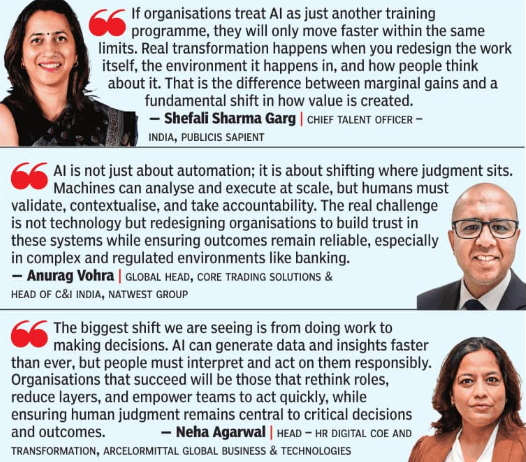
That’s a simple analogy. AI is more than just a software upgrade. It changes the way tasks are performed, teams are structured, and decisions are made. Training employees without redesigning the system often has limited impact.Publicis Sapient realized this early on. Rather than focusing solely on upskilling, we approached AI as an organization-wide transformation. “AI doesn’t just impact people,” Garg said. “The nature of the work itself and the environment in which that work takes place will change. All three need to be addressed at the same time.”To that end, the company created a dedicated transformation team to rethink everything from career paths to learning models. Garg argues that traditional training is no longer sufficient. “Learning is no longer about teaching people courses; it’s about continually building capacity for the future,” she said. “And it starts with mindset.”That mindset shift is often the hardest part. Many organizations are still trying to fit AI into old, incremental processes. But AI works differently. You can perform multiple tasks at once, speeding up your entire workflow.Garg pointed to a project where a team of 50 people was replaced by a much smaller group working in conjunction with AI tools. “We delivered faster and more efficiently,” she said. “But the real change has been in the way we work. AI allows things to be done simultaneously rather than in stages. ”find that balanceHowever, for large companies, redesign efforts are not easy. Anurag Vohra, global head of core trading solutions and head of C&I India at NatWest Group, said organizations need to rethink how they make decisions and who is accountable for them.“AI can do a lot of the heavy lifting, but humans still need to make decisions and take responsibility for the results,” he said. “It’s a transition from someone who does the work to someone who guides and validates it.”This requires deeper structural changes. Many companies are still built around layers of approvals and sequential workflows, slowing down the benefits that AI can bring. “Our structure was not designed for this kind of speed and interaction,” Vohra says. “To really reap the benefits, organizations need to rethink their structure, not just add AI.”In industrial settings, this change is less about uniform adoption and more about where AI can meaningfully enhance work.“In heavy industry, many tasks remain physical and safety-sensitive,” said Neha Agarwal, Head of HR Digital CoE and Transformation, ArcelorMittal Global Business & Technologies. “AI adoption is much more powerful in the enterprise sector than in manufacturing.”But even there the nature of work is changing. Routine and repetitive tasks are increasingly automated, while the role of humans shifts to judgment and decision-making. AI also speeds up decision-making by reducing layers of analysis. “Previously, there might have been multiple layers of reviewing data,” she explained. “AI can now compress that process, allowing teams to move faster.”