Topic modeling is a technique for uncovering thematic structures underlying large text corpora. Traditional topic modeling techniques, such as Latent Dirichlet Allocation (LDA), are limited in their ability to generate specific and interpretable topics, which can make it difficult to understand document content and make meaningful connections between documents. These models also offer limited control over topic specificity and format, hindering their practical application in content analysis and other fields that require clear thematic classification. In this paper, we aim to address these limitations by proposing TopicGPT, a novel method that leverages large-scale language models (LLMs) to generate and refine topics in corpora.
Traditional topic modeling methods such as LDA, SeededLDA, and BERTopic have been widely used to explore latent thematic structures in text collections. LDA represents topics as distributions of words, which can result in inconsistent and difficult to interpret topics. SeededLDA uses user-defined seed words to guide the topic generation process, while BERTopic uses contextualized embeddings for topic extraction. Although these models are useful, they often fail to generate high-quality and easily interpretable topics.
TopicGPT is a new framework that distinguishes itself from previous methods in several key ways. It leverages large-scale language models (LLMs) for prompt-based topic generation and assignment, aiming to generate topics that are closer to human categorization. Unlike previous methods, TopicGPT provides natural language labels and descriptions for topics, increasing their interpretability. The framework is also capable of generating high-quality topics, providing users with the ability to refine and customize topics without the need to retrain models.
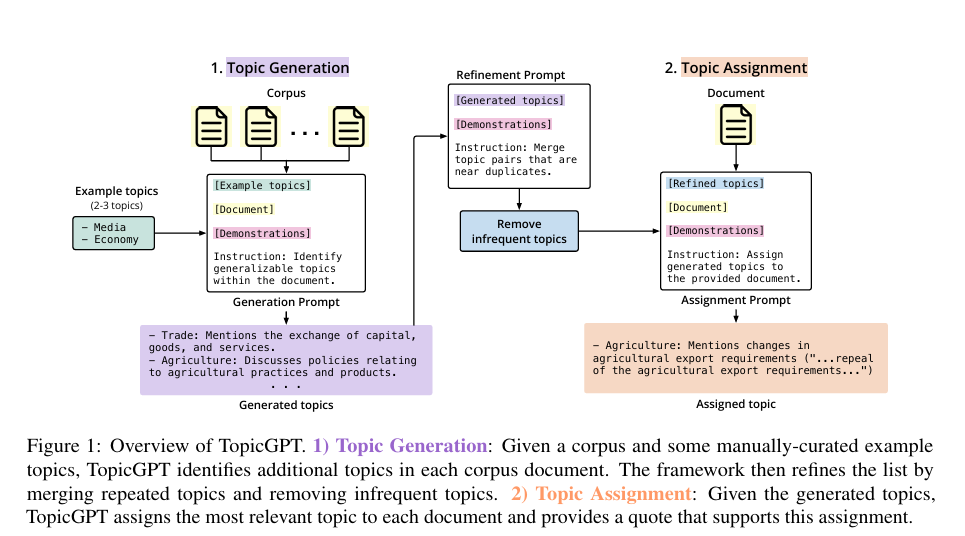
TopicGPT works in two main stages: topic generation and topic assignment. In the topic generation stage, the framework repeatedly instructs LLM to generate topics based on samples of documents from the input dataset and a list of previously generated topics. This process encourages the creation of distinctive and specific topics. The generated topics are then refined to remove redundant and infrequent topics to ensure a consistent and comprehensive set. The LLM used for topic generation is GPT-4, while GPT-3.5-turbo is used for the assignment phase.
In the topic assignment stage, LLM assigns topics to new documents by providing citations from documents that support the topic assignment, increasing topic verifiability. Our method is shown to generate high-quality topics compared to traditional methods, achieving a harmonic mean purity of 0.74 for human-annotated Wikipedia topics, compared to 0.64 for the strongest baseline. TopicGPT topics are semantically consistent with human-labeled topics and have significantly fewer mismatched topics than LDA.

The performance of the framework was evaluated on two datasets: Wikipedia articles and Congressional bills. The results showed that TopicGPT's topics,assignments are more consistent with actual topics annotated by,humans than those generated by LDA, SeededLDA, and BERTopic.,The researchers measured topic agreement using external,clustering metrics such as harmonic mean purity, normalized,mutual information, and adjusted Rand exponent, and found,significant improvements over baseline methods.
TopicGPT is a groundbreaking advancement in topic modeling, not only overcoming the limitations of previous methods but also offering practical benefits. Using a prompt-based framework and combined features from GPT-4 and GPT-3.5-turbo, TopicGPT generates consistent, human-aligned topics that are interpretable and customizable. This versatility makes it a valuable tool for a wide range of applications such as content analysis, and is expected to revolutionize the field of topic modeling.
Please check paper. All credit for this research goes to the researchers of this project. Also, don't forget to follow us: twitter.
participate Telegram Channel and LinkedIn GroupsUp.
If you like our work, you will love our Newsletter..
Please join us 44k+ ML Subreddit


Shreya Maji is a Consulting Intern at MarktechPost. She did her B.Tech from Indian Institute of Technology (IIT), Bhubaneswar. An AI enthusiast, she enjoys staying updated with the latest advancements. Shreya is particularly interested in practical applications of cutting edge technologies, especially in the field of Data Science.