


The Open AI logo can be seen in this illustration taken on August 26th.
December 17, 2025 7:00 (Japan time)
To scale up the appropriate use of artificial intelligence, many challenges need to be addressed in areas such as education, employment, and industry. As the use of generative AI progresses rapidly, we need to reconsider how it is developed and used, and create an appropriate usage environment.
The Yomiuri Shimbun has compiled recommendations for coexistence with reliable generative AI in order to create an environment in which generative AI can be utilized. These recognize that AI is a technology that is deeply connected to national strength and the lives of its people, from economic security to the formation of new ideas, and emphasize the need to protect Japan's independence.
Currently, the United States and China are leading the way in AI development, with U.S.-based OpenAI and China's DeepSeek dominating international rankings for the performance of generative AI systems.
In Japan, companies such as NTT Corporation and SoftBank Corp. are developing domestic AI models. Preferred Networks, Inc. and the National Institute of Information and Communications Technology are jointly developing an AI system that utilizes computers from the National Institute of Advanced Industrial Science and Technology. However, it is also true that AI models developed by foreign companies are widely used in Japan.
The “content” of AI models tends to be opaque in many respects, raising concerns that the responses provided by any of these systems may be influenced by prevailing ideas and principles in the country in which they were developed. The impact this has on children's development in terms of ideology cannot be ignored, as it can lead children's thinking in a certain direction.
The proposal emphasizes the need for government-led development of highly reliable AI models that fully reflect the ethical standards and values that Japanese society has cultivated, in light of the risks of over-reliance on foreign-made AI systems.
Increased use of Japanese-made AI systems could reduce payments from Japan to foreign companies and curb the drain on national wealth. Currently, Japan pays foreign companies for digital services by more than 6 trillion yen a year more than it receives.
The proposal states that the data used to develop AI in Japan should ideally contain as accurate information as possible about Japan.
In addition, high-quality Japanese data is essential for developing AI that fully understands Japanese ethics and values, and it is urgent to create an environment that allows for the collection and use of a wide range of data.
A circle of reliable AI
The proposal also outlines a vision for an international network connecting “trusted AI models” developed by countries. Countries such as the UK, France, India and South Korea are moving to develop and operate their own AI models to avoid dependence on foreign models. This vision aims to lead to the creation of an international circle of “trusted AI models” in which all member countries recognize each other’s models.
For example, when researching countries participating in a network, an AI model that reflects the characteristics of that country can provide accurate information, reducing the risk of spreading false information. The proposal states that this will promote the use of Japanese-made AI systems overseas and meet the needs of foreigners.
In 2023, the Hiroshima AI Process, a set of international rules regarding generative AI, was agreed upon by the G7, led by Japan.
This proposal calls for the use of the Hiroshima AI Process Friends Group, an international framework for balancing the regulation and use of generative AI, when building a network of “trusted AI models.” This group is made up of countries and regions that support the spirit of the Hiroshima AI Process.
social and educational concerns
The proposal also calls on governments to quickly address the downsides of AI, such as job losses and widening inequality.
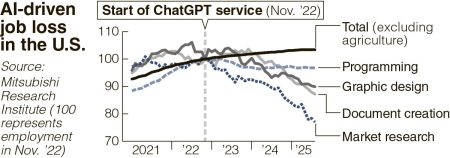
In the United States, employment has continued to decline in certain industries since the introduction of ChatGPT in 2022. According to Mitsubishi Research Institute, the decline was particularly large in areas such as document preparation, computer programming, and market research. In the market research sector, employment has declined by up to 23 percentage points since November 2022. “The impact on employment will be felt in Japan within a few years,” said researcher Yuta Asai.
The recommendations call on the government to take proactive measures to prevent social unrest.
The proposal also addresses the dangers of reliance on AI and its implications for education, noting that increased use of generative AI on a daily basis could lead to people becoming overly dependent on the technology, leading to a lack of thinking.
The proposal highlights particular concerns about the use of AI by young people, calling for the use of generative AI with the utmost care and awareness of the risks of the technology during compulsory schooling, when children develop critical thinking and other skills.


