Generative Flow Networks (GFlowNet) address the complex challenge of sampling from non-normalized probability distributions in machine learning. By learning a policy on a constructed graph, GFlowNet facilitates efficient sampling through a series of steps to approximate a target probability distribution. This innovative approach sets GFlowNet apart from traditional methods by providing a robust framework for handling complex sampling tasks.
A persistent problem in probability modeling is the difficulty of sampling from complex, non-normalized distributions that feature multiple modes separated by low probability regions. Traditional methods such as Markov Chain Monte Carlo (MCMC) have difficulty dealing with these distributions, often leading to mode collapse. This phenomenon occurs when the sampling process is limited to a single mode, resulting in a lack of diversity in the generated samples and limiting the validity of the model.
Current methods such as MCMC algorithms are widely used to sample from complex distributions. These methods generate random samples by simulating a Markov process in the sample space, eventually converging to the target distribution. However, MCMC has significant limitations, especially when regions of low probability mass separate the modes of the reward function. Since the probability of transitioning from one mode to another is exponentially small, MCMC samples can become entangled in one mode, reducing the diversity of the generated objects. Furthermore, MCMC methods for discrete objects with combinatorial constraints are not as well developed as those for continuous objects, further limiting their applicability.
Researchers at the University of Montreal-Mira introduced GFlowNets as a potential solution to overcome these limitations. GFlowNets aims to provide a robust framework for sampling from non-normalized distributions by learning a policy that approximates the target distribution. The research team focused on designing experiments to formalize GFlowNets' generalization and test its ability to discover unseen parts of reward functions. This approach leverages GFlowNets' strength of capturing complex patterns in reward functions and generalizing it effectively to new unseen parts.

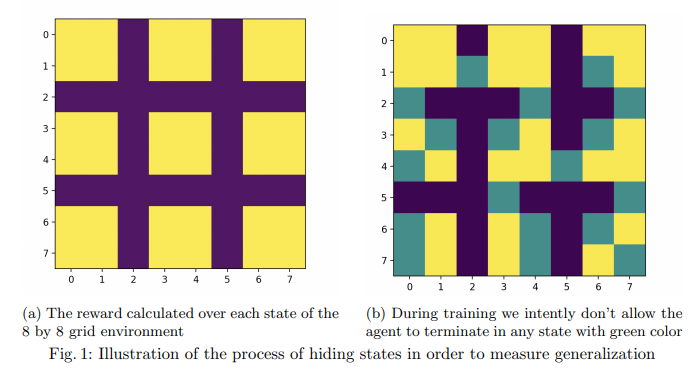
GFlowNets work by constructing a policy that models the sequence of actions that lead to a terminal state in a directed acyclic graph. The generation process samples from this policy to generate new samples from a target distribution. Researchers proposed the Trajectory Balance loss as a way to train GFlowNets. This loss function provides necessary and sufficient conditions for the learned policy to accurately approximate the target distribution, allowing for tractable optimization without defining flow estimates. The Trajectory Balance loss involves learning a forward transition policy and a backward probability transition function, facilitating efficient sampling.
The performance and results of GFlowNet were evaluated through a series of experiments designed to test its generalization ability. The results demonstrated that GFlowNet trained with detailed balanced loss outperformed those trained with other objectives, showing its robustness and effectiveness. Specifically, the policy derived from the detailed balanced loss showed good generalization ability and successfully reconstructed hidden parts of the reward function. For example, in one experiment, the policy was able to generalize to conditions requiring longer trajectories than those seen during training, highlighting its robustness and effectiveness.

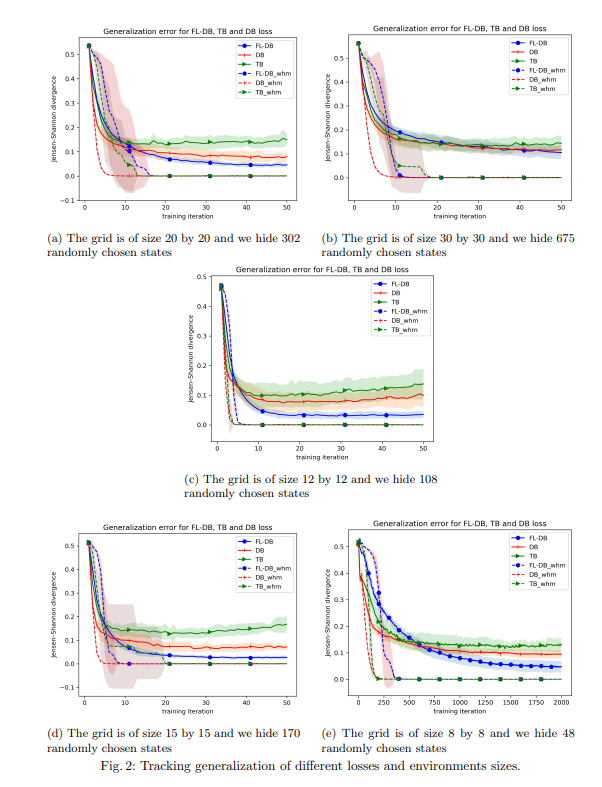
Experiments reveal quantitative results that highlight the advantages of GFlowNet. One notable point is that policies trained with a detailed balance loss perform better than policies trained with a trajectory balance loss. The Jensen-Shannon divergence, used to measure the divergence between learned and target distributions, has lower values for the detailed balance policy, indicating better generalization. This result suggests that the choice of training objective plays an important role in the model's ability to effectively generalize.
In conclusion, this work tackles the grand challenge of sampling from complex, non-normalized distributions by introducing GFlowNet. The proposed method exhibits strong generalization capabilities and offers a promising alternative to traditional sampling methods such as MCMC. Our findings suggest that GFlowNet, especially when trained with a detailed balance loss, may lead to more robust and diverse sampling techniques in probabilistic modeling. This advance marks an important contribution from the Université de Montréal Mira research team and highlights the potential of GFlowNet to revolutionize sampling methods in machine learning.
Please check paper. All credit for this research goes to the researchers of this project. Also, don't forget to follow us. twitter.
participate Telegram Channel and LinkedIn GroupsUp.
If you like our work, you will love our Newsletter..
Please join us 46k+ ML Subreddit


Nikhil is an Intern Consultant at Marktechpost. He is pursuing a dual degree in Integrated Materials from Indian Institute of Technology Kharagpur. Nikhil is an avid advocate of AI/ML and is constantly exploring its applications in areas such as biomaterials and biomedicine. With his extensive experience in materials science, Nikhil enjoys exploring new advancements and creating opportunities to contribute.