
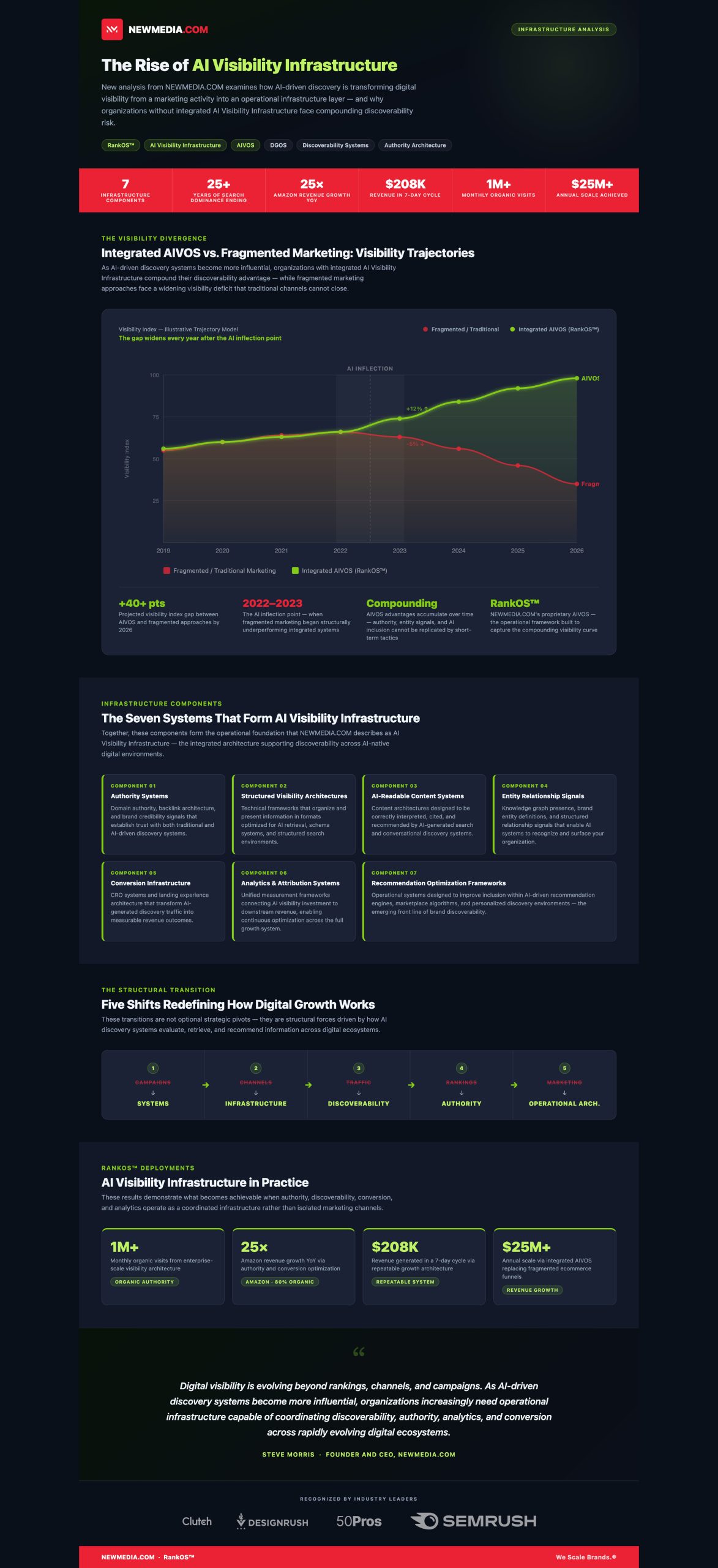
New York, NY, June 24, 2026 (Globe Newswire) — NEWMEDIA.COM releases new analysis on the emergence of AI visualization infrastructure. AI visibility infrastructure is an integrated system and operational framework that determines whether a brand is discoverable, citable, and recommended across an AI-driven search, recommendation, and retrieval environment.
What is AI visualization infrastructure?
AI visibility infrastructure refers to the integrated systems, content architecture, and operational frameworks that help organizations remain discoverable and quotable as AI systems increasingly mediate the way people research and select companies. This spans search visibility, authority signals, structured AI-readable content, entity definition, analytics and attribution, and transformation. The crucial idea is that these are no longer separate campaigns. The AI engine that assembles the answers uses them all at once, so they work as one coordinated system.
According to NEWMEDIA.COM, this marks a shift in digital visibility. For 20 years, visibility has been a marketing activity primarily measured by search rankings. As AI-generated search, conversational assistants, and recommendation systems play a larger role in discovery, visibility is moving closer to the infrastructure—the foundation that companies operate and maintain, rather than the set of campaigns they run and stop.
Moving from search ranking to AI discovery
For most of the history of digital marketing, being found meant ranking on a list of links, supported by paid advertising, content, and social distribution. Those channels are still important. What has changed is the demographic in front of them now. Buyers are increasingly first encountering brands through AI-generated summaries, conversational search, recommendation engines, and AI-assisted commerce, and they often act on aggregated answers before visiting individual websites.
The scale of that change is becoming measurable. Gartner predicts that the volume of traditional search engines will decline significantly as consumers move their questions to AI assistants and other virtual agents. As the proportion of surveys answered by AI increases, the question for brands will no longer be just where they rank. What matters is whether it’s included in the answer and whether the answer presents your brand as a reliable option.
This is the distinction NEWMEDIA.COM takes center stage: between being cited and being recommended. AI systems may use your brand as a source of information without presenting your brand as an employer. For commercial decision-making, a more valuable outcome is to move from occasional citations to consistent recommendations, which requires intentional work on entity clarity, substantiation, and authority, not just keyword optimization.
Why visualization is becoming infrastructure
When assembling answers, the AI system rewards brands that are clearly defined and consistently described wherever they appear. This favors organizations whose underlying systems are mutually consistent. NEWMEDIA.COM has identified several components that are currently shaping discoverability and that increasingly need to work together rather than alone.
- An authority system that builds trusted and substantiated references across the web.
- AI-readable content and structured data that machines can parse and trust.
- Entity and relationship signals that define what a brand is and what it does.
- Analytics and attribution that turns visibility into revenue.
- A transformation infrastructure that turns discoveries into measurable outcomes.
Even though each of these may seem healthy when treated individually, your brand may not yet surface in the AI’s answers. These are treated as one architecture, reinforcing a single, consistent story that the AI engine can recognize and repeat. That coordination is what NEWMEDIA.COM stands for as AI visualization infrastructure.
How the AI engine selects and cites sources
Understanding why infrastructure matters means understanding how AI systems actually move from questions to cited answers. Although the platforms differ in detail, their paths are broadly consistent and brands can be excluded at any stage.
- Crawl and indexing: Content must be accessible and indexed to be eligible for inclusion.
- Entity recognition: The system must identify the brand as a well-defined, distinct entity. This relies on consistent names and descriptions across the web.
- Substantiation: As brand claims are checked against other reliable sources, weak, missing, or contradictory references weaken trust.
- Search and synthesis: The system assembles an answer from the most trusted sources, often issuing several related subqueries to do so.
- Quotes and Endorsements: Brands are named as sources or, more valuable, presented as options for buyers to choose from.
Each step maps to a different part of the infrastructure. Indexing and structured content depend on technical systems, entity recognition depends on consistent definitions, corroboration depends on acquired authority, and recommendations depend on the agreement of all of them. Isolated tactics tend to underperform, as a weakness at any stage will break the chain. Even if a brand has a strong classic ranking, it can be dropped at the entity recognition and substantiation stage. This is because the systems that provide information to these stages are completely uncoordinated.
For buyers, the benefits are tangible. Improving one stage in isolation, such as publishing more content or getting more links, rarely drives AI recommendations on its own. By arranging the stages so that your brand is defined, backed, structured, and measured as one system, you will reap lasting benefits. This coordination is a real case of an AI visualization operating system, rather than a set of disconnected services, and is the layer on which NEWMEDIA.COM focuses its work.
Why fragmented marketing structures struggle
Many organizations still run search, paid media, digital PR, conversion optimization, analytics, and content as independent functions, often across separate teams and vendors. In an environment where AI systems value consistency and certainty, that fragmentation poses particular challenges.
- Inconsistent signals of authority, with brands expressing themselves differently in different locations.
- Disconnected customer journeys that AI systems can’t trace cleanly.
- Weak linkage between content, technical structure, and acquired authority.
- Acquisition costs overlap and clarity of attribution is limited.
The cost of fragmentation is not a new observation. A McKinsey & Company study on an integrated omnichannel approach found that organizations that aligned their channels achieved significantly higher annual growth than those that operated in a more fragmented and scattered manner. AI-driven discovery increases the risk of that discovery as the engine rewards the same adjustments that the integrated operator is already pursuing.
From operating system to results: NEWMEDIA.COM’s approach
If the AI visualization infrastructure is the foundation, then the AI visualization operating system manages it. RankOS™, developed by NEWMEDIA.COM, is the company’s operating system for coordinating these components rather than running them as separate efforts. It is built around three connected layers: a site and conversion layer that clearly defines your brand on its own page, an authority layer built through analytics earned media, and an AI visualization layer that monitors citations and recommendations and feeds your next work.
In practice, this means that the same system governs how the brand is described, how the brand is backed, how the page is structured for the machine, and how visibility is measured against revenue. NEWMEDIA.COM connects this directly to commercial work such as AI search optimization. So the goal is not abstract visibility, but moving from citations to recommendations in queries that drive the pipeline. Google’s own guidance for site owners is consistent with this approach. We highlight that the same fundamentals of useful, well-structured content that support search also support incorporation into AI capabilities. This means there are no shortcuts, only well-tuned systems.
Introducing RankOS™
This approach is based on client outcomes rather than theory. NEWMEDIA.COM’s recent RankOS™ deployment includes an integrated visibility and transformation system that has delivered massive results across direct-to-consumer and business-to-business operations.
Documented examples include growing a D2C brand to approximately $78 million, driving 22x growth in a high-value B2B e-commerce business, generating over $15 million in D2C revenue, and growing a low-value D2C brand to approximately $20 million. In each, the common denominator was adjustment. This meant discoverability, permissions, conversions, and analytics were operated as one system rather than as separate campaigns.
independent evaluation
NEWMEDIA.COM’s position is reinforced by third-party recognition in leading agency directories and awards (as of June 2026).
Clutch: Clutch profile with verified customer reviews and recognized as a Clutch Global Leader in 2023, 2024, and 2025.
- UpCity: Award of Excellence in 2023, 2024, and 2025.
- Inc. 5000: Named America’s Fastest Growing Agency four years in a row.
- Other recognitions include winning the Mashable Global Award and being repeatedly recognized as a top web design agency by regional business magazines.
NEWMEDIA.COM also publishes its own research through RankOS™. A December 2025 benchmark found that approximately 87 percent of U.S. businesses do not appear in AI-generated search results, even if they rank on the first page of Google. AI visualization infrastructure is being built to fill this gap.
From campaigns to discovery systems
Taken together, these changes represent a broader structural shift in digital growth: from campaigns to systems, channels to infrastructure, traffic to discoverability, and rankings to authority. The organizations most at risk are those that still rely on siled tactics for visibility, as they can see their presence in AI answers quietly decline while their traditional rankings remain stable. NEWMEDIA.COM argues that the opportunity lies with those who treat visibility as infrastructure and operate it intentionally.
executive commentary
“Digital visibility has evolved beyond rankings, channels and campaigns,” said Steve Morris, Founder and CEO of NEWMEDIA.COM. “As AI-driven discovery systems grow in influence, organizations need operational infrastructure to orchestrate discoverability, permissions, analytics, and conversion across a rapidly evolving digital ecosystem. The brands that win are not the ones running the most campaigns; they are the ones operating the most consistent systems, because AI engines are built to recognize and make recommendations.”
important facts
|
Related resources
About NEWMEDIA.COM
Founded in 1996, NEWMEDIA.COM is a full-service digital marketing agency headquartered at One World Trade Center (285 Fulton Street, Suite 8500) in New York City with teams located throughout North America. The agency has completed more than 4,500 engagements for more than 1,000 clients across more than 50 industries, spanning website design and development, e-commerce, search engine optimization, paid media, conversion rate optimization, digital PR, and AI search optimization. NEWMEDIA.COM is the creator of RankOS™, the AI Visibility operating system that impacts the way brands are displayed, cited, and recommended across Google, AI Overviews, ChatGPT, Perplexity, and Gemini. The company operates under the trademark We Scale Brands.
For more information, please visit newmedia.com.
-
Rise of AI Visualization Infrastructure | Discoverability System Analysis


