
image:
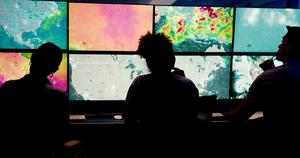
ECMWF’s AI Weather Quest background image
view more
Credit: ECMWF’s AI Weather Quest
AI Weather Quest’s competitors use AI technology to create sub-seasonal weather forecasts, which are forecast time ranges that bridge the gap between long-term and short-term forecasts, which is essential for regions to prepare for extreme weather events such as cyclones and cold waves.
The team, which spans 15 countries, will wait for actual weather events to unfold to see how accurate their predictions turn out to be.
The competition, organized by the European Center for Medium-Range Weather Forecasts (ECMWF), aims to foster collaboration and innovation in subseasonal weather forecasting, which is notoriously difficult to predict at this time of day due to complex interactions in the atmospheric circulation.
Unlike seasonal forecasts, subseasonal forecasts predict conditions within a specific period of the season and help indicate when communities will be affected. You can also narrow down your forecasts from large continental areas to much more specific regional locations than seasonal forecasts.
For example, seasonal forecasts indicate an increased likelihood of cyclones occurring over large areas of the Indian Ocean, while subseasonal forecasts can predict risk at a more specific regional level, such as northwestern Madagascar. Similarly, instead of predicting an increased risk of cold conditions across Europe, a subseasonal forecast might highlight that winter hazards are likely to occur at a country level, such as France, during a particular period.
This increased level of detail allows communities to get resources to the right places and take actions such as preparing for evacuation, reinforcing homes, stocking food, and more.
In the competition, which attracted 42 teams in its first year, participants submit weekly subseason predictions and are scored on how accurate their models turn out to be. Weekly scores are then displayed live on the AI Weather Quest website and aggregated for each 13-week competition period.
Today, ECMWF revealed that MicroEnsemble is the winning team for the latest period, December 2025 to February 2026 (DJF 2025/26).
The team, led by Microsoft and comprised of scientists with strengths in meteorology, engineering, statistics, and AI, had the most consistent performance across the following weather variables: temperature, mean sea level pressure, and precipitation. Their approach uses AI technology to post-process state-of-the-art dynamic predictions from ECMWF.
Speaking on behalf of the team, Lester Mackey, Senior Principal Scientist at Microsoft Research, said:
”Working on AI Weather Quest was an exhilarating process and a valuable learning experience in improving our probabilistic forecasts. We believe our success comes from building great teams with complementary strengths in meteorology, engineering, statistics, and AI, and a shared passion for building solutions that benefit society. We look forward to continuing to improve our subseasonal prediction technology and collaborating with ECMWF and other subseasonal AI developers.. ”
The leaderboard remains close to the top, with China-based team MicroEnsemble finishing just above LP, which came in second place with a three-week forecast and third with a four-week forecast. ECMWF’s own team placed third in the three-week forecast and fourth in the four-week forecast.
All three teams have demonstrated rapid progress in both post-processing and purely data-driven approaches, and these will continue to evolve in the next period of the competition as teams refine their models through this real-time benchmarking process.
Speaking on behalf of the LP team, Lu Peng, senior engineer at Jiangsu Provincial Climate Center, said:
“We are very grateful to ECMWF for giving us such a valuable opportunity to test our ideas in an environment that approximates real-world predictions. Our simple approach to predicting precipitation requires less than 100 lines of additional code and runs in less than 10 seconds on a regular computer without a GPU. This shows that valuable experiments can be done using relatively simple tools that many people have access to. By collaborating with participants from diverse backgrounds who share strong expertise and enthusiasm, we can work towards developing the next generation of predictive systems.”
Most entries came from Europe, China, and the United States, but teams from Niger, Morocco, Kenya, South Africa, Peru, and South Korea also participated, reflecting the global reach of AI/ML approaches to forecasting.
Kenya-based team Fahamu continually submits forecasts and has pioneered the use of Anemoi technology, which enables operational sub-seasonal forecasts in developing countries.
Nishad Karadas, data scientist and machine learning expert at IGAD Climate Prediction and Applications Center (ICPAC), said on behalf of the team:
“AI Weather Quest provides a unique opportunity for operational forecasting centers, researchers, and experts working in weather and climate to collaboratively explore how new AI techniques can complement and extend traditional weather forecasting systems. This collaboration is essential if we want AI-powered weather and climate predictions to be part of an operational early warning system that benefits communities on the ground. For our teams in East Africa, reliable sub-seasonal forecasts are essential to improve early warning systems and support proactive action against hazards such as droughts and floods. AI Weather Quest allows you to test how AI-based ensemble prediction systems can be translated into actionable information for decision makers.”
ECMWF’s own team in the competition applied an Artificial Intelligence/Integrated Forecasting System (AIFS) to present the highest ranking pure data-driven model, i.e. a model that does not use output from traditional physically-based weather models as input.
“We’re excited to see more weather forecasts than ever before,” said Jakob Schloer, a data-based subseasonal forecast scientist at ECMWF and leader of Weather Quest’s AIFS team.
“AI Weather Quest provides an excellent opportunity to test different versions of your AIFS model in real time during the early stages of development. This is exciting for the team and really fun. We are pleased to see that AIFS has established itself as the best-performing pure data-driven model in the competition. But what makes it especially valuable is the chance to see how other teams are tackling the same challenges, especially those combining traditional numerical methods with machine learning. Ultimately, we all learn from each other, which advances the field as a whole.”
The competition, funded by the European Union through the Destination Earth initiative and approved as a World Meteorological Organization (WMO) WMO Integrated Processing and Prediction System (WIPPS) pilot project, is currently at the halfway point of its first round. Olga Loegel, user outreach and engagement associate at ECMWF and head of the AI Weather Quest organization, concludes:
“AI Weather Quest is not only a transparent benchmark for evaluating how artificial intelligence performs in subseasonal weather forecasting. It is also a global learning framework. Our collaborative approach, bringing together researchers, weather services and industry from ECMWF member countries, partner countries and the international community, creates a shared space to exchange insights on where and how AI can improve forecasts. This is key to building robust scientific evidence, strengthening confidence in new methods, and ultimately improving predictions that support decision-making around the world. Everyone who competes, regardless of their position, contributes to this cause.”
Check out our latest blog post to learn more.
A webinar on Thursday, March 19th will feature some of the top candidates and announce their results. You can sign up here: https://events.ecmwf.int/event/486/
For more information, how to participate, and leaderboard updates, visit https://aiweatherquest.ecmwf.int/.


