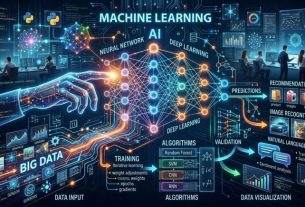
Once a futuristic fantasy, artificial intelligence is rapidly becoming woven into the fabric of modern life. From personalized recommendations to self-driving cars, machine learning algorithms are powering a growing number of applications. However, this computing revolution comes at the cost of significantly increasing energy demands. While the potential of AI lies in its ability to optimize efficiency across a variety of sectors, training and operating these complex models is surprisingly energy-intensive. This is not just a problem of higher electricity bills. This is a fundamental challenge to the sustainability of the AI revolution and requires a re-evaluation of algorithm design and hardware infrastructure. The relationship between computation and energy is not new, but the scale and speed of AI growth is unprecedented, forcing us to confront the thermodynamic limits of intelligence.
Rolf Landauer’s legacy: information as a physical product
The fundamental relationship between computation and energy consumption was first articulated in 1961 by Rolf Landauer, a physicist at IBM Research. Landauer established the principle that erasing one bit of information requires a minimum amount of energy dissipation. kTln(2) Joule, here k is the Boltzmann constant, T is the absolute temperature. This is a fundamental law of thermodynamics, not a practical limit such as the speed of light. In other words, forgetting comes at a physical cost. At room temperature, this equates to a tiny amount of energy, but the sheer scale of data processing in modern AI systems significantly increases this cost. Although initially met with skepticism, Landauer’s research has become increasingly important as the world grapples with the energy demands of the digital age. This emphasizes that information is not ethereal. It is physically embodied and requires energy to operate. This principle underpins the energy cost of every machine learning algorithm, from simple linear regression to the most complex deep neural networks.
The rise of deep learning and parameter problems
The current surge in AI energy consumption is primarily driven by the rise of deep learning, a subfield of machine learning that utilizes artificial neural networks with multiple layers. These networks are inspired by the structure of the human brain and excel at tasks such as image recognition, natural language processing, and game play. However, that power comes at a price. Deep learning models are characterized by a huge number of parameters, which are tunable variables that the algorithm learns during training. GPT-3, a large-scale language model developed by OpenAI, boasts a significant number of parameters, but newer models like PaLM 2 and GPT-4 are rumored to have even more. Training these models requires processing huge datasets and performing trillions of calculations, consuming large amounts of energy. The more parameters a model has, the more energy it requires for training and operation, creating scaling issues that can outweigh energy efficiency improvements.
The carbon footprint of large language models: A growing concern
The environmental impact of training large-scale language models (LLMs) is significant. A 2019 study by Strubell et al. It is estimated that training a single large-scale NLP model can produce the same amount of carbon dioxide as five cars over its entire lifecycle. Since then, models have become significantly larger and more complex, so this number may be an underestimate. Energy expenditure is not limited to the training phase. Even running an LLM trained for inference and generating responses to user queries requires significant power. The proliferation of LLM-powered chatbots and virtual assistants has exacerbated this problem. AI’s carbon footprint is not evenly distributed. The majority of energy consumption is concentrated in the hands of a few large technology companies that have the resources to train and deploy these models. This raises questions about environmental justice and the need for more transparency and accountability.
Jeffrey Hinton and the backpropagation bottleneck
A key component of training deep learning models is the backpropagation algorithm, developed in the 1980s by Geoffrey Hinton, a cognitive psychologist and computer scientist at the University of Toronto. Backpropagation allows a model to adjust parameters based on the difference between predicted and actual values. However, this process is computationally expensive and requires multiple passes through the entire dataset. Deep learning pioneer Hinton recently expressed concerns about the energy efficiency of backpropagation and is exploring alternative training methods. He argues that current approaches are fundamentally inefficient and new algorithms are needed to reduce the energy costs of AI. The backpropagation bottleneck highlights the need for algorithmic innovation to address deep learning’s energy challenges.
Beyond backpropagation: Exploring alternative learning paradigms
Researchers are actively exploring alternative learning paradigms that can reduce the energy consumption of AI. One promising approach is spiking neural networks (SNNs). This mimics the way biological neurons communicate using discrete spikes of electricity. SNNs are inherently more energy efficient than traditional artificial neural networks because they only consume power when spikes occur. Another area of research is neuromorphic computing. It aims to build hardware that directly implements the principles of biological neural networks. These chips, designed by researchers such as IBM’s Dharmendra Modha, promise significant energy savings compared to traditional CPUs and GPUs. In addition, techniques such as pruning, which removes unnecessary connections from neural networks, and quantization, which reduces the precision of parameters, reduce model size and computational complexity, leading to lower energy consumption.
David Deutsch and the promise of quantum computing
Although current AI systems rely on classical computers, quantum computing offers a potential means to dramatically reduce energy consumption. David Deutsch, an Oxford physicist and pioneer of quantum computing theory, demonstrated in 1985 that quantum computers can solve certain problems exponentially faster than classical computers. This speedup can lead to significant energy savings for AI applications. Quantum machine learning algorithms, such as quantum support vector machines and quantum neural networks, are being developed to harness the power of quantum computers. However, quantum computing is still in its early stages of development, and building stable and scalable quantum computers remains a major technical challenge. The realization of fault-tolerant quantum computers could revolutionize AI, but it could be decades before this technology is widely available.
Hardware bottlenecks: specialized accelerators and energy-efficient chips
Even as algorithms improve, the underlying hardware plays a key role in determining the energy efficiency of AI. Traditional CPUs and GPUs are not optimized for the types of computations performed by machine learning algorithms. This has led to the development of specialized accelerators designed to accelerate deep learning workloads, such as Google’s Tensor Processing Units (TPUs) and NVIDIA’s Tensor Cores. These accelerators can deliver significant performance gains while consuming less energy compared to general-purpose processors. Additionally, researchers are exploring new materials and architectures to build more energy-efficient chips. For example, resistive random access memory (ReRAM) and memristors offer the possibility of storing and processing data in the same location, reducing the energy cost of data transfer.
Gil Karai’s skepticism and the limits of scalability
Despite the potential for algorithmic and hardware improvements, some researchers remain skeptical about the long-term sustainability of the current AI trajectory. Gil Karai, a mathematician at Hebrew University known for his critical views on quantum computing and AI, argues that the rapid increase in model size and data requirements is unsustainable. He suggests that we are approaching a fundamental limit of scalability, and the benefits of increasing model size are diminishing. Karai’s skepticism serves as a valuable counterpoint to the optimism prevalent in the AI community, reminding us that technological progress is not always linear and that there are inherent trade-offs between performance and energy consumption. It is important to consider the long-term impact of AI’s energy demands and explore alternative approaches that prioritize efficiency and sustainability.
Towards sustainable AI: A holistic approach
Addressing the energy costs of AI requires a holistic approach that includes algorithmic innovation, hardware optimization, and responsible data management. We need to focus not just on scaling up models, but on developing more efficient algorithms that can achieve comparable performance with fewer parameters. Investing in neuromorphic and quantum computing research is essential to unlocking the potential of energy-efficient AI. Additionally, sustainable data techniques such as data compression and data pruning should be employed to reduce the amount of data that needs to be processed. Finally, transparency and accountability are essential. Technology companies should be required to disclose the energy consumption of their AI models and adopt sustainable practices throughout the AI lifecycle. The future of AI lies not only in its ability to solve complex problems, but also in its ability to do so in a sustainable and responsible manner.