

March 19, 2026
story
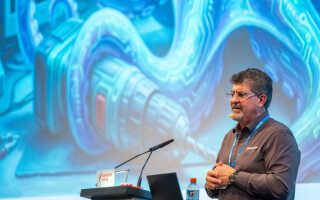
Many themes and trends were discussed this year at the 2026 Embedded World Exhibition and Conference in Nuremberg, Germany. These are energy efficiency and sustainability, security regulations such as the Cyber Resilience Act (CRA), and, of course, artificial intelligence (AI), which will continue to be a hot topic for many embedded computing companies in the coming years and beyond.
I attended a keynote speech by Rich Simoncic, COO of Microchip, and had the opportunity to learn from one of the leaders in the semiconductor industry. I was able to sit in a room full of eager listeners and hear how Microchip, as a company, is evolving with the ever-evolving trends of intelligent and connected systems.
The analogy used in Simoncic’s talk was based on an octopus. This creature was imagined to illustrate the octopus’ connected but decentralized nervous system and how it should relate to today’s AI systems.
Octopus tentacles aim to mimic connected devices and distributed intelligence. According to Simončić, today’s need for distributed intelligence can be represented by an octopus. That’s because “two-thirds of the neurons reside in the tentacles and skin, where they function independently.”
Simoncic explained how systems need to move from being centralized to decentralized, where different tentacles within the system operate independently. autonomous intelligence.
We also talked about the various challenges of connected systems, such as power challenges at the edge, event-driven information rather than continuous pull, and the concept of making changes to the software when a system requires changes or updates without first making significant changes to the hardware. And of course, security shouldn’t be entirely cloud-based.
Simoncic shared the idea of using AI to sense, decide, and act locally, with systems that can take advantage of AI without requiring a complete redesign. The phrase “build once, scale anywhere” means that AI would ideally be built directly into existing hardware systems. The idea is that AI is just one tool in an engineer’s toolbox, and the AI node is that tool.
Overall, I think the keynote shared some solid opinions, but also left open ideas for businesses and individuals to take what they heard and embrace it as their own. We already knew that octopuses are one of the most intelligent and independent creatures in the ocean. So, like the octopus, it may be time to start thinking about today’s systems, however connected they may be.

Tiera Oliver is an assistant managing editor at Embedded Computing Design, responsible for editing web content, product news, and building stories. She develops content and builds ECD podcasts such as Embedded Insiders. Before working at ECD, Tierra graduated from Northern Arizona University with a bachelor’s degree in journalism and political science and worked as a news reporter for the university’s student-run newspaper, Lumberjack.
Other works by Tierra


