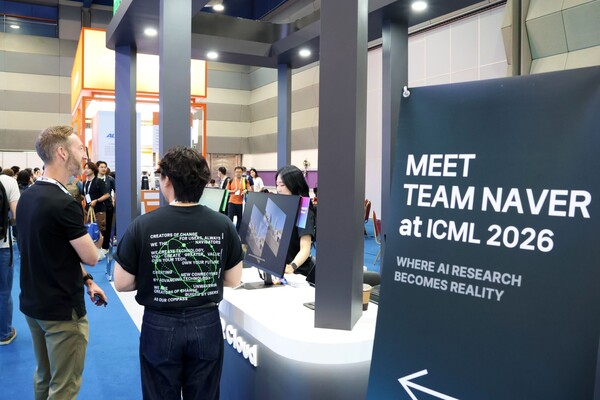
Team Naver announced on Sunday that it has participated in the 2026 International Conference on Machine Learning (ICML) to present research results across fields ranging from advanced AI models to physical AI. ICML is considered one of the world’s top three AI and machine learning conferences, along with NeurIPS and ICLR. It was held at COEX in Seoul from July 6th to 11th.
Team Naver set up a booth with the theme “Where AI research becomes reality” and introduced research results and actual service examples.
The presentations were divided into three areas: enhancing AI safety, improving model and agent operational efficiency, and understanding 3D space and extending it to the physical world.
The technology that attracted the most attention in Team Neighbor’s research was “red teaming.” This is a technique for identifying vulnerabilities in large-scale language models (LLMs) from an attacker’s perspective. Team Naver structurally addressed the problem of training instability and repeated similar patterns in existing approaches through a generative model training method, Stable-GFlowNet. This paper was selected for “Spotlight” and ranked in the top 2.2% of accepted papers. Before deploying LLM in a live service, you can verify attack vulnerabilities across different scenarios.
In the area of improving the operational efficiency of models and agents, we have released a technology that integrates multiple models. “SyMerge” is a model merging method that combines multiple models specialized for different tasks into one. Unlock synergies between models and ensure performance on a variety of benchmarks such as visual and natural language processing by adjusting a single layer.
“FlowBot” is a technology that allows AI to find the order of tasks by itself when multiple AIs work together. We also introduced a technique to improve the post-training performance of LLM by splitting hundreds to thousands of datasets into split training groups and combining them all at once.
In 3D Spatial Understanding, we introduced work that reconstructs moving 3D scenes from shaky and out-of-focus single camera footage. The study used a method that estimates shape based on motion trajectories.
Team Naver also introduced the “Seoul World Model,” which is a virtual recreation of Seoul. The model was jointly developed by Naver, Naver Labs, Korea Advanced Institute of Science and Technology, and Seoul National University. This is a physics AI platform that can simulate spatial data across Seoul and use it to train robot routes and actions.