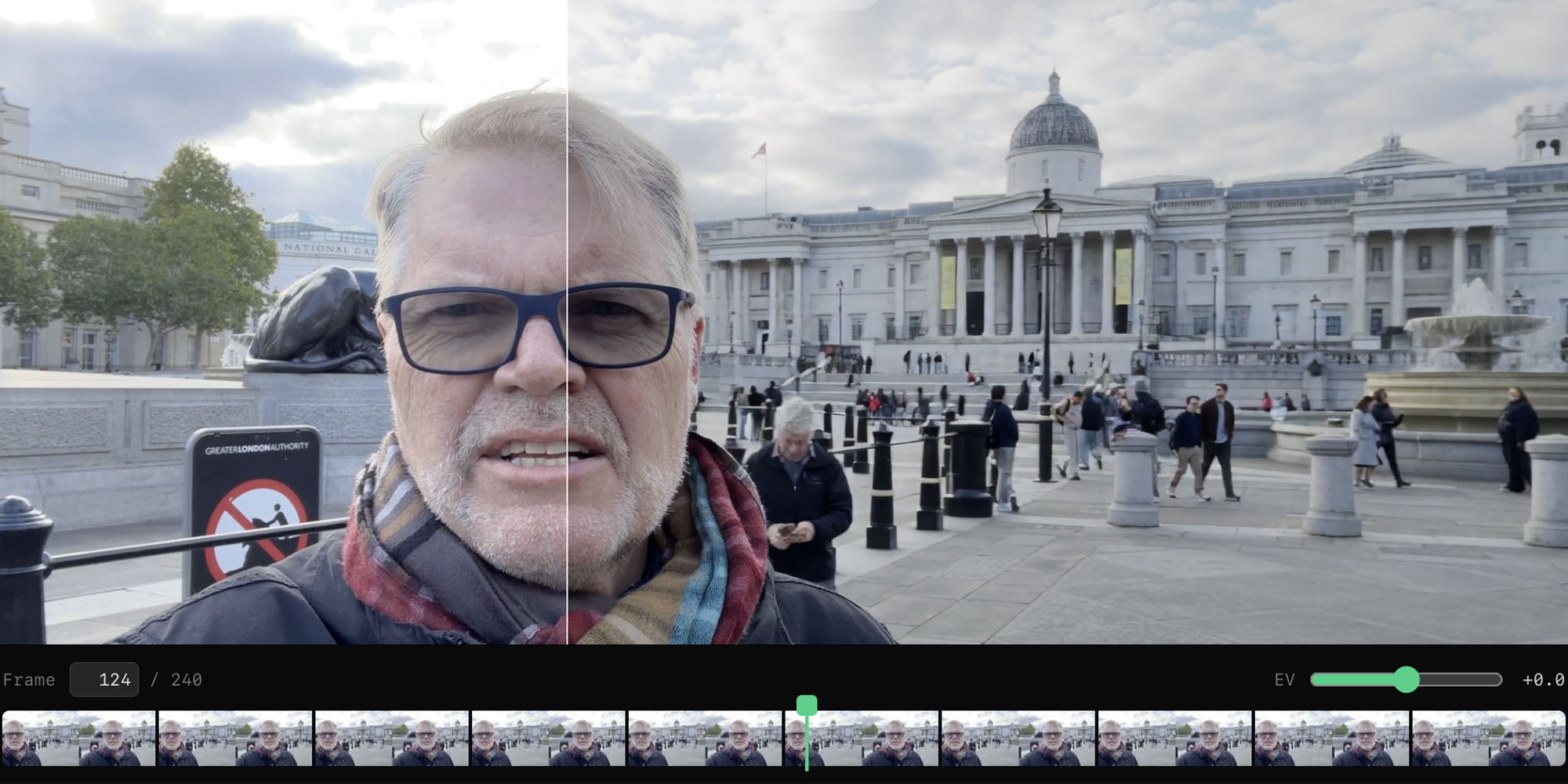
Beeble announced SwitchHDR, a new AI model designed to reconstruct HDR images from traditional SDR video and output scene-linear 16-bit EXR sequences for professional post-production. The company is positioning this tool squarely for filmmakers, colorists, and VFX artists who need to bring older, traditional, or dynamic range-limited material into modern HDR finishing pipelines.
SwitchHDR is available through the Beeble web application. We’ve been testing it and spoke to Hoon Kim, founder and CEO of Beeble AI.
Built on real HDR data.
The interesting claim here is not just that SwitchHDR “converts” SDR to HDR. There are many tools that can extend or remap SDR images to larger HDR containers. The more important difference, Beeble says, is that SwitchHDR is primarily trained on real HDR footage, rather than the vast ocean of SDR images that dominate the internet.
This is important because SDR video only captures compressed slices of the original scene. When highlights get clipped, shadow detail collapses into noise, or is heavily compressed, there’s no obvious mathematical way to restore lost shine. Traditional SDR to HDR approaches can redistribute the remaining signal, but cannot truly recover the unencoded signal. This is why many automatic SDR to HDR conversions tend to reveal banding, amplified noise, strange highlight roll-offs, or plastic-like shadow reconstruction.
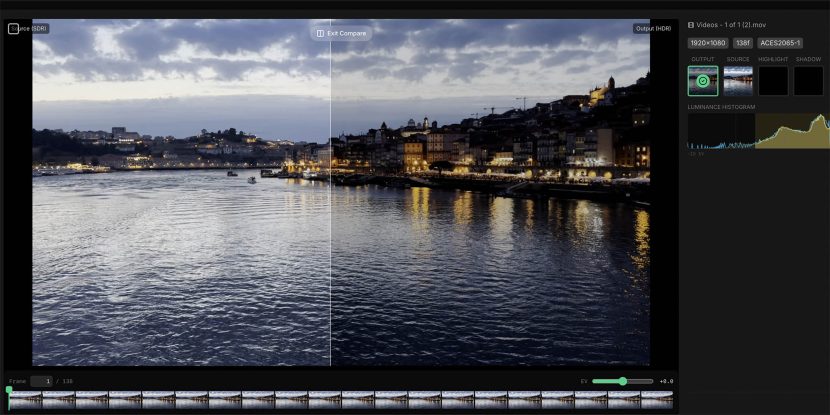
Beeble’s approach is more like an informed reconstruction. SwitchHDR doesn’t magically “search” for information that isn’t present in the image. Instead, it infers a reasonable HDR representation based on what it learns from actual HDR footage. From an actual post-production perspective, the difference is significant. While the recovered values may not be physically or mathematically accurate, they may be close enough visually that the shot can be regraded, composited, and integrated into HDR workflows in a much more convincing way than simple signal stretching.
Given the complexity of the task, we asked Hoon Kim how he approached the problem.
“From day one, we built SwitchHDR around what you actually need for post-production, not what makes a great demo. EXR, which meant temporal consistency across the complete sequence, and the artist’s explicit control over where the reconstruction occurs in the footage, where it is fully clipped, is guided by the mask and prompts. This distinction is why we make it production grade.
Using VFX
SwitchHDR is a usage of AI that is very relevant to VFX. In many production contexts, the question is not whether the estimated HDR is a perfect measurement of the original scene. The question is whether to give colorists and compositors enough reliable freedom to work with images. If AI reconstruction avoids the more obvious failures of SDR expansion, such as cropped skies, crushed shadows, posterization, and temporal instability, the results can be extremely useful, especially when reusing archival footage, stock material, documentary sources, or old plates that need to be preserved within modern new HDR masters.
“Most of the world’s video exists in SDR, but today’s productions increasingly expect HDR-quality assets,” Kim adds. “SwitchHDR bridges that gap by inferring scene-linear HDR representations from existing footage, giving filmmakers a practical way to integrate SDR footage into modern HDR production pipelines while maintaining creative control.”
Based in Seoul, South Korea, Kim founded Beeble in 2022. Since then, the company has developed a suite of machine learning tools aimed specifically at production and post-production problems related to relighting, compositing, and AI-assisted VFX workflows.
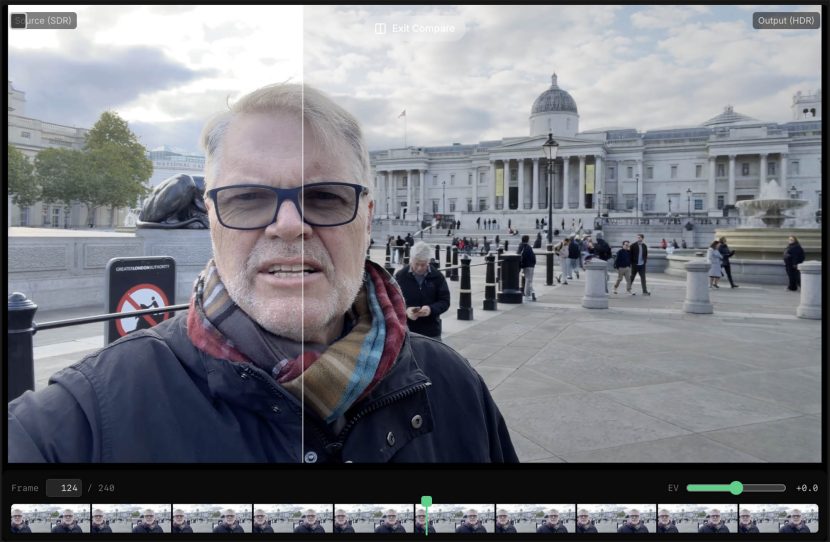
Controlled SDR to HDR conversion
One of the more important aspects of SwitchHDR is that it’s not just an automatic, one-button SDR to HDR process. Beeble includes direct artist control. Users can define highlight and shadow areas using intensity masks and guide the reconstruction with individual text prompts. HDR reconstruction can only be applied to selected areas, and the rest of the image is passed through without AI reconstruction.
It’s a smart decision that focuses on productivity. In VFX and color, control is often more valuable than automation. The model may infer highlights in a way that is technically impressive but not creatively appropriate. A director may want to leave the window blown out, or a colorist may prefer a more subdued highlight recovery. By allowing artists to target only specific areas and guide the reconstruction, SwitchHDR becomes less of a black-box conversion tool and more of an auxiliary VFX and finishing tool.
The output is delivered as an ACES2065-1 scene-linear 16-bit EXR sequence using AP0 color primaries. This means that the results are meant to fit within a real-world professional workflow, rather than simply producing HDR-like files for viewing. EXR output is especially important for VFX artists. This allows the reconstituted material to be moved into the compositing or finishing pipeline in a format that is already standard and producible.
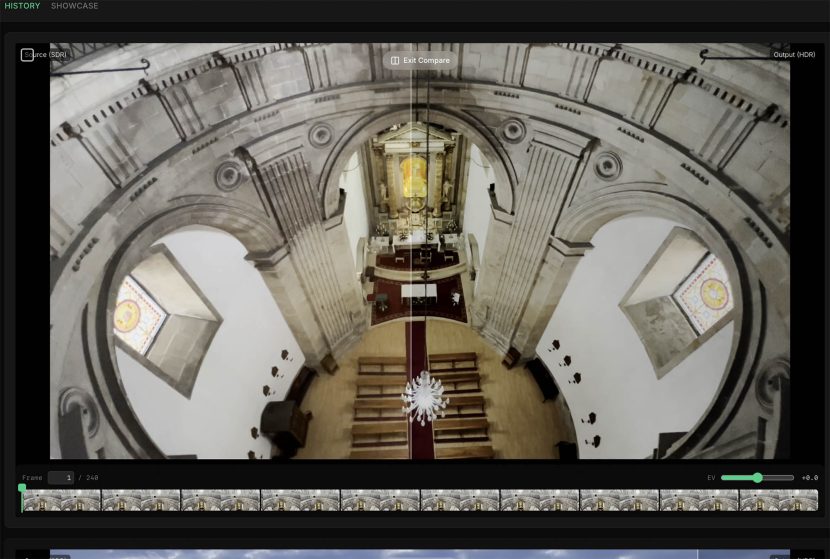
SwitchHDR is intended for feature films, commercials, restoration, VFX, and broader post-production workflows. Beeble’s existing suite of AI tools has also been expanded with an increased focus on production-grade relighting, compositing, and virtual production applications.
The tool isn’t perfect yet, and temporal consistency is still a minor issue with complex textures, but given the importance of HDR footage in the VFX pipeline, fxguide has tested a range of these HDR AI conversion tools and there’s no doubt that SwitchHDR is one of the best out there right now.
fxguide first wrote about Beeble in June 2023. Since then, the company has grown significantly. Most recently, Beeble introduced Canvas, a node-based AI tool, which was exhibited and discussed at ACM SIGGRAPH in Los Angeles. SwitchHDR continues on the same trajectory. Machine learning is not used as a replacement for artists, but as a way to restore, reshape, and make footage more flexible within professional image pipelines.
“When fxguide first covered us in 2023, SwitchLight was a single relighting model. Three years later, that line of research has grown into a complete AI toolset: SwitchLight 3.0 for video to PBR, SwitchX for mask-guided video to video, and SwitchHDR for HDR reconstruction,” Kim explained, looking back on 23 years. “We’re also building Canvas, a node-based editor that integrates models with third-party models that are perfect for compositing and rotoscoping. We’re still amazed at the pace, but the direction remains the same. We’re building models that give filmmakers control and shipping them in a format that real pipelines can use.”
SwitchLight: AI light switch