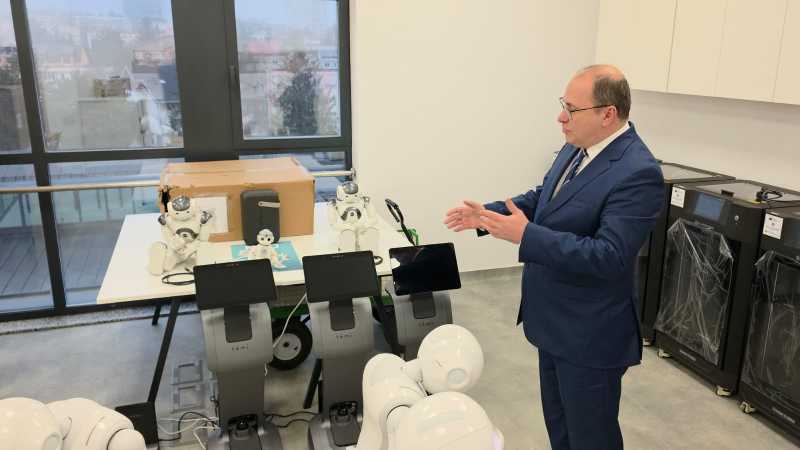
Starting from the 2026-2027 academic year, the “Stefan cel Mare” University of Suceava (USV) will incorporate a master’s program specializing in artificial intelligence and social robotics with applications in healthcare, USV Rector Mihai Dimian told AGERPRES.
He said the program will be taught in English and will be jointly implemented with two partner universities in Tours, France, and Orebro, Sweden, over a semester of study at both universities.
“On the one hand, there is a demand from both employers and students in the region to develop a master’s program in artificial intelligence. On the other hand, by analyzing the research projects and collaborations that we carry out jointly with colleagues from the Faculty of Medical and Biological Sciences, this need became clear to them and their graduates as well, and we noted that there are more and more applications of artificial intelligence both in medical image processing and in the organization of other processes, such as genetics, an area in which we are intensively developing at Suceava (…) And the series of factors that led us to this development, with the addition of social robotics to artificial intelligence, are: Perhaps there will also be an opportunity to visit universities that are developing humanoid robots, so to speak, artificial intelligence laboratories, ”the USV rector told AGERPRES.

Mihai Dimian supports the need to anticipate and adapt to developments in the labor market. He believes that a master’s program specializing in artificial intelligence and social robotics with applications in the medical field will prepare him for the future.
“This is preparing for the future, but this future is very near, and universities in general have to prepare not only for now, but also for what will happen in three, four, five years.” When it comes to bachelor’s degrees, those who enter next year will be graduating from medical school in three, four, five, six years… So you have to prepare and make predictions. Although difficult to predict, we must make some predictions about the labor market. On the other hand, technology changes so rapidly that it is not enough to prepare for what will happen upon graduation, and perhaps even five years after graduation,” Rector Dimian argued.
He also pointed out that USV has a new quantum computing laboratory developed on the premise that “universities should be incubators of the future.”
“At the moment these computers are not in use in the Suceava and Botošani regions. They are used internationally, but only 5-10 It is expected that within the year these computers will also be used in our region. As a result, we are developing our laboratories and preparing for the future. I think that this feature of higher education is not well defined in Romania. We generally do not understand that universities should be incubators of the future. We start with the image of pre-university education. These are things that have been known for decades, perhaps centuries, and we need this foundation provided to young people, but then when they go to university, they need to look to the future. All these institutes cost money, and it costs money to train people for the future. But this is the role of the university.

He said USV also offers introductory courses in artificial intelligence and cybersecurity, which all students are required to take, regardless of their field of study.
“We believe that every student graduating from university, whether it’s law, economics or even philology, should know how to use these artificial intelligence tools and should have certain verification keys, because we’re already seeing people asking if what’s written there is true.” They don’t question that it might be. And there are clear reasons why the results could be wrong. On the other hand, in cyberspace you obviously have to protect yourself. We know that there is a lot of electronic theft happening right now, but perhaps we are not aware of the theft of data, which is just as important as the theft of electronic money,” added Rector Mihai Dimian. AGERPRES (RO – Author: Cristian Lupascu; English – Author: Adina Panaitescu)
Photo credit: CRISTIAN LUPASCU / AGERPRES