

In the early 1980s, when I was a teenager, I realized the potential of using video games in education. My high school classmates who couldn’t pass their school tests somehow remembered which potions and scrolls to use to tame dozens of monsters in their favorite video games like “Dungeons and Dragons” and “Rogue.”
Decades later, as a professor of astronomy and astrophysics at Penn State, I was frustrated by poorly attended classes. As many as 300 students registered to attend my lectures, but only half attended classes regularly.
So in 2015, I decided to turn my course “The Artistic Universe,” which explores astronomy through artistic expression, into a video game called “University of Mars.” Instead of attending lectures, students learn the same astronomy content just by playing games. Most students who graduated from Penn State last year earned college credit by playing this video game course.
Because of its fusion of astronomy and art, “The Artistic Universe” is one of the most popular choices for students to meet the school’s requirement to take interdisciplinary courses to graduate.
jane charltonCC BY
What will we explore in this course?
Students taking this class will study abroad at a fictitious Mars University. So they wonder what it would be like to live on another planet. They fly from planet to planet in the solar system, sending alien babies back to their home planet orbiting another star. They venture out into the vastness of space, explore collections of stars called galaxies, and assemble their own universes.
While playing this video game, students will learn about astronomy, including understanding constellations, planets, stars, galaxies, and the expanding universe.
Students then build on what they learned in the game by working on a variety of tasks, including creative writing and visual art.
Why is this course important now?
Students learn differently today than they did 30 years ago when I began teaching at Penn State. Most of my students no longer tend to read textbooks systematically, as they were required to do in their previous astronomy classes. Some students choose whether to attend class based on whether they can get the same information from their notes and slides.
By playing video games like peeling back the layers of the sun or flying through the thin disk of a spiral galaxy, my students can learn, have fun, and make school feel less like work. This game helps students think about humanity’s place in the vast universe.
What are the key lessons you learned from this course?
Playing video games draws students into the story. It encourages students to imagine life beyond Earth and realize that life may be scattered throughout the universe.
It’s amazing to think about the possibility of different forms of life spread across the vast universe. It’s humbling to know that humans have existed for less than 500,000 years out of the more than 13 billion years since the universe began expanding.
The entirety of human history is a microscopic part of something much larger. And where did our universe come from? What will become of it? Is it part of a larger, multidimensional structure? I encourage all students to reflect on what all of this means to them as they develop their own life purpose.
What materials are included in the course?
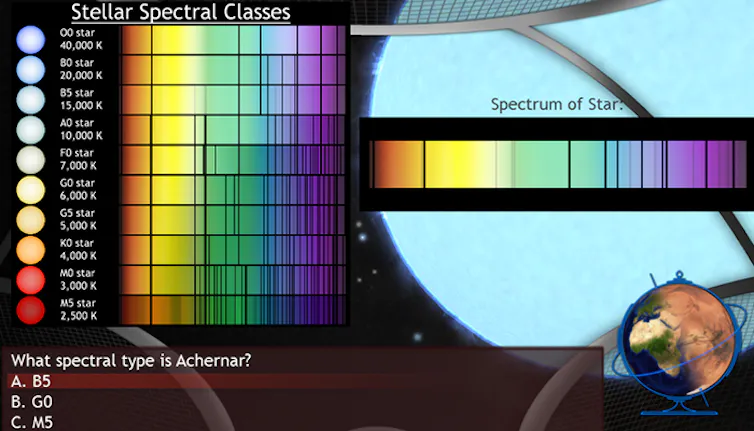
University of Mars begins in a colony on Mars and takes players on an adventure to the solar system, nearby stars, and other galaxies. Also includes many mini-games. Some allow players to move the moon around the Earth to understand its phases, while others manipulate light and gas to understand spectroscopy (the study of how light interacts with matter).
After playing the game, students participate in creative writing exercises that tell about their experiences, such as letters, diaries, and even original songs. One creative writing assignment asks students to describe in detail the first human-alien encounter they experienced in-game. In other instances, they struggle with whether to join a hive mind (the scientific version of hive consciousness) and gain immortality while losing their individuality.
Art projects include creating your own planet and its alien inhabitants, or converting black and white images from the Hubble Space Telescope into colorful images using Photoshop.
What will students be able to do with this course?
“The Artistic Universe” accomplishes different things for each student. For some, exposure to art allows them to reconnect with their artistic side, which was put aside in college to pursue more practical pursuits.
Ten years from now, they may not remember the details of the game or the lesson, but I hope they remember the feeling they felt when they realized how far away the nearest star and nearest galaxy really are.
Playing video games and experiencing cosmic stories can provide students with a sense of security and familiarity. This comfortable position allows you to pause and reflect. For many, the Mars University experience provides a new appreciation and perspective on life.

Uncommon Courses is an occasional series on The Conversation US that showcases unconventional approaches to teaching.


