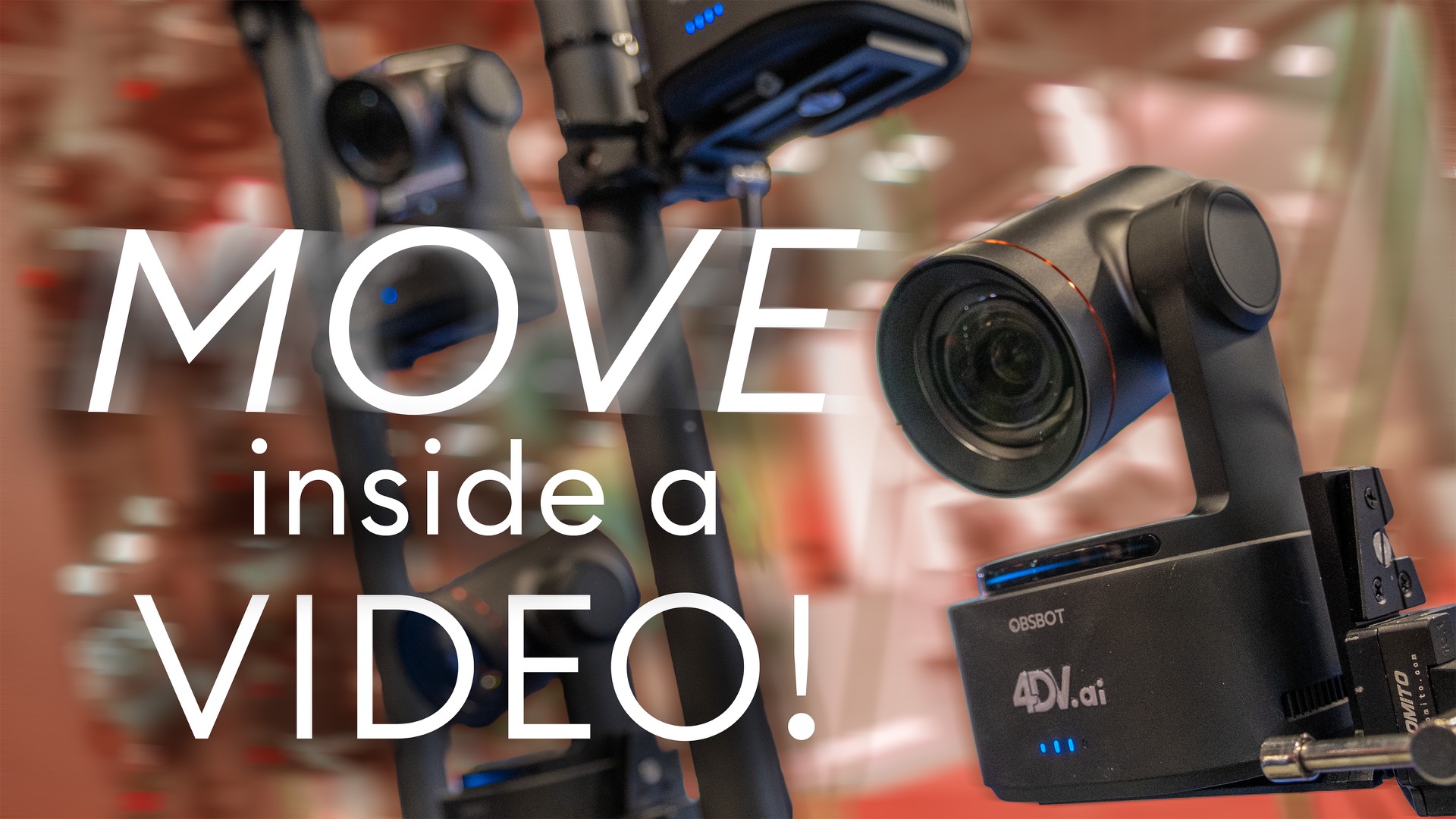
At NAB 2026, 4DV.ai and OBSBOT teamed up to show what professional 4D Gaussian Splatting volumetric capture looks like once it leaves the research lab. Their joint installation used roughly 60 OBSBOT Tail 2 PTZR cameras as a synchronized capture array, feeding 4DV.ai’s continuous-representation pipeline to produce navigable holographic video that visitors could explore in VR on the show floor.
We caught up with Jiaming Sun, founder and CEO of 4DV.ai, alongside Antoine from OBSBOT, at the OBSBOT booth in Las Vegas. Volumetric capture has been a recurring theme at NAB 2026, with several companies showing different approaches to converting synchronized multi-camera footage into navigable 3D space. Our recent other NAB video and article on Radiant Images’ 24-iPhone Gaussian splatting bullet-time rig covered one approach. The 4DV.ai and OBSBOT collaboration takes the idea a step further by introducing motion across time, what the industry calls 4D Gaussian Splatting, or 4DGS.

From 3D splats to moving holograms
Static Gaussian splatting has been steadily moving into mainstream production over the past two years, and our overview of bullet time and volumetric capture explains the foundations. In a static scene, thousands of colored 3D ellipsoids (or “splats”) are fitted to multi-camera imagery, allowing a virtual camera to fly through the reconstructed space. The 4D version, as Jiaming described it, adds the dimension of time: the splats themselves move. He liked the effect to holograms, the kind of free-roaming, walk-around volumetric content people have been imagining for decades.
The core difference between 4DV.ai’s approach and many existing implementations is continuity. Traditional 4DGS pipelines reconstruct the scene frame by frame, with each frame’s splats computed independently. According to Jiaming, that produces visible flickering, because no information is shared across time, and ignores the fact that most of the scene is highly redundant from one moment to the next. 4DV.ai instead tracks the splats across time as a continuous representation. The benefits are practical: fewer artifacts, support for infinite slow motion since the system can interpolate between any two moments, and tolerance for unsynchronized cameras, which dramatically lowers the technical barrier to capture.
Why the Tail 2 works as the backbone of a volumetric rig
The OBSBOT Tail 2 we covered separately in our NAB 2026 booth interview was not designed for volumetric capture, but several of its properties turned out to be unusually well suited to the task. Pan, tilt, zoom, and rotate are all controllable over IP, the cameras carry a 1/1.5-inch 50MP CMOS sensor with 4K at 60fps, and each unit records to its own internal microSD card. That last point matters more than it sounds: dozens of streaming simultaneous 4K feeds to a central server in real time is a networking nightmare, but having each camera write locally and offload after the take sidesteps the problem entirely.

4DV.ai’s capture software exploits the PTZ capability in a way that is specific to volumetric work. Rather than locking every camera to a fixed angle, the system detects the subject in 3D space and assigns regions of interest, or ROIs, in the form of 3D bounding boxes. Groups of Tail 2 cameras are then commanded to point at those ROIs simultaneously, so that each shot can be optimized for whatever detail matters most. As Jiaming put it, when a viewer eventually walks around inside a 4DGS scene, the part they tend to look at is the face, so resolution needs to be concentrated there. Across different shots, the ROIs change, and the cameras follow. A static, non-PTZ rig simply cannot do that.
Cabling is also notably minimal. Power over Ethernet handles both data and electrical supply through a single cable, which keeps the rig clean enough to deploy in a trade show booth. For mobile capture, the Tail 2’s built-in battery and Wi-Fi 6 radio mean the system can run wire-free if needed. Antoine pointed out that this was one of the reasons 4DV.ai selected the Tail 2 in the first place: a well-established PTZ camera with battery, Wi-Fi, and respectable image quality is not a common combination.

A compression pipeline that fits over the public internet
The data side of a 60-camera rig is daunting on paper. With each Tail 2 producing roughly 120Mbps of source video, even a 70-camera array generates around 8.4Gbps of raw footage. After capture, that data is gathered to a central server and uploaded to 4DV.ai’s data center for processing. The reconstruction pipeline, Jiaming explained, then compresses the entire dataset down to somewhere between 30 and 60Mbps for the final 4DGS output, a figure low enough to stream over a normal home internet connection. That kind of compression is only possible because the continuous representation shares splat data across time rather than storing each frame as an independent reconstruction.
Live streaming is not yet part of the product. 4DV.ai is working on a 4D livestream pipeline, but the current shipping workflow remains capture-then-process, with results delivered as a 4D asset rather than as a real-time feed. Even so, the compression numbers suggest that streaming 4D content over consumer networks is closer than it might appear.
Beyond a research demo: cats, performances, and a rocket launch
When we asked whether 4DV.ai is still in research mode, Jiaming was emphatic that the company is past that phase and ready to ship. He pointed to a range of completed productions that span dramatically different scales, from a small cat to a 13-person stage performance to an actual rocket launch (most of them can be experienced interactively on the 4DV.ai website). The team also collaborated with MediaStorm on the iPhone 17 review video, executing what he described as virtual camera moves that be impossible to achieve with a traditional rig. That kind of impossible move is one of the strongest arguments for volumetric capture in a VFX context: once the scene exists as a true 3D asset, the camera path is no longer constrained by physical geometry, gimbal limits, or operator safety.

The pipeline produces treated depth maps, optical flow, and alpha mattes alongside the colored video, which Jiaming described as a strong alternative to traditional virtual production. Instead of building an LED volume or staging green-screen shots, every 4DGS take is effectively a green-screen shot, with high-quality matting included by default.
XR, holograms, and the ambition behind the partnership
The other major application is immersive content. Most XR video to date has been three-degrees-of-freedom, or 3DoF, where a viewer can rotate their head but cannot walk around in the scene. 4DGS, paired with displays like the Apple Vision Pro or the Meta Quest 3, opens the door to true six-degrees-of-freedom playback. Viewers can step into a captured scene, walk around it, change their scale relative to the action, or stand among the performers. Jiaming framed the long arc as the addition of a new dimension to video itself: from 2K to 4K, then 8K, and now a step beyond resolution into time-varying volume.
4DV.ai’s clients, while not all named publicly, span production studios, streaming platforms, and companies that build XR devices. The collaboration with OBSBOT goes deeper than a single trade show. According to Jiaming, the two companies are jointly developing what he called the perfect camera rig for 4D volumetric capture, with OBSBOT providing the imaging hardware and 4DV.ai providing the software stack. For OBSBOT, this turns the Tail 2 from a single-camera live production tool into a building block for entirely new computational video pipelines.
Volumetric video keeps inching closer to mainstream production, and this rig is one of the clearest signs yet. Could you see 4D Gaussian Splatting fitting into your workflow, whether for VFX, XR, or live events? Don’t hesitate to let us know in the comments below!