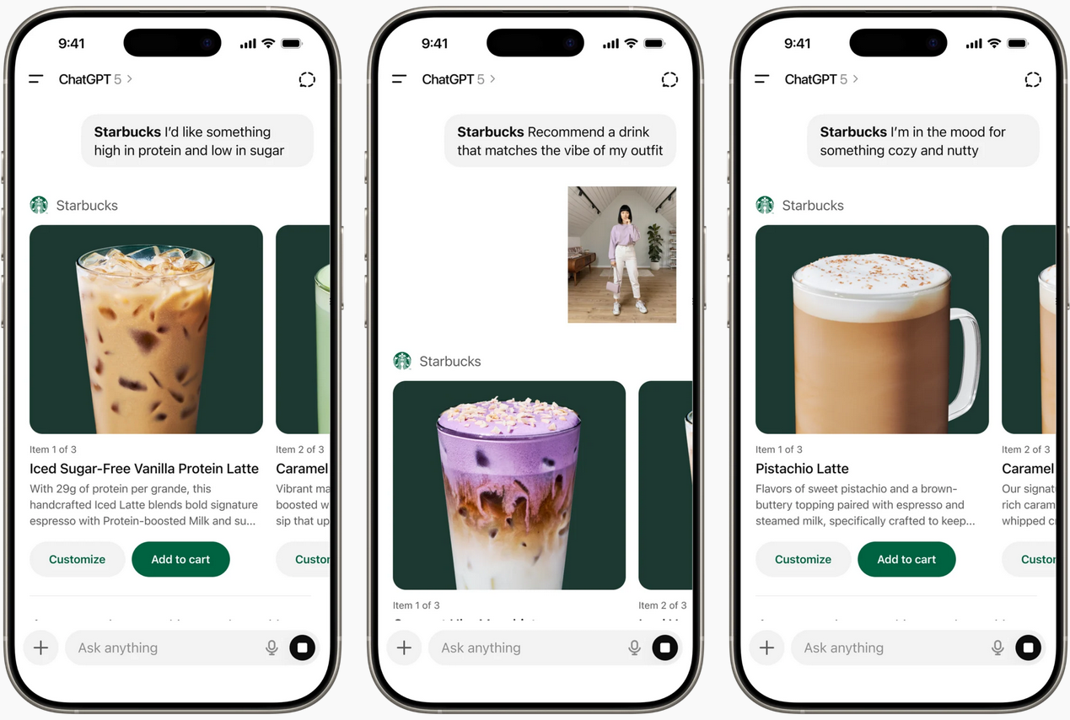
Not so long ago, the idea that customers could describe their mood rather than a menu item and receive customized drink recommendations would have felt experimental. What stands out about this week’s launch of Starbucks’ integration with ChatGPT is not just the feature itself, but its timing. This comes as major restaurant brands begin to more carefully test where large-scale language models fit into the customer journey, and just as importantly, where they don’t.
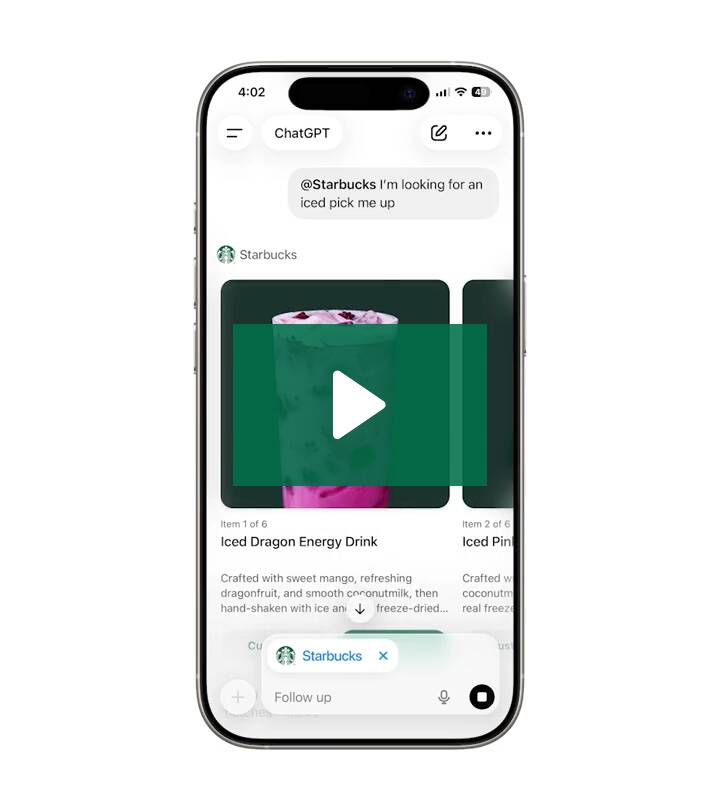
This feature allows customers to interact in natural language, describe how they’re feeling and what they want to eat, and receive drink suggestions that can be customized and routed through Starbucks’ existing order flow. In that sense, it does not replace a company’s digital infrastructure. It sits in front of that and acts as a detection layer rather than a transaction engine.
This difference reflects broader changes in the evolution of restaurant technology. For much of the past decade, innovation has focused on streamlining ordering and payments. What has remained relatively unchanged is the decision-making process before a customer finalizes an order. Starbucks’ latest tests suggest that phase is now becoming a more active area of experimentation.
It would be easy to interpret this as a fundamental change in the way customers order. A more cautious view is that this is one of several parallel efforts across the industry, each targeting a different part of the workflow. In quick service, much of the focus these days is on execution. Chains have been testing voice AI in their drive-thrus with the goal of improving order accuracy and taking pressure off staff. These systems operate within tight constraints and convert speech input into structured instructions. The goal is speed and consistency, not exploration.
Results were uneven. While some pilots saw efficiency gains, others struggled with edge cases and variations in customer conversations. This pattern is consistent with earlier waves of restaurant automation. Systems that operate within narrow parameters tend to be easier to implement but can be improved over time. Systems that attempt to interpret open-ended intent are more flexible, but difficult to scale reliably.
Starbucks’ approach falls somewhere between these two models. It uses a general-purpose conversational interface, but applies it to a relatively specific problem: allowing customers to choose from a known set of products. If the recommendations are not completely correct, you can adjust them. Small deviations have a lower cost, making use cases more forgiving.
There are practical reasons to focus on discovery. Starbucks operates one of the most complex beverage platforms in the industry, with a high degree of customization and a steady stream of seasonal changes. This flexibility is a strength, but it can also create friction for customers who don’t know what to order. Conversation layers can reduce that friction by narrowing the choices without removing them. It also reflects how customers are already finding your product. Social media is a key driver of beverage trends, shaping demand in real time with new combinations and visual aesthetics. Integration effectively formalizes that process. Instead of browsing posts or asking questions to baristas, customers interact with a system that allows them to translate their loosely defined preferences into specific menu items.
The question is how far this behavior will spread. Many customers approach Starbucks with default orders and have little interest in finding alternatives. Others, especially those who visit occasionally or are drawn to seasonal gifts, may be more willing to accept guidance. This feature is likely to appeal most to the second group, at least initially. Control is also affected. By placing parts of the discovery process within a third-party conversational platform, Starbucks will gain access to the new interface but share some influence over how recommendations are presented. The company alleviates this by routing transactions to its own apps and websites and retaining ownership of orders and related data. Still, as more consumer interactions move into AI-driven environments, the balance between reach and control will continue to be considered.
Beyond Starbucks, the underlying concept has clear relevance to the restaurant industry as a whole. The idea of translating broadly defined customer intent into a concrete menu of recommendations can be applied in a variety of situations, especially in segments where choices are abundant and decision-making is prone to fatigue. For example, fast-casual brands could use a similar approach to guide customers to create their own menus, helping them assemble meals based on their dietary preferences, time of day, and even mood. Instead of choosing ingredients one by one, customers can describe what they’re looking for and receive a starting point that they can modify as needed.
Full-service restaurants could extend the concept to digital reservations and pre-arrival experiences, offering cuisine and pairing suggestions based on occasion, group size, or prior visit. For beverage programs, especially those with extensive cocktail or wine lists, a conversational interface can help guests narrow down their choices without requiring in-depth product knowledge. Even quick-service chains that are primarily focused on speed and efficiency could experiment with a lighter version of this model in their mobile apps, offering guided recommendations during off-peak browsing rather than at the time of ordering. In either case, the key is not to replace the menu, but to add a layer that allows customers to interact with it more intuitively.
The challenge is to match these experiences with operational reality. Recommendations should reflect what can actually be done consistently in-store. It also needs to integrate cleanly with existing systems so that the transition from proposal to order is seamless. Without this alignment, the value of conversational discovery quickly diminishes.
For now, the Starbucks test is best understood as an incremental step rather than a definitive change. The way we make drinks and fulfill orders remains the same. It changes the way customers reach decisions, at least for those who choose to use it. It may seem like a small adjustment, but it touches on a relatively static part of the experience. As large-scale language models become more accessible and familiar to consumers, expectations for systems to be able to interpret intent in natural language are likely to increase.
The restaurant industry is still in the early stages of how to meet that expectation. Some applications remain in the background for better operation and consistency. Other features, such as Starbucks’ latest features, will also be visible to customers and shape how they interact with the brand. As a result, a single dominant model is unlikely. Each will likely be a combination of approaches appropriate for specific situations within the customer journey. What they all have in common is that the boundaries between viewing, deciding and ordering are becoming less rigid. For operators, the question is not whether those boundaries change, but how quickly and which parts of the experience matter most.