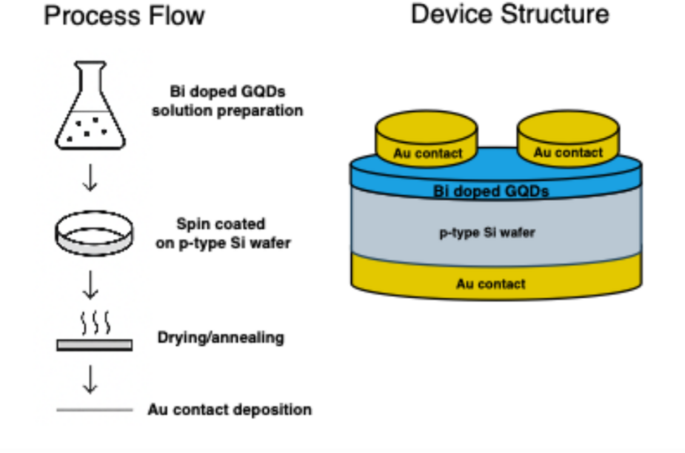
This study utilized I–V measurements obtained from a Bi-GQDs/p-Si nanocomposite device to train and evaluate four boosting algorithms—AdaBoost, GB, XGBoost, and CatBoost—for predicting the illumination-dependent I–V characteristics of the device. To further enhance predictive performance, a stacking ensemble approach was employed to combine the outputs of the individual models. For each illumination, 1000 ln(I)–V data points were collected, with the voltage (V) ranging from − 5 V to + 5 V in 0.01 V increments, while the ln(I) values were experimentally measured and calculated.
The ln(I)–V curves of the Bi-GQDs/p-Si nanocomposite photodetector under dark and illumination conditions (22, 44, 66, 88, and 110 mW/mm²), as shown in Fig. 3a, were directly recorded using the Keithley 4200 SCS, without any software modification other than standard plotting. The results reveal a clear correlation between light intensity and the device electrical response. The slight offset of the ln(I)–V curve at V = 0 V in the dark is attributed to the built-in potential at the Bi-GQDs/p-Si interface, combined with contact resistance and measurement sensitivity effects. Under dark conditions, the device exhibits minimal current flow, with ln(I) values decreasing sharply as the applied voltage increases. This behavior indicates low leakage current and confirms the high-quality rectifying nature of the device in the absence of illumination. From the ln(I)–V characteristics, the device exhibits a clear rectifying behavior, with a rectification ratio defined as RR(V) =\(I{{\left( { + V} \right)} \mathord{\left/ {\vphantom {{\left( { + V} \right)} {I\left( { – V} \right)}}} \right. \kern-\nulldelimiterspace} {I\left( { – V} \right)}}\), yielding a value of 7.52 × 10⁴ at 5 V under dark conditions. The low baseline current establishes a strong contrast against the illuminated conditions, which is crucial for evaluating photoresponse performance. As the illumination intensity increases, the ln(I) values shift upward significantly across the voltage range. In particular, forward bias voltages result in a sharp increase in current, indicating efficient photogeneration of charge carriers. Each illumination level produces a distinct ln(I)–V curve, with higher light intensities leading to progressively higher current responses. The curve for 110 mW/mm² shows the most significant increase, followed by those at 88 mW/mm², 66 mW/mm², 44 mW/mm², and 22 mW/mm², respectively. This trend confirms that the device’s performance is strongly dependent on illumination and that it demonstrates high photosensitivity across the examined range. A sharp dip in ln(I) values near 0 V is observed in all curves, consistent with the expected transition between reverse and forward bias regions in diode behavior. The results also confirm that the device maintains its rectifying behavior while exhibiting an enhanced, intensity-dependent photoresponse.
As shown in Fig. 3b, the photocurrent (Iph) increases nonlinearly with illumination power density (P, mW/mm2) at + 1 V bias. The extracted exponent (γ = 1.49) from the ln(Iph) –ln(P) fit (Fig. 3c) confirms a super-linear dependence, which can be attributed to trap-filling and photoconductive-gain effects in the Bi-GQDs/p-Si heterostructure42.
These findings highlight the suitability of the Bi-GQDs/p-Si device for optoelectronic applications such as photodetectors or solar energy harvesting, where sensitivity and non-linearity are advantageous. Additionally, the well-separated response curves under different illumination levels provide a robust dataset for the development and evaluation of ML models aimed at modeling and predicting the diode’s nonlinear photoresponse characteristics.

(a) Semi-logarithmic I–V characteristics of the Bi-GQDs/p-Si nanocomposite photodetector measured under dark and various illumination power densities. (b) Photocurrent (Iph) as a function of illumination power density (P (mW/mm2)) at + 1 V bias. (c) The corresponding ln(Iph)–ln(P) relationship fitted by the power-law equation Iph ∝ Pγ, yielding γ = 1.49.
Table 4 summarizes the performance of four boosting basic models in predicting ln(I)–V characteristics at an illumination intensity of 44 mW/mm². Among the models, AdaBoost achieved the highest R² score of 0.9599, indicating strong linear correlation with the experimental data. It also recorded the lowest MSE (0.2497) and MAE (0.3634), outperforming the other models in all metrics at this illumination level. Although the gradient-based methods (GB, XGBoost, and CatBoost) produced comparable results, they demonstrated slightly higher error rates and lower R² values compared to AdaBoost. These findings suggest that AdaBoost, despite its relatively simple ensemble structure, was better suited to modeling the device’s response under moderate illumination condition (44 mW/mm²), likely due to the less complex photocurrent behavior at this level.
Table 5 presents the performance of the same four boosting basic models under a higher illumination intensity of 88 mW/mm². Compared to the results at 44 mW/mm², all models—except AdaBoost—demonstrated significantly improved performance, with lower error values and higher R² scores. Notably, XGBoost, and CatBoost achieved the best overall results, recording the lowest MSE (0.0682), and MAE (0.1840 and 0.1854) respectively, along with an excellent R² value of 0.9874. GB and AdaBoost followed closely, showing almost identical metrics, highlighting their strong ability to generalize under increased illumination. This performance gap reinforces the idea that while AdaBoost may be adequate for moderate illumination levels, it struggles to capture the more complex and intensified nonlinear behavior at higher light intensities.
The overall reduction in error values for all models at 88 mW/mm² also confirms that the device’s photoresponse becomes more consistent and predictable under stronger illumination, enabling ensemble basic learning algorithms to achieve greater accuracy. Among the tested models, AdaBoost yielded the most accurate prediction for detector performance at 44 mW/mm², whereas XGBoost, and CatBoost performed best under 88 mW/mm² illumination conditions.
To further improve predictive performance, four advanced boosting algorithms—AdaBoost, GB, XGBoost, and CatBoost—were trained individually. Their complementary strengths were then leveraged by employing a stacking ensemble technique, which combined their predictions to produce a more accurate and robust model. Table 6 presents the performance evaluation of the stacking ensemble model using statistical metrics. The ensemble model shows strong predictive performance, especially under higher illumination. As the intensity increases from 44 to 88 mW/mm², the model’s accuracy improves significantly — with R² rising to 0.9874 and error metrics (MSE and MAE) decreasing notably. This indicates that the ensemble approach effectively leverages the strengths of XGBoost and CatBoost, particularly under enhanced lighting conditions.
Figure 4a presents experimental and stacking ensemble predicted ln(I)–V curves at illumination intensities of 44 and 88 mW/mm². The results demonstrate a strong correlation between the predicted and experimental measurements, particularly in the forward bias region where the photocurrent increases rapidly. The stacking ensemble model successfully captures the overall shape and nonlinear behavior of the experimental curves. While the predicted curve at 44 mW/mm² aligns well with the experimental data, an even more accurate fit is observed at 88 mW/mm². This suggests that the model performs better at higher illumination intensities, likely due to more stable and pronounced photocurrent characteristics. These findings confirm the ensemble model’s ability to generalize and interpolate between training conditions, further highlighting its effectiveness in predicting the device’s behavior under previously unseen illumination levels. Figure 4b presents the statistical performance of the base models under two illumination intensities (44 and 88 mW/mm²), evaluated using R², MSE, and MAE. The plots were generated based on the predictions of the best-performing models: AdaBoost at 44 mW/mm² and XGBoost and CatBoost at 88 mW/mm². The R² values are high in both cases, with the model achieving near-perfect accuracy at 88 mW/mm². Both MSE and MAE significantly decrease as the illumination increases, indicating reduced prediction errors. The results show improved model accuracy and reduced errors at higher illumination levels. Figure 4c presents the performance of the stacking ensemble model, evaluated using three statistical metrics—R², MSE, and MAE—at two different illumination intensities (44 and 88 mW/mm²). At 44 mW/mm², the model shows relatively good performance with an R² above 0.9872; however, MSE and MAE values are notably higher compared to the results under stronger illumination. At 88 mW/mm², the ensemble model performs significantly better, achieving a near-perfect R² value (0.9874) and substantial reductions in both MSE and MAE. This highlights that the model benefits from increased illumination, leading to more accurate and reliable predictions. These findings align with the previously discussed ln(I)–V comparisons and further confirm that the model performs more accurately when photocurrent behavior is more stable and prominent—typically under stronger illumination. Therefore, the use of advanced ensemble models proves particularly effective in capturing complex optoelectronic behaviors in high-light conditions.

(a) Comparison between the experimental and stacking-ensemble-predicted ln(I)–V characteristics of the Bi-GQDs/p-Si photodetector under illumination intensities of 44 mW/mm² and 88 mW/mm². (b) Statistical performance of the base models (AdaBoost, GB, XGBoost, and CatBoost) evaluated at different illumination levels using R², MSE, and MAE metrics. (c) Performance evaluation of the stacking ensemble model at 44 and 88 mW/mm², showing superior predictive accuracy with R² > 0.98 and minimal error values, confirming its robustness and generalization capability.
These predicted ln(I)–V characteristics enabled the extraction of illumination-dependent photodetector parameters. The key performance parameters of photodetectors are summarized as follows. Sensitivity (\(\:S=\frac{{I}_{photo}}{{I}_{dark}}\)) reflects the ability of the device to respond to weak optical signals and is often expressed as the minimum detectable input power or the output signal change per unit optical power. Responsivity (\(\:R=\frac{{I}_{photo}-{I}_{dark}}{{P}_{inc}}\)), defined as the ratio of the photocurrent to the incident optical power (Pinc), indicates the electrical output efficiency of the device. Specific detectivity (D*) provides a noise-normalized figure of merit and is widely used to compare different detectors. It can be expressed as \(\:{\text{D}}^{\text{*}}=\frac{\sqrt{\text{A}{\Delta\:}f}}{{i}_{\text{n}}}\text{R}\); where A is the device area, \(\:{\Delta\:}f\) the electrical bandwidth, and \(\:{i}_{n}\) the noise current. Table 7 shows the estimated photodetector parameters of Bi-GQDs/p-Si at 5 V, obtained using the stacking ensemble model’s I-V characteristics. The photodetector exhibited notable performance across varying illumination intensities at 5 V. As shown in Table 7, under an illumination of 44 mW/mm², the device achieved a responsivity of 1.396 mA/W, and a specific detectivity of 6.79 × 10⁹ Jones. When the illumination increased to 88 mW/mm², these values significantly improved to 2.389 mA/W, and 1.16 × 10¹⁰ Jones, respectively. These results indicate that the photodetector’s response scales positively with increasing light intensity. The stacking ensemble model effectively captured the nonlinear relationship between illumination and photodetector response, enabling precise estimation of sensitivity and detectivity values.
Hybrid quantum dot (QD) photodetectors have demonstrated exceptional performance through synergistic material combinations. Konstantatos et al.43 reported ultrahigh gain (~ 10⁸ electrons per photon), responsivity of ~ 10⁷ A·W⁻¹, and detectivity of 7 × 10¹³ Jones using graphene covered with colloidal QDs. Wang et al.44 achieved a gain of ~ 10⁹ and responsivity of ~ 6 × 10⁵ A·W⁻¹ in graphene–perovskite hybrids, while Subramanian et al.45 demonstrated graphene QD/CH₃NH₃PbI₃ hybrids with responsivity of 12 A·W⁻¹ and detectivity of 6.5 × 10¹¹ Jones. More recently, Algadi et al.5fabricated N-doped GQDs/CsPbBr₃ heterostructures with responsivity of 0.24 A·W⁻¹ and detectivity up to 2.5 × 10¹² Jones. Parallel advances in QD–perovskite photodetectors have also been remarkable: Guo et al.46,47 achieved responsivities up to 240 mA·W⁻¹ and detectivities exceeding 10¹³ Jones using CuInSe₂ QDs with halide perovskites, Liu et al.48 reported 521.7 mA·W⁻¹ responsivity and 2.57 × 10¹² Jones detectivity with SnS QDs in FAPb₀.₅Sn₀.₅I₃, and Kim et al.49 demonstrated CdZnSeS/ZnS QD photodiodes with responsivity of 0.258 A·W⁻¹ and detectivity of 1.0 × 10¹³ Jones. In comparison, our BiNPs&PEI-N-GQDs/p-Si photodetector exhibits responsivity values of 1.396–2.389 mA·W⁻¹ and detectivity in the 10⁹–10¹⁰ Jones range, which, while more modest than state-of-the-art perovskite–QD hybrids, surpass many graphene- and organic-based devices. These results position our device as a stable, environmentally benign platform ideally suited for proof-of-concept machine learning modeling.
To provide a clear overview, Table 8 summarizes the key characteristics of the included studies. According to Table 8, all three studies employed supervised learning for photodetector modeling, using distinct model types: DTs24, ensemble neural networks29 and regression models30. Each study focused on a different photodetector type—2D metal halide perovskite, monolithic PET, and graphene-based FET, respectively—and reported varied performance metrics, including Root MSE (RMSE), R², MSE, Full width at half maximum (FWHM), signal-to-noise ratio (SNR), contrast-to noise ratio (CNR), structural similarity index measure (SSIM). Similarly, Öter et al.15 compared AI-driven and traditional approaches for predicting the behavior of polyethyleneimine-functionalized graphene quantum dot-based Schottky diodes. They applied four supervised learning algorithms—K-Nearest Neighbor, RF, MLPNN, and Support Vector Machine—to a dataset of 200 measurements from 30 physical diodes.
The performance of the included studies is evaluated through various prediction accuracy metrics, which are summarized in Table 9. According to Table 9, the studies employed distinct model types: DT -based models24, ensemble neural networks29 and polynomial regression30. Performance metrics varied across studies; Pandey et al.24 reported low RMSE values for responsivity and detectivity, Iborra et al.29 reported 2–2.4 mm FWHM and qualitative improvements in SNR, CNR, and SSIM without numerical values; Sorathiya et al.30 cited R² and MSE, noting polynomial regression outperformed linear regression. Illumination conditions were specified only in Sorathiya et al.30(deep UV); Pandey et al.24 included irradiance as a model feature, while the third study did not report illumination details. Additionally, Öter et al.15 applied for four supervised learning algorithms—including RF, which achieved a very low MSE of 4.1 × 10− 5 and an R² of 0.999998—to model polyethyleneimine-functionalized GQDs-based Schottky diodes, although no illumination was applied in their experimental setup.