
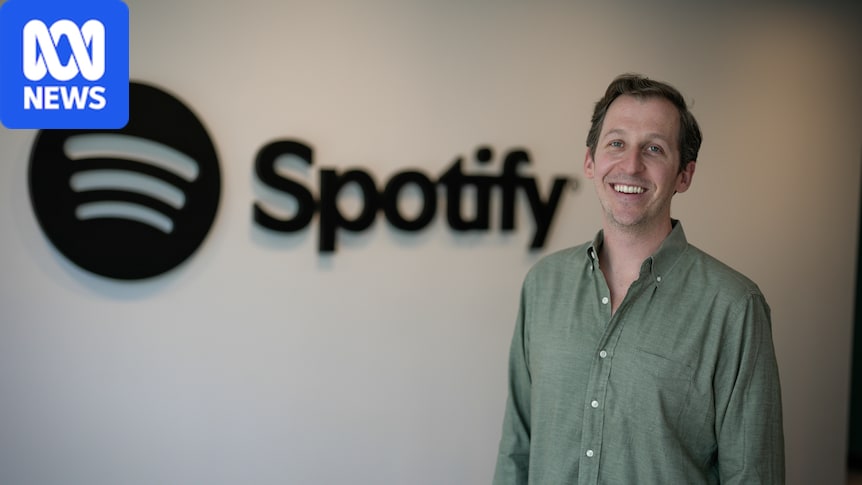
As one of the world’s largest and most popular music streaming services, Spotify has considerable influence over what Australians listen to.
The Swedish streamer, which has more than 100 million songs in its database and more than 761 million monthly users, has taken it upon itself to remove what it calls “AI slop” from its platform.
This includes 75 million “spam tracks” over a 12-month period.
“No one wants shoddy content, spam, or low-effort content to tarnish their experience on Spotify or any other streaming service,” said Sam Duboff, global head of artists, marketing, and policy at Spotify.
“We tag all those trucks and remove them from recommendations completely.
“If it’s bad spam, we’ll remove it from our entire service.”
Spotify’s Sam Duboff says the streaming giant is making AI music easier to discover. (ABC News: Billy Cooper)
However, Spotify does not decide whether artists can share songs created using AI on its platform.
“What we are hearing from artists is that many are choosing not to use AI in their creative process,” Dubov said.
“That’s great.
“We believe that artists, songwriters, [and] Producers decide whether and how to use AI as a tool in the creative process.
“But if they use AI, we think it’s really important that they share that with their listeners.”
Spotify has introduced a new artist verification program that gives verified artists a green checkmark.
On top of that, AI credits have been added, allowing musicians to be more transparent by indicating whether they used AI on their instruments, vocals, etc.
Spotify is rolling out AI credits functionality on its platform. (Provided by: Spotify)
However, Duboff acknowledged that some songs may slip through the cracks because it relies on artist disclosure.
There has been speculation as to whether the number one song on Australia’s national airplay chart was created using AI.
Josh Fawaz’s cover of Madonna’s song of the same name, “Like a Prayer,” has been streamed more than 37 million times on Spotify.
Dubov didn’t mention the specific song, but said AI remixes and covers often gain traction on social media.
“What happens is it’s made by an off-platform producer,” he says.
“It gets spread on social media and uploaded to streaming services.
“Typically, the covered artist receives publishing royalties, while the person who created it receives recorded royalties.
“In a system like the one we are building in a licensing environment, the artist is in control.
“So for the products we build, artists will choose whether or not they can remix or cover their own songs.
“Once people listen to it, it will definitely be properly credited.”
Spotify pays artists, but is that enough?
Duboff previously fired back at rap superstar Snoop Dogg when he claimed in a viral clip that he earned less than $45,000 ($64,000) from Spotify for 1 billion streams.
Dubov told the Kato On The Track YouTube channel that the streaming giant actually paid him between $3 million and $5 million for 1 billion streams.
Snoop Dogg claimed that his revenue was negligible for his 1 billion streams, but Spotify pushed back. (AAP: Joel Catlett)
He explained to ABC News that royalty checks can be difficult for artists to understand, especially if they have received a large advance from a record company that must be recouped. Or when multiple songwriters contribute to a song.
“The truth is, Spotify started 20 years ago,” Duboff said.
“I think 2014 was the industry’s lowest point in terms of world record revenue for music.
“And Spotify introduced a streaming model born out of respect for copyright and to see if it could rebuild the industry at a time when piracy was rife in the industry.
“And if you look back 10 years ago, around that low point, there were a lot of legitimate questions about whether streaming would scale as an economic model.”
However, he says that in 2014, Spotify was paying just $1 billion a year, but that amount has increased rapidly.
“We have the largest payroll in the industry,” he says.
“We pay $[US]11 billion per year.
“And the most exciting part is that while the superstars are doing well, it’s actually a new class of emerging artists who can make more and more money.”
He said artists ranked in the top 100,000 now earn about $7,300 a year from Spotify, an increase of nearly $7,000.
He also cleared up some misconceptions about how the royalty pool works and how much of its share is consumed by AI-generated music.
“Royalty pools are managed monthly based on stream shares,” Dubov said.
“If you get 1 percent of the stream that month, you get 1 percent of the royalty pool.
“Those royalties go to artists that listeners love and listen to, artists that we all love, artists that are validated, artists that are human and authentic.
“When you look at the completely AI-generated music that people are concerned about, music that is industrially produced with less human input, you see this: [and] Other streaming services see less than 1% of their consumption going to these tracks.
“Listeners don’t want that…and we’re really seeing a decline in consumption there.
“What we’re hearing from our fans, and what we’re seeing on our service, is that people want and want to hear music from real people.”

